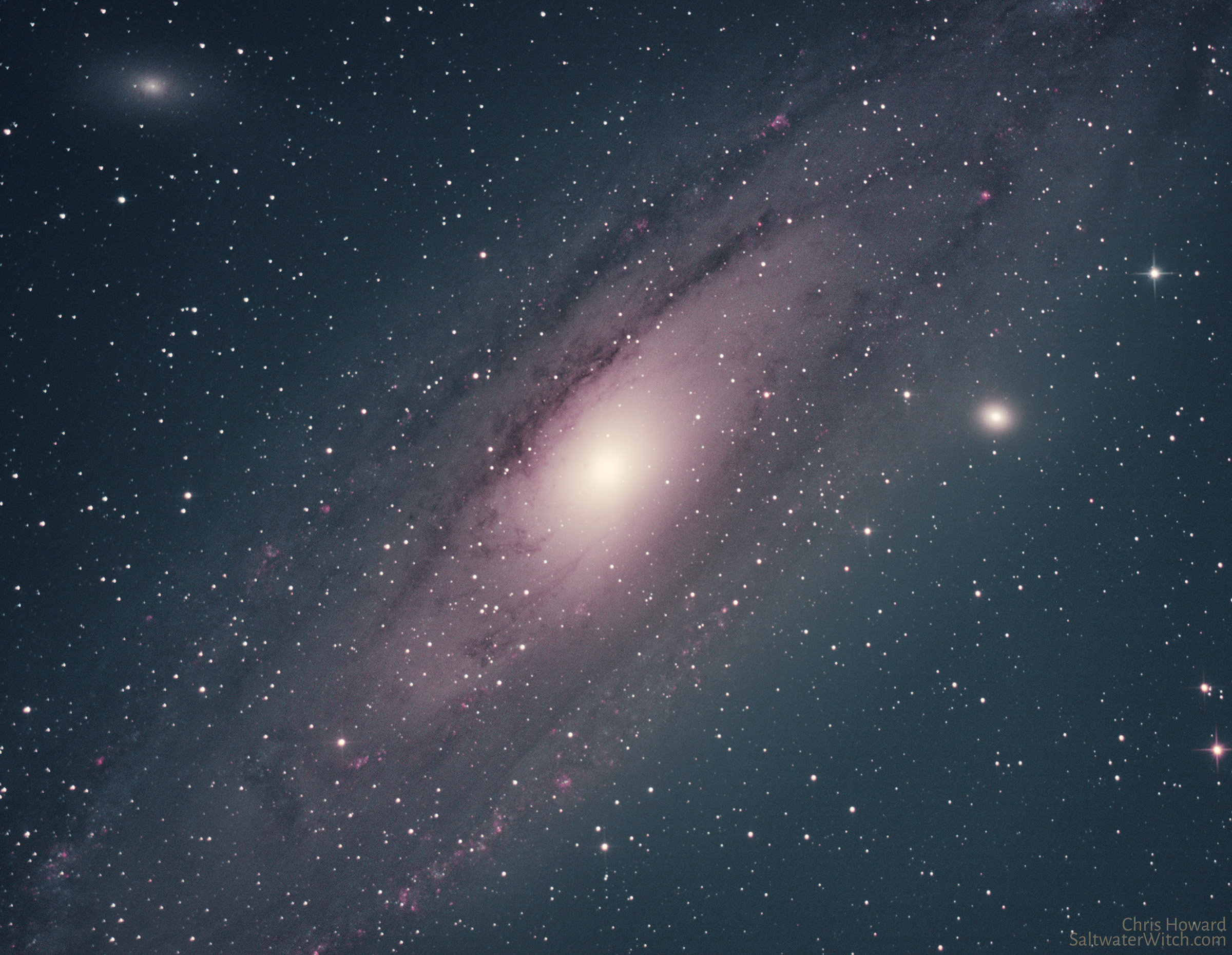
M31 and M33
I used the Optolong L-eXtreme for half of the exposures, filtering out everything except 7nm lines along hydrogen-alpha and oxygen 3, and then switched to full broadband, just the UV/IR Cut Filter. Notes: 8" 800mm f/4 Newtonian and the ZWO ASI071MC cooled color camera.
I'm not really a galaxy guy, more of a nebula guy, mainly because I don't have a scope over 1350mm, which is just long enough to get a handful of nearby galaxies. So, for now, I usually capture a couple of our galactic neighbors when they swing around this time of year--and if the moon and clear night skies line up for broadband color imaging!
The central region of M31, Andromeda Galaxy:
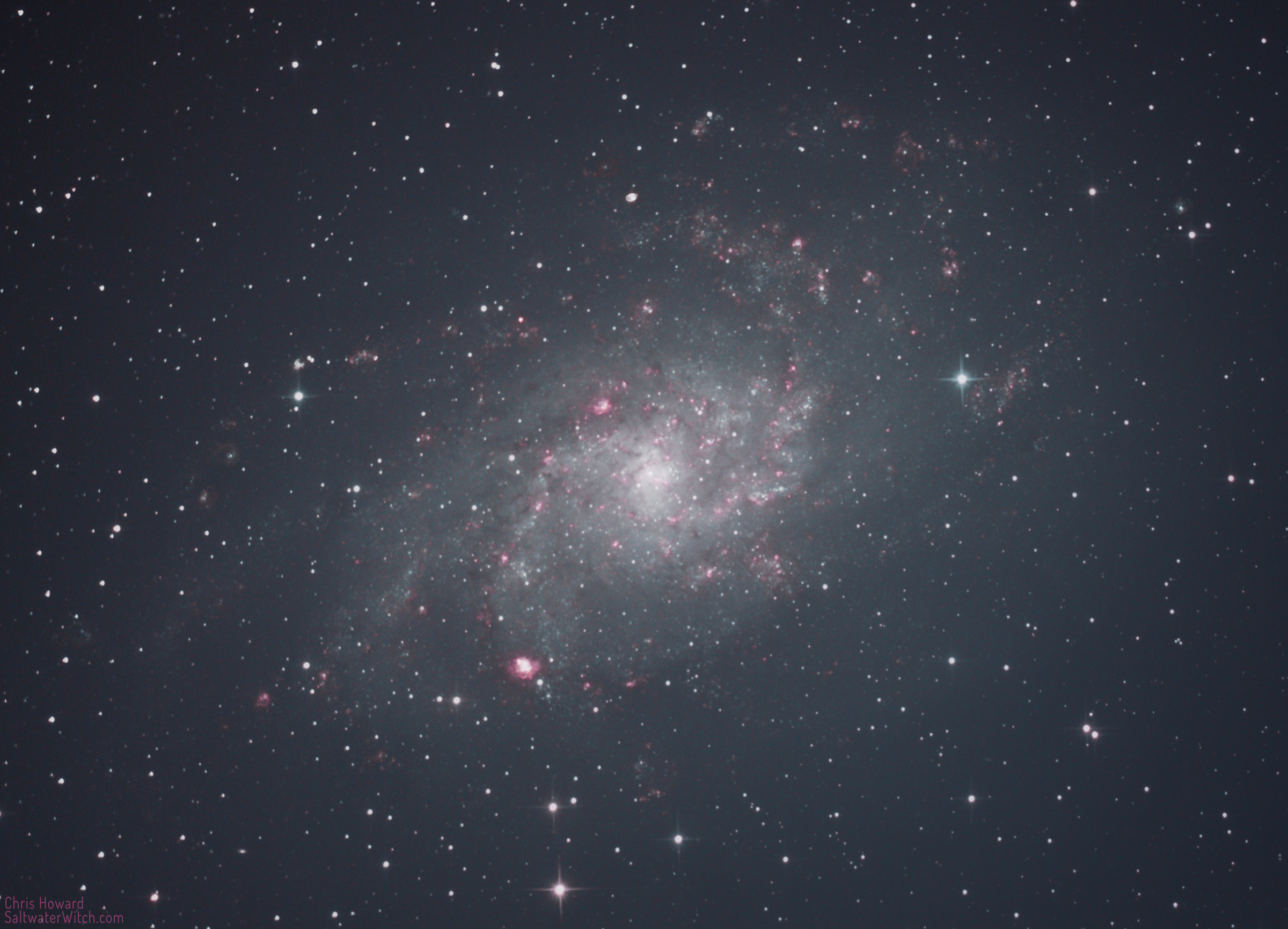
The Triangulum Galaxy from my backyard--it's only 2.73 million light-years from Earth! I've said it before. Once we develop MFTL technology (Much Faster Than Light) and we have the ability to hop to nearby galaxies, count me in on a trip to M33, the Triangulum Galaxy. The chunky pinkish masses are vast regions of interstellar ionized hydrogen that make up the nebulae in M33, perfect for an astrophotography outing. Until then, maybe we can take a trip to the southern hemisphere? Notes: Apertura 8" Newtonian OTA--800mm at f/4, ZWO ASI071MC cooled color camera. Optolong L-eXtreme dual narrowband filter. 48 x 240-second exposures stacked in DSS.
Posted September 4, 2022
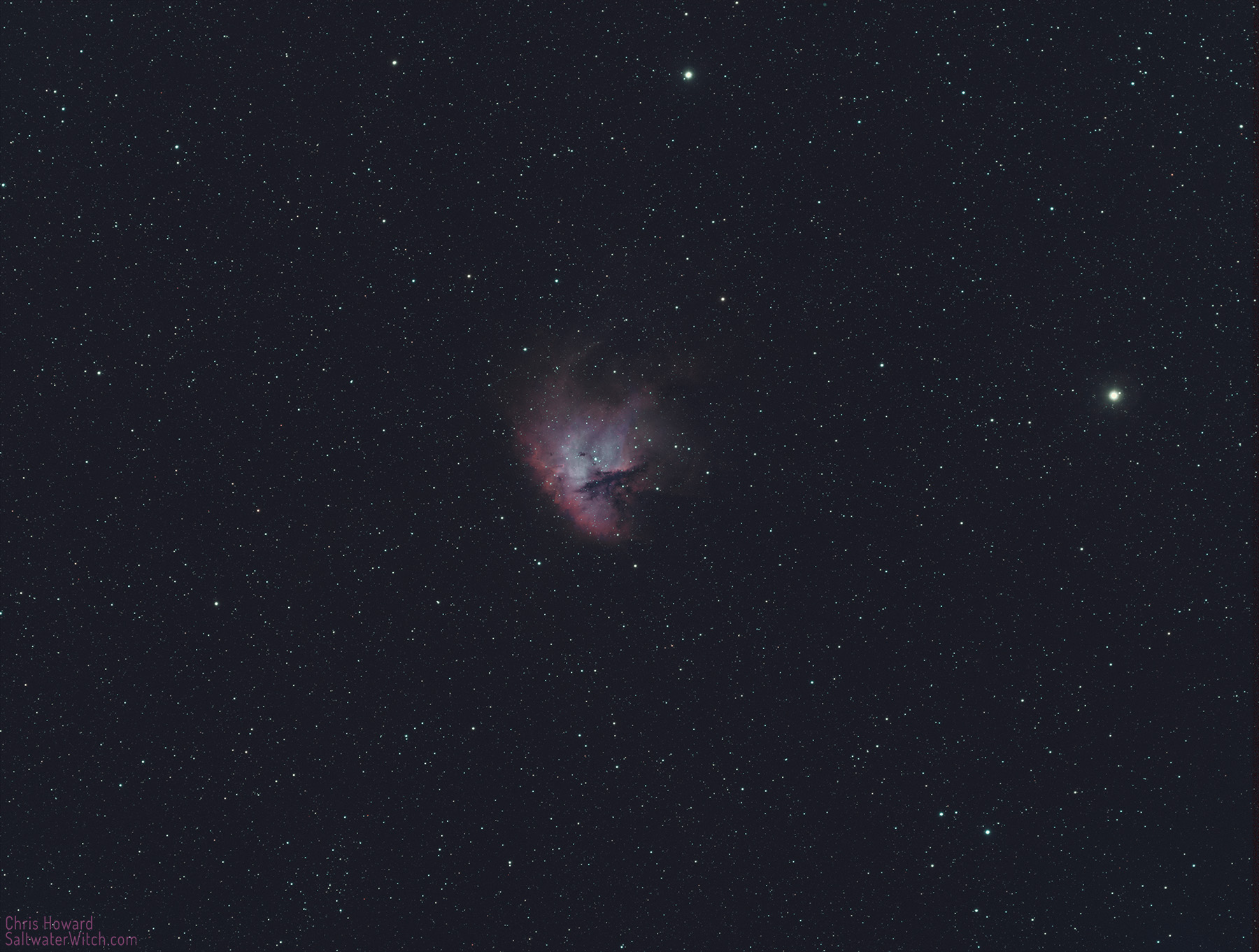
Pacman
A wide-field view of the Pacman Nebula (NGC 281, IC11, Sh20184) in Cassiopeia (Ha + OIII), about 9500 lightyears away. The massive star on the right is α Cassiopeiae (or "alpha Cass" if you're on friendly terms) which makes up the right lower point of the W asterism of the constellation Cassiopeia. The bright star at the top is eta Cass, a binary star system that's only about 20 lightyears away from us, downright neighborly, and is not part of the W asterism.
Posted September 4, 2022
Cave Nebula, part one
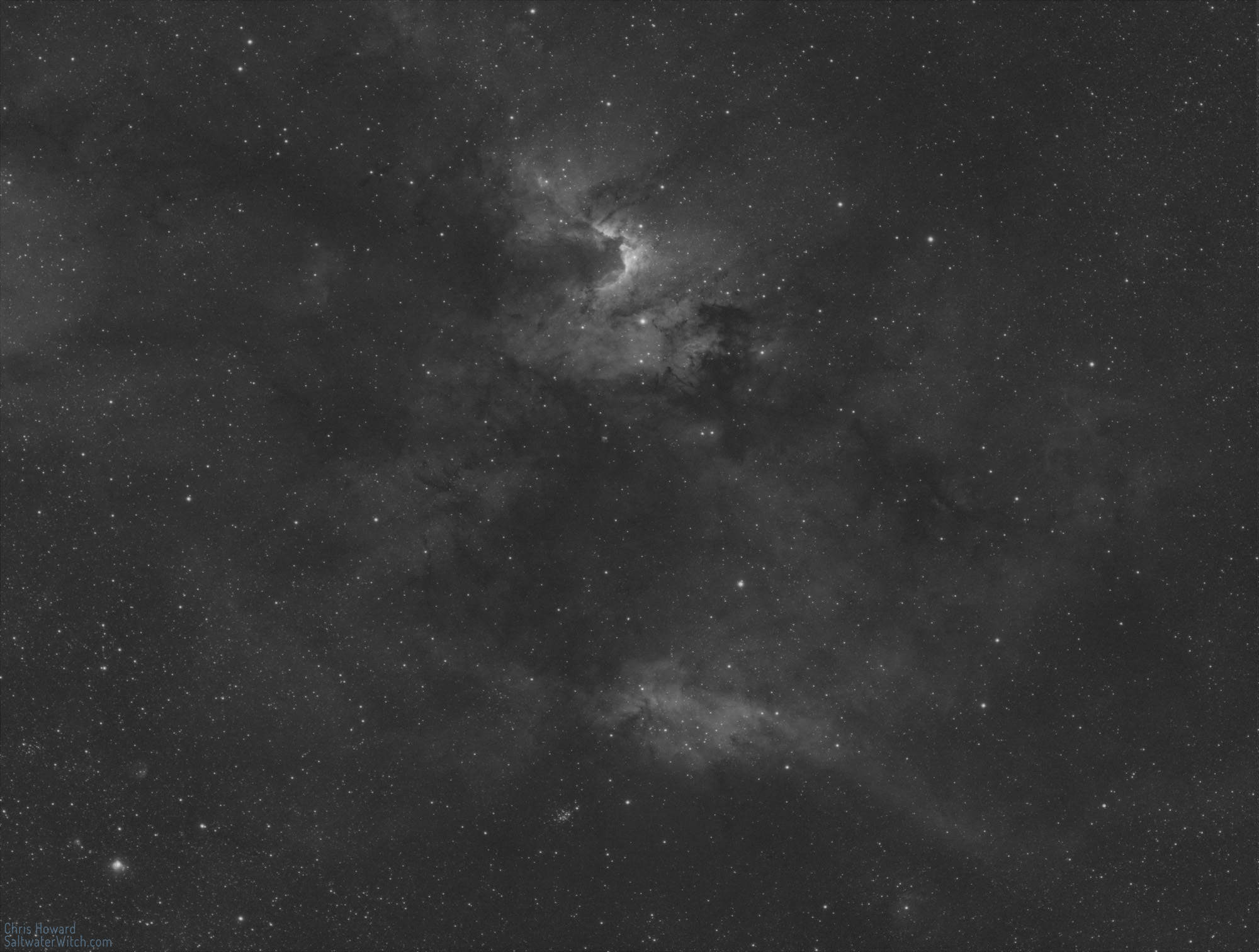
The Cave Nebula (Caldwell 9) in Cepheus. I started the Ha run last night but Earth's atmosphere wasn't having any of it. Seeing was poor at best, and the random wisps of cloud passing through just made it worse. I stacked the first 30 subs just to see where it was going, and even with the excessive noise, I think this is headed in the right direction.
Posted September 1, 2022
NINA/ASCOM: Connect your ZWO AM5 Wirelessly
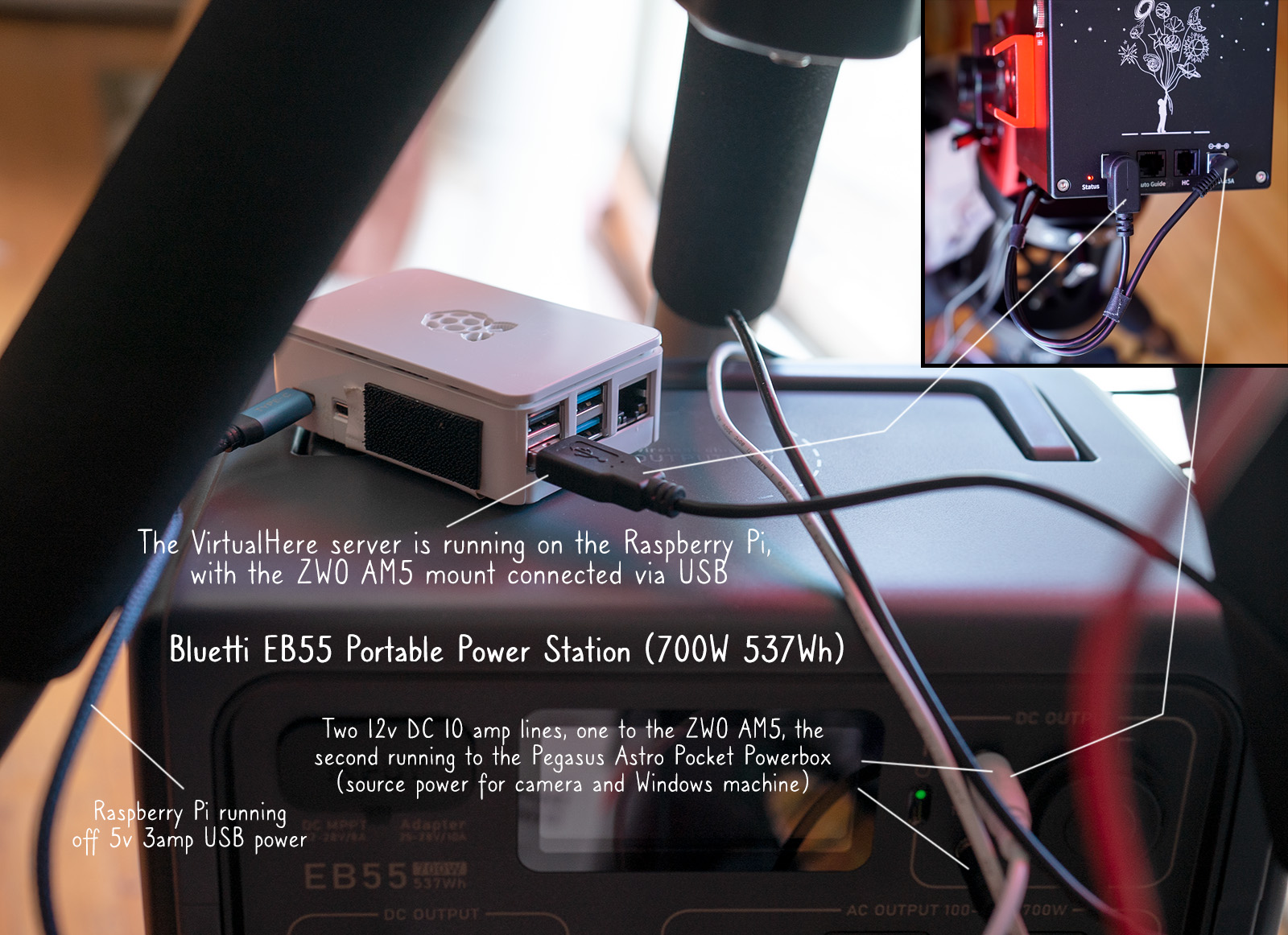
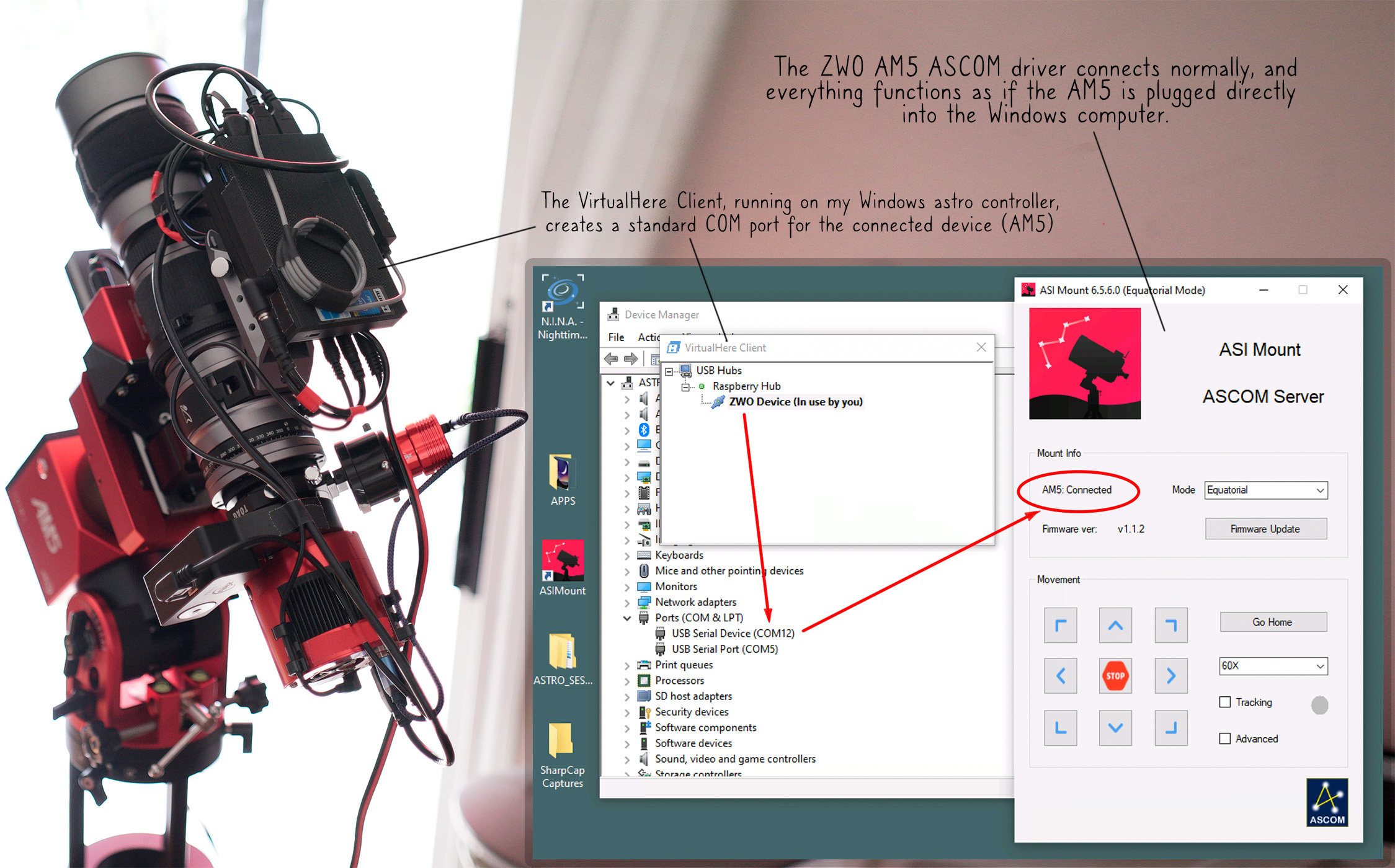
Tonight's test with the ZWO AM5 mount: run a virtual USB server from a Raspberry Pi and connect wirelessly to the AM5 from my Windows machine running NINA/ASCOM. The VirtualHere server is running on the Raspberry Pi, with the ZWO AM5 mount connected via USB The VirtualHere Client, running on my Windows astro controller, creates a standard COM port for the connected device (AM5). The ZWO AM5 ASCOM driver connects normally, and everything functions as if the AM5 is plugged directly into the Windows computer.
See my older post on this--connecting the Sky-Watcher EQ6R-Pro: Connecting your astro devices without cables
I'm using a VirtualHere server (https://www.virtualhere.com)
Don at Novaspirit Tech has a great video, walking through the complete setup on the Pi, using Linux on both ends, but it works basically the same with Windows on the client side. (https://youtu.be/I5zA1lU5Tw0). VirtualHere has servers for just about every OS and hardware combination imaginable, and clients for MacOS, Linux, and Windows. Whatever you're running, it's probably supported.
UPDATE: I ran an entire night with this setup and ran into an issue about midway through. The virtual USB port inexplicably closed at about the five-hour mark. I have a licensed version installed, so I don't think this is a trial version limitation. I haven't updated the client or server side since I used this setup with the EQ6R-Pro. I reconnected, and everything ran fine after that, but the last thing any of us wants to introduce into the system is unpredictability, so I will have to dig into the cause before trying again.
Posted August 31, 2022
A Long Night of Single-target Hydrogen-alpha Imaging
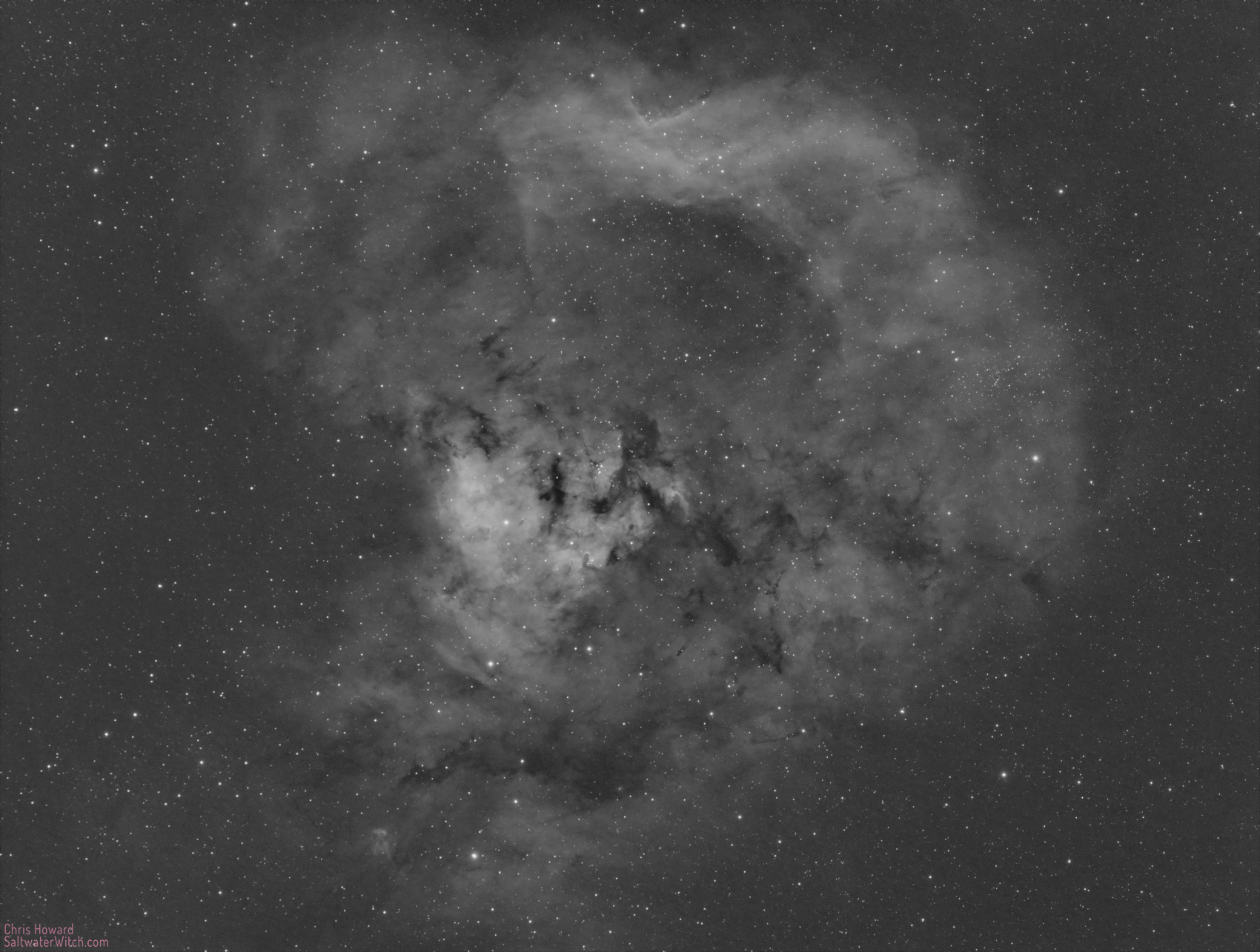
Five hours of narrowband data right there. This is what 61 x 5-minute exposures will get you through a 3 nanometer Hydrogen-alpha filter--when you algorithmically stack them all together. NGC 7822 is a star forming region in Cepheus, including the emission nebula Cederblad 214, Sharpless 171 and the star cluster Berkeley 59. Apparently this outrageously cool nebula doesn't have a common name, which just doesn't make sense. This should totally be called the Laughing Skull Nebula—or something even better. Missed opportunity right there. Unfortunately, I don't have the authority to make these names... or do I? Okay, while we're at it, see that small squarish cloud structure near the bottom (with two dark eyes and a nose), left of that bright star, which is labeled HR 9094 by the way? That little nebula that looks like it's peeking out of a pocket, is now called the Meerkat of Eternity.
Posted August 30, 2022
After a week of clouds, the skies are clear enough for imaging
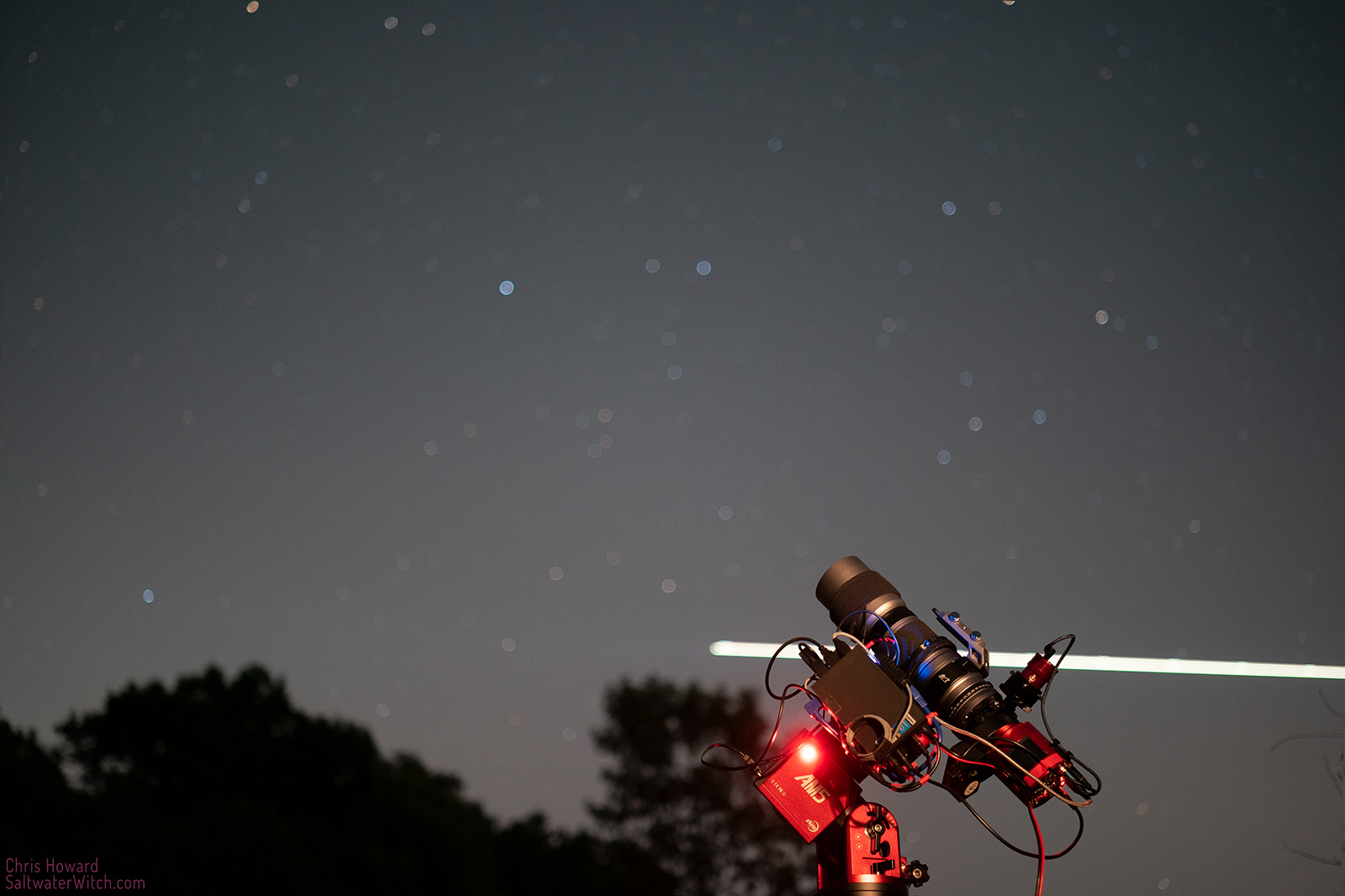
Right now, I'm in the middle of a 70 x 240 second Ha imaging run of sh2-157, the Lobster Claw Nebula in Cassiopeia and crossing the border into Cepheus. (I shot this with a Sony A7s, Zeiss Batis 40mm f/2 CF, 15 sec exposure, ISO 1600). That bright star in the center (out of focus—bokeh) is actually Jupiter.
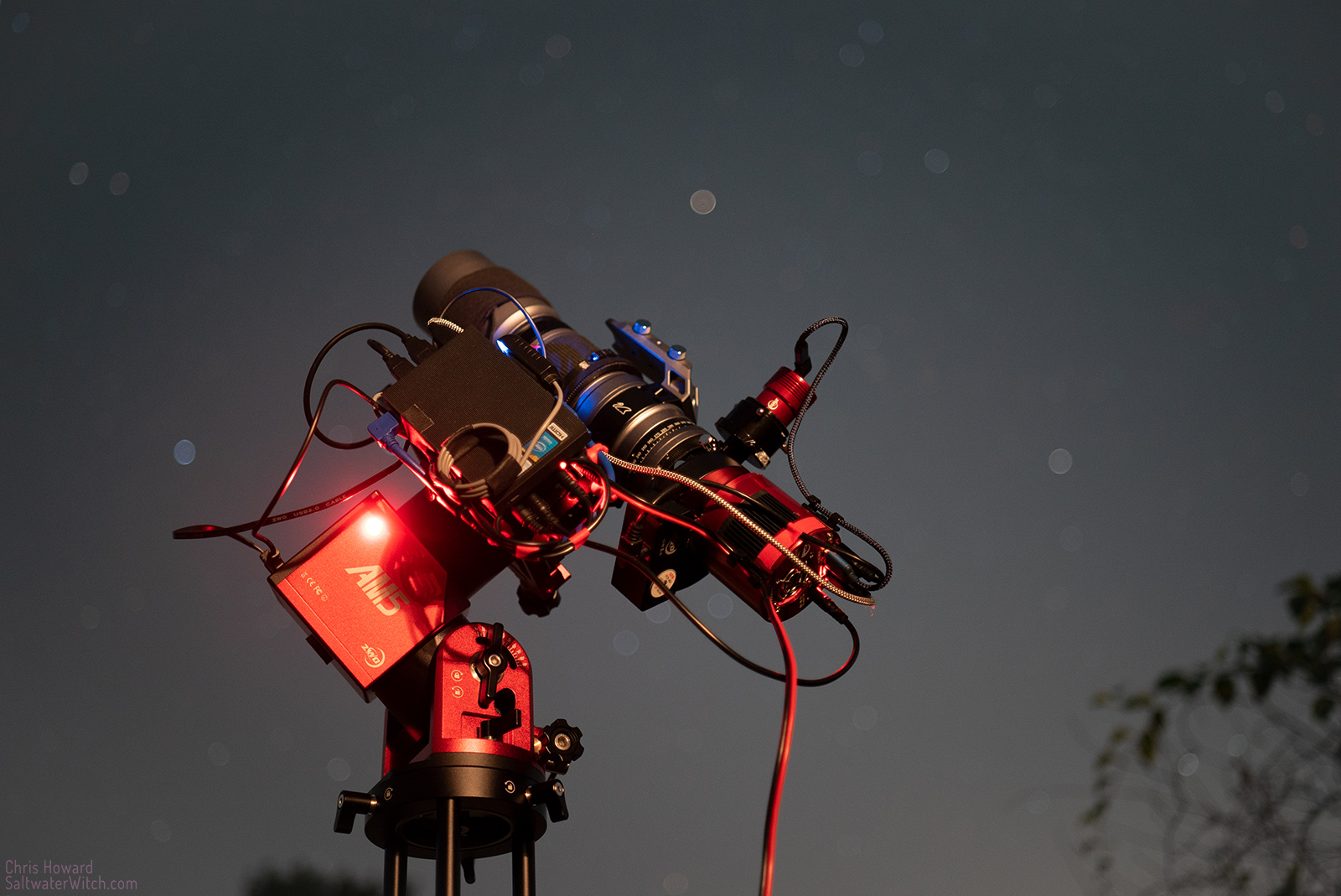
Another one of the astro setup, this time with an Air Force tanker cruising in for a landing at Pease, just outside Portsmouth, in the background. (I think it was a tanker, going by the sound because I couldn't actually see anything but the lights. Pease is home to the 157th Air Refueling Wing).
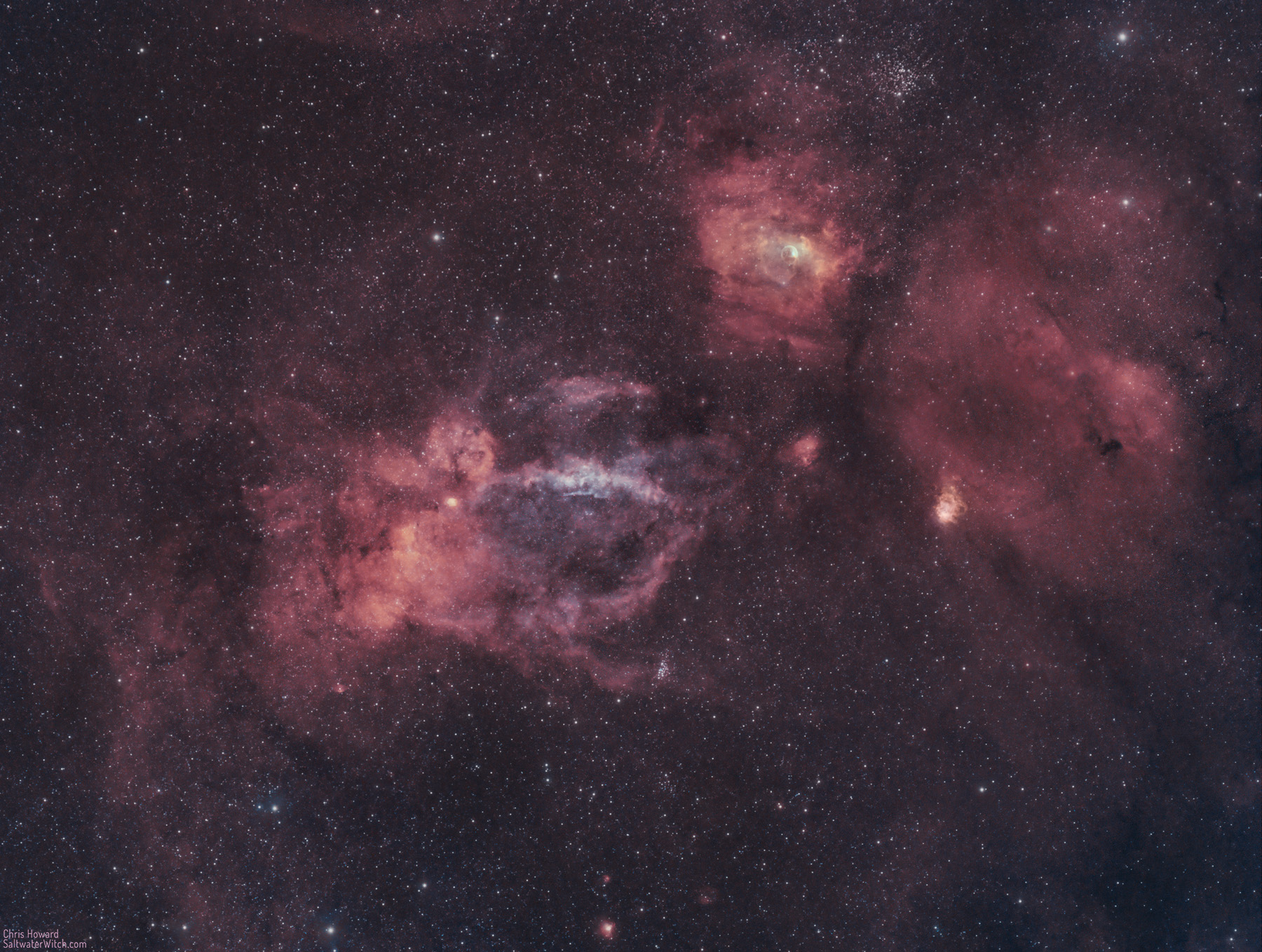
I finished up the Lobster Claw Sunday night with some 3 nanometer Oxygen3 data. The Lobster Claw (Sh2-157), the Bubble Nebula, and so much more, extending over the border from Cassiopeia into Cepheus. The squarish bright region, Sh2-157a, at the joint of the top bluish arc of the Claw is a denser emission structure surrounding the Wolf Rayet star WR-157. The Bubble Nebula is middle top (NGC 7635, Sharpless 162, Caldwell 11), and the bright emission region below and to the right is NGC 7538. That cluster of stars above the Bubble Nebula is Messier 52 (M52). The Lobster Claw Sh2-157 is about 8000 lightyears away.
Posted August 28, 2022
Power & Control for the ZWO AM5
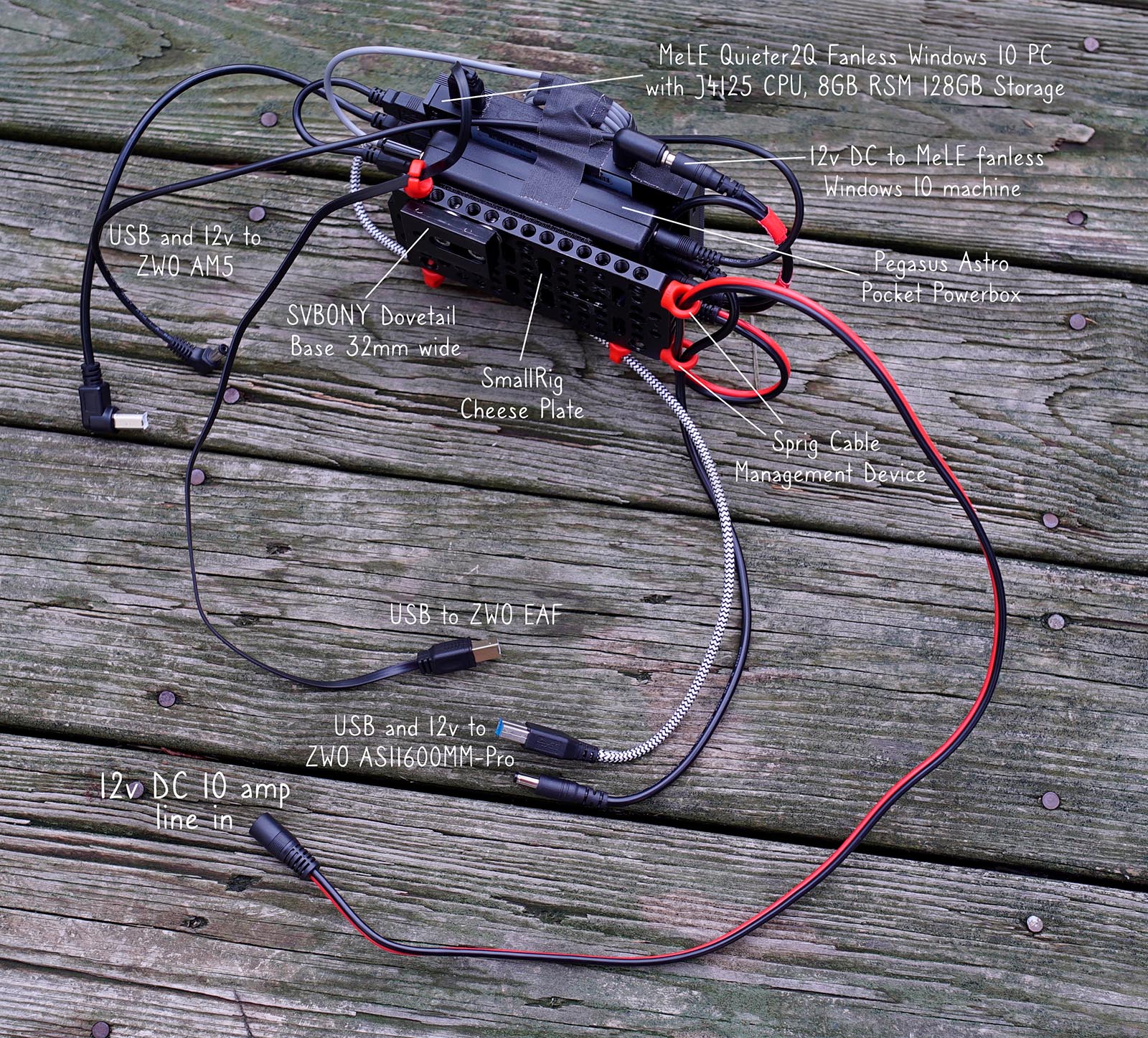
I am using a fanless Windows 10 machine and a Pegasus Astro Pocket Powerbox to run my ZWO AM5 mount. Both of these are mounted to a SmallRig cheese plate with 3M Command Strips (I like these better than Velcro).
MeLE Quieter2Q Fanless Windows 10 PC with J4125 CPU, 8GB RSM 128GB Storage
https://amzn.com/dp/B08ZXXJL6N
Pegasus Pocket Powerbox
https://pegasusastro.com/products/pocket-powerbox
SmallRig Multi-Functional Cheese Plate
https://amzn.com/dp/B019C2ZM8Q
Sprig Cable Management Device
https://www.bhphotovideo.com/c/product/1632736-REG
SVBONY Dovetail Base 32mm wide
https://amzn.com/dp/B07MR35HML
Posted August 23, 2022
Bad-weather Build: thin film dew heating strips
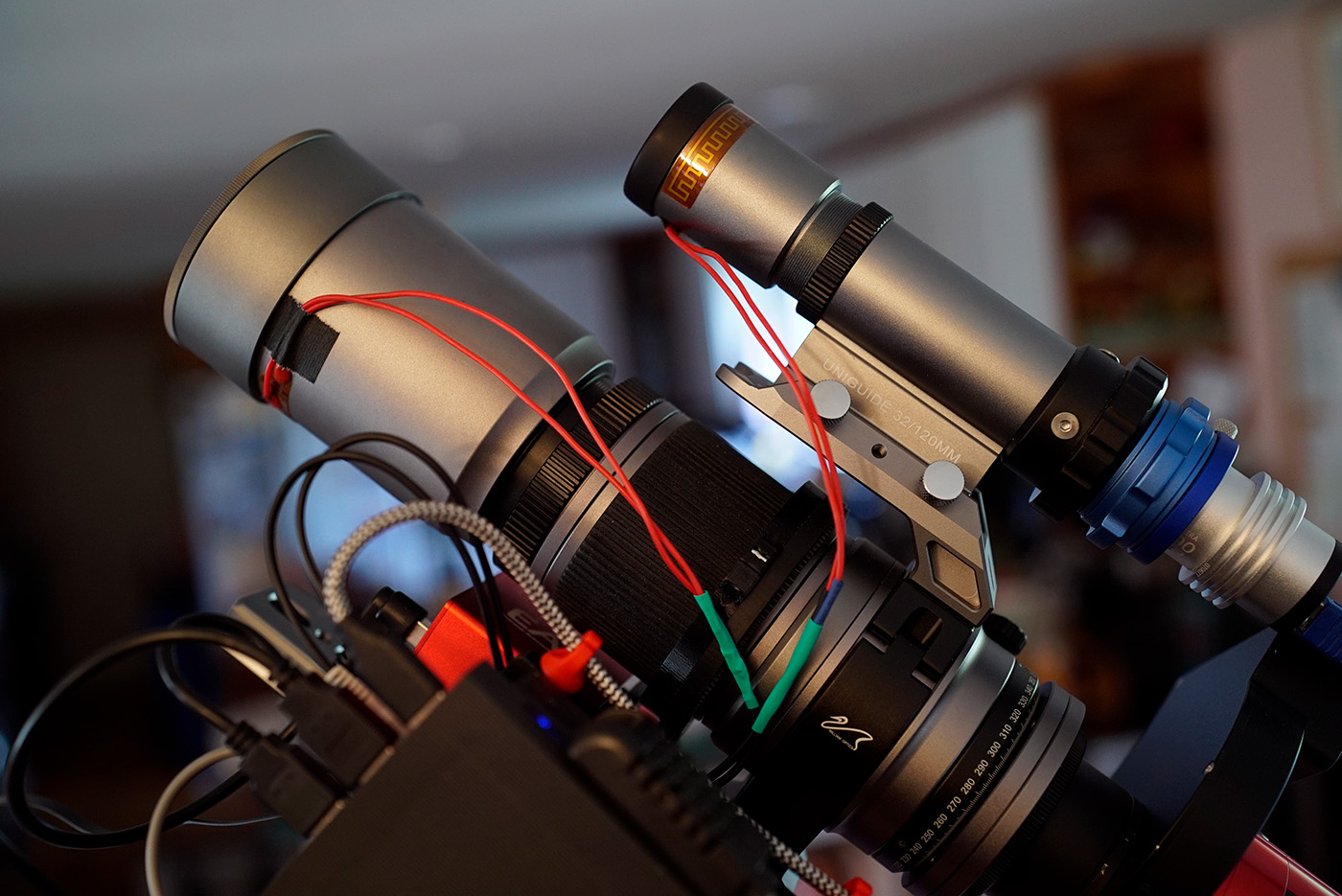
I have been thinking about a low-profile method for warming up the main scope and guide scope, and Polyimide film heaters seem like the perfect candidate. They're very thin, adhesive backed, and come in voltages (12v dc) and max output wattage that seem perfect for dew control. These aren't new in astrophotography. I know ZWO uses a Polyimide heating ring dew heater for the front of their cooled cameras, and I am pretty sure Deep Sky Dad uses similar film heating for the built in dew control on the motorized telescope cover and controllable flat panel available for some William Optics, Takahashi, and Askar scopes.
The build for this is relatively simple. I cut up an old stereo + video RCA cord, using the red and white male end audio jacks. I soldered the two leads from the jacks to the two leads from the heater film, covered the splice with shrink tubing, and that's it. I plugged both into the Pegasus Astro Pocket Powerbox to get a sense of where to set the PWM dial for best dew control results. It turned out to be quite a bit lower than expected.
CAUTION: The dew heating range in the Pocket Powerbox is 0 to 255, and I normally run my dew strips somewhere near maximum. You have to be careful with the Polyimide film though, because these generate a lot more heat, maybe enough to damage some scopes. After a couple tests, it seems like a range of 30 to 75 works. The next step is more testing--soon as the night skies clear up!
- RCA Male Jack, two leads stripped and ready to solder https://amzn.com/dp/B081TYCKC6
- Polyimide Film 12V 12W with adhesive back https://amzn.com/dp/B076PD7TXW
- Deep Sky Dad: Automated, flap panel https://shop.deepskydad.com/product/wo-redcat-flap-panel-fp1
- ZWO Anti-dew heater https://astronomy-imaging-camera.com/product/anti-dew-heater