Soul Nebula in SHO
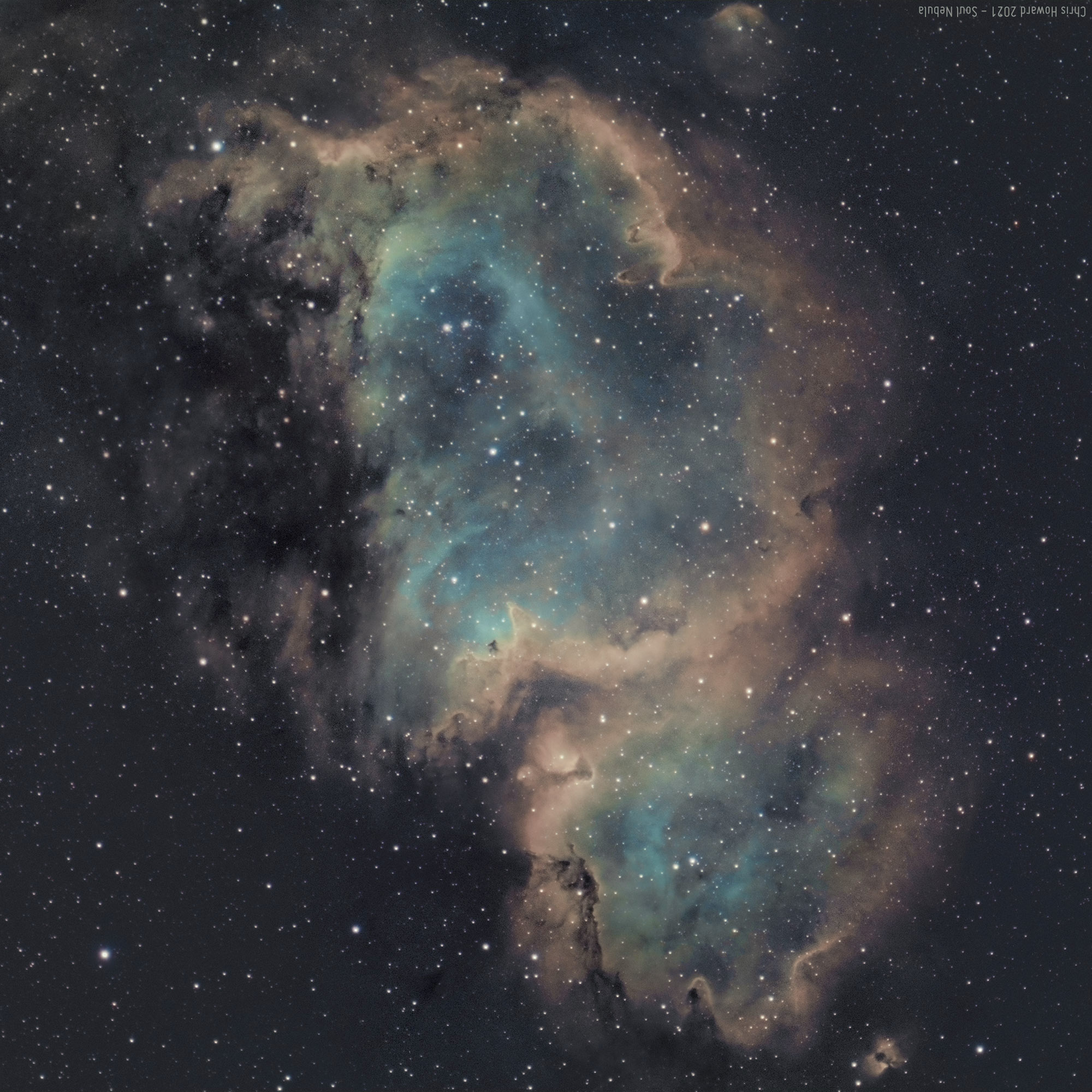
And the Soul Nebula in color… I haven’t captured any OIII or SII data in the last few months, but I do have the Sh2-199 data in all three bandpasses from last year. Using Ha from last week with O3 and S2 from last year for this one in SHO -> RGB.
Posted October 24, 2021
Soul Nebula Westerhout 5 (Sharpless 2-199) in Hydrogen-alpha
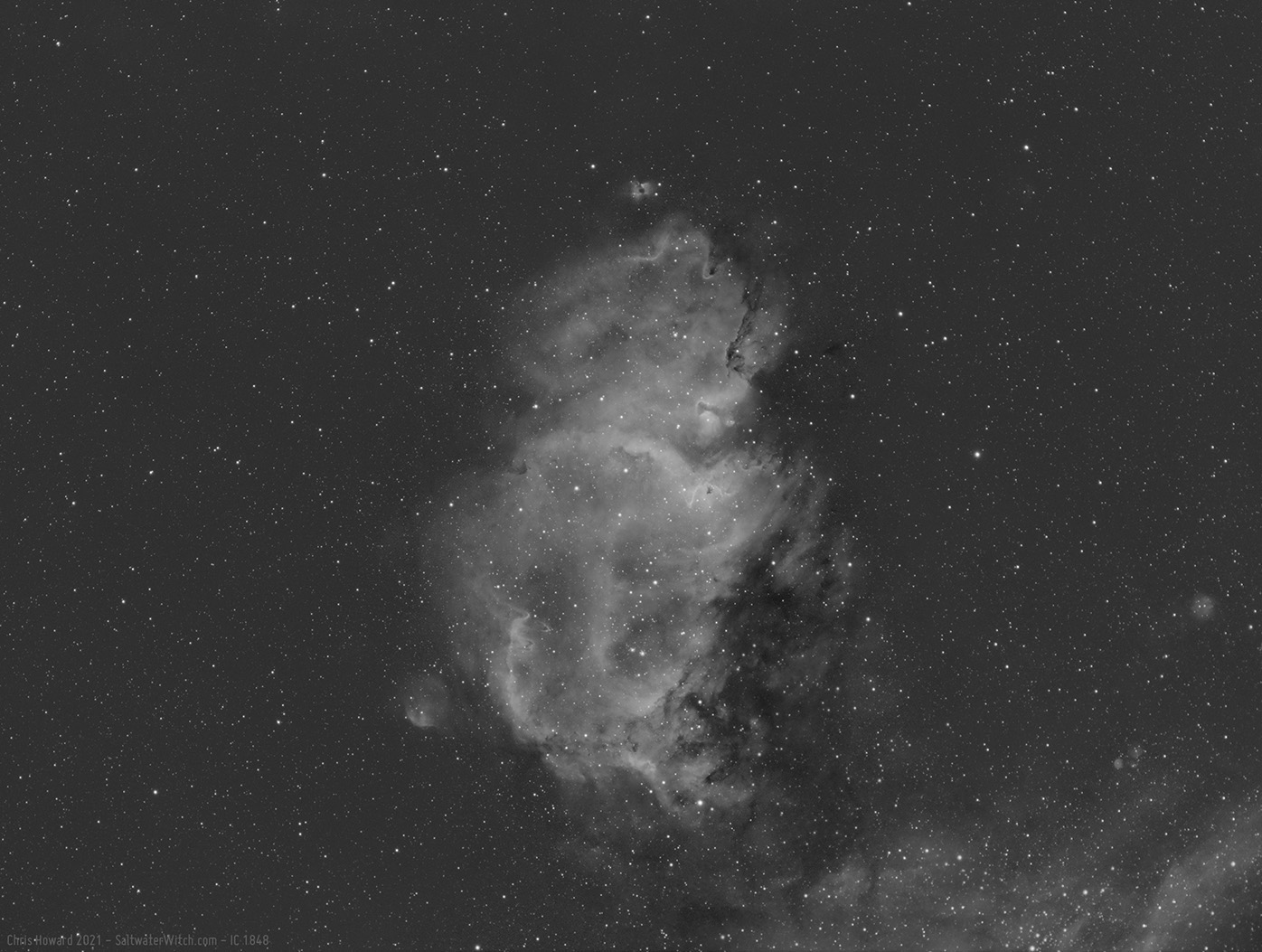
From last night's imaging run: Soul Nebula (Westerhout 5, Sharpless 2-199) in the Constellation Cassiopeia, 65 x 240 second stacked subs with the William Optics SpaceCat51 APO refractor, ZWO ASI1600MM-Pro monochrome camera, and the Antlia 3nm Ha Pro narrowband filter. The designation IC 1848, which is the catalog entry for the star cluster in the lower right region of the nebula, but it's popularly used to refer to the entire nebula. The Soul is a massive star-forming region about 6500 lightyears away, with several open clusters, including CR 34, 632, and 634.
Posted October 12, 2021
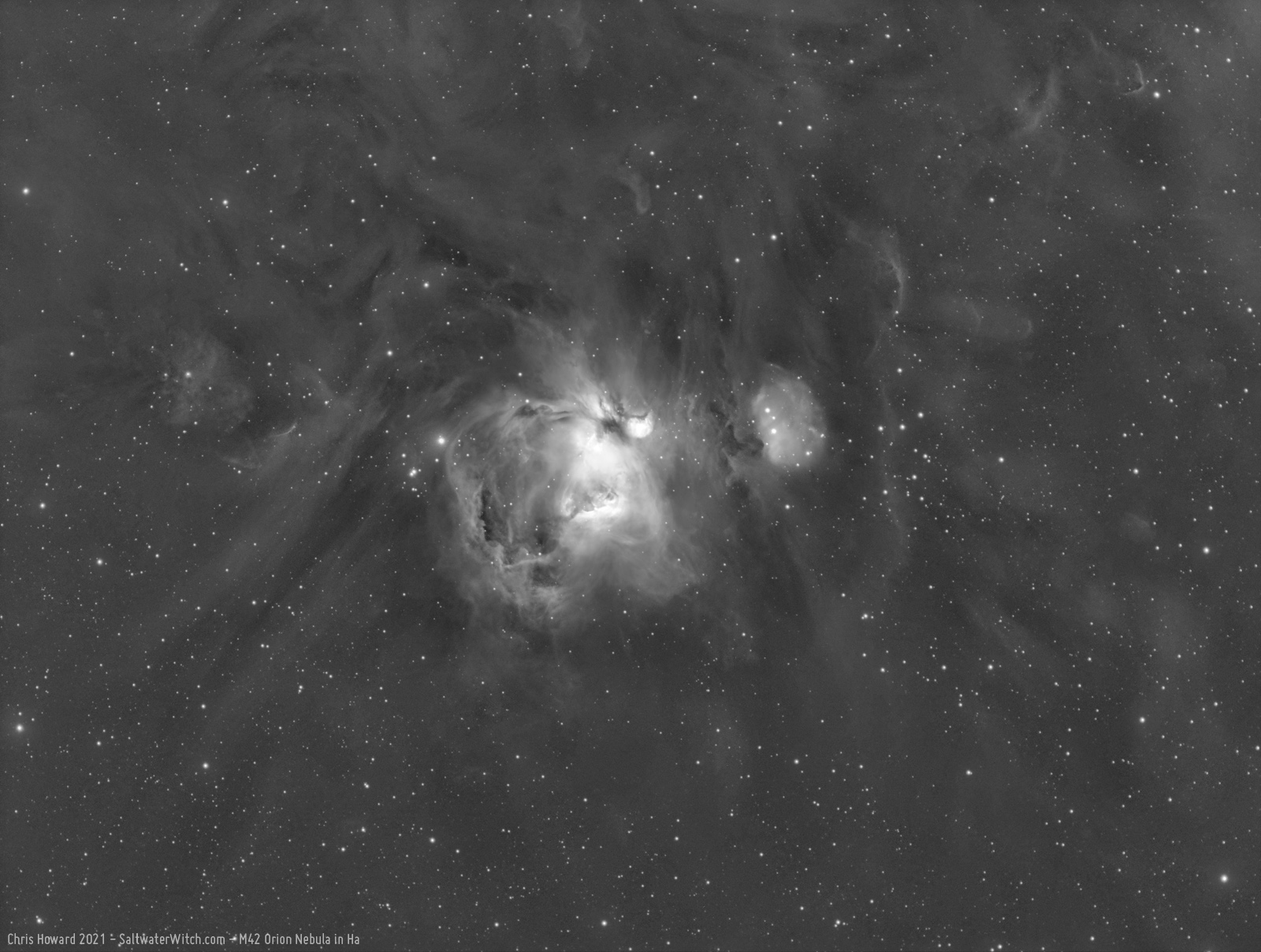
Orion Nebula (M42) in Hydrogen-alpha
More fun with the Antlia 3nm Ha filter on the William Optics SpaceCat 51. 55 x 240-second stacked subs of the Orion Nebula and surrounding clouds of atomic hydrogen.
Posted October 12, 2021
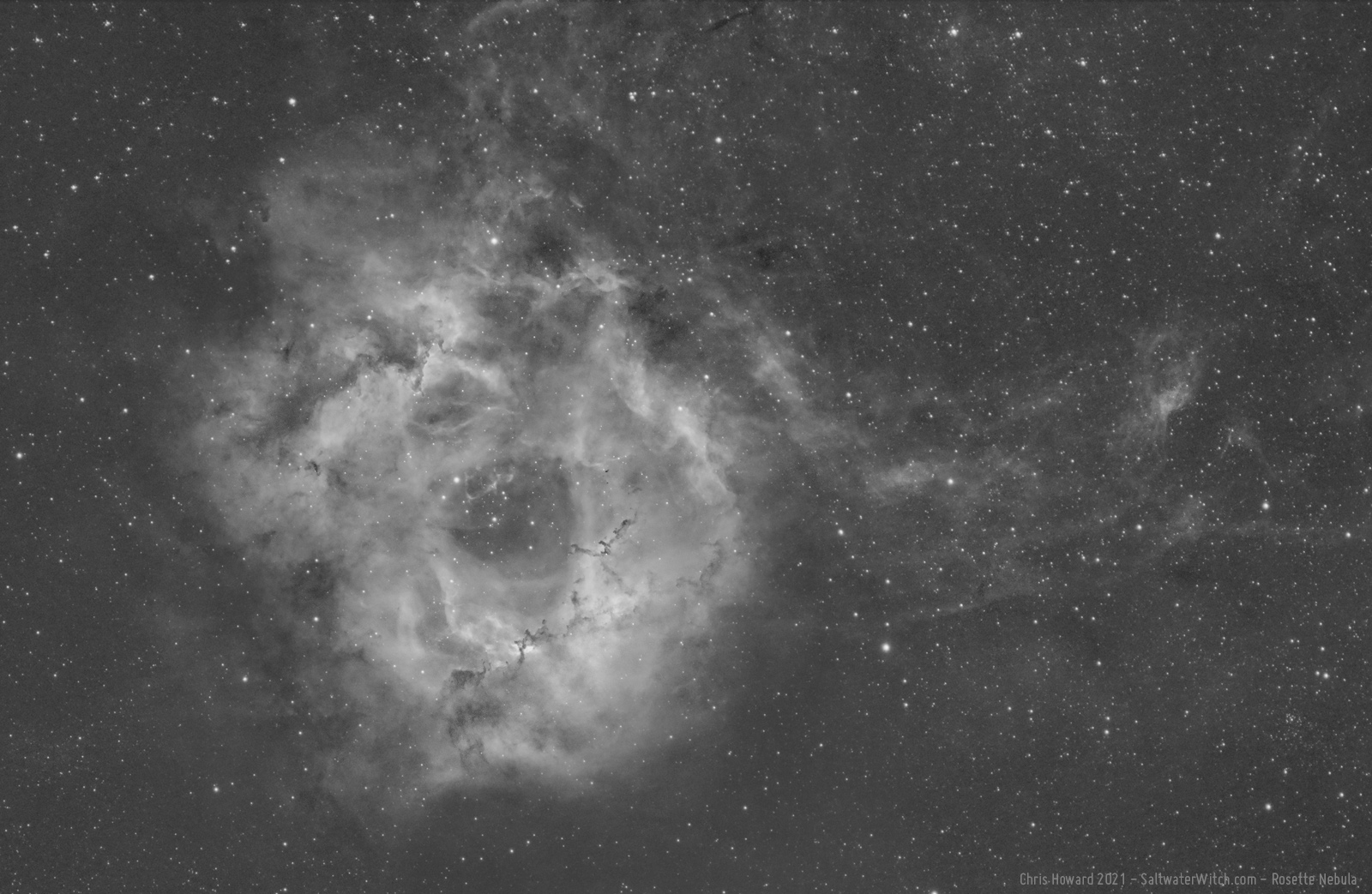
Rosette Nebula in Ha
Narrowband imaging is all about the filters you use to block out every bit of light except one narrow section of the electromagnetic spectrum. The photons landing at your telescope's front door with the correct wavelength (around 656nm for hydrogen-alpha) are allowed to pass. Everyone else is kicked out. And sometimes with narrowband imaging you just want to go...narrower. Over the last ten years of astronomy and astrophotography I have used 12 nanometer, 7nm, and 6nm filters. (These numbers represent the gap in the filter, allowing light of a specific range of wavelengths through). I bought an Antlia 3nm Narrowband H-alpha Pro Filter a month ago, but haven't had a chance to test it out until now--mostly due to poor weather. The Antlia 3nm Ha filter is only $269 USD, Agena Astro; compare this price with high-end filters Chroma $575, Astrodon $564.
Wednesday, Oct. 6th was my first night out with the 3nm Ha in the EFW, along with my Astronomik 6nm Ha, OIII, and SII filters. At some point I may do a side-by-side comparison with the Astronomik 6nm, but I'm already working out different strategies for using both, depending on the target. I assumed I would double exposure times or number of exposures going from 6nm to 3, and went with a little of both--67 x 300 second subs for the Rosette Nebula, which is very bright. One noticeable difference during capture was lower contrast in the individual subs--or the appearance of lower contrast because I think there's now hydrogen data where I was expecting empty space, and this gives the entire frame a brighter, more uniform appearance? I was expecting more Ha data--that's the reason to go narrower, to cut out everything except hydrogen-alpha (looking at you NII--nitrogen 2).
So, I was a little worried, watching five minute exposures appear in Ekos, that seemed flatter, with less detail, but after capturing 70 and stacking 67, the result was better than expected. The other difference I hadn't really anticipated--or even thought about--is longer autofocus times because I've bumped up the exposure time to 30 seconds at 1x1 binning. For the ZWO EAF, I went with linear/SEP in Ekos and it takes 4 - 5 minutes for the full autofocus process, most of that in exposure time. I usually see about 2 with other narrowband filters, and something like a minute with the clear filter (taking 1 - 4 second exposures with the Clear). The Astronomik filters are close to parfocal, but the Antlia is pretty far off, to the point where I will probably use a starting offset for the Ha 3nm when jumping between different filters. Okay, so longer exposure times and focusing routine, what about the imaging? Well, I'm impressed. Unfortunately, I don't have experience with other 3nm Ha filters, but I can tell you there is a noticeable difference between the 3nm and my 6nm--and I like what I'm seeing. Like any new tool or process, it takes some getting used to, but once you're there, this Antlia 3nm Ha filter seems to work well, does exactly what it's designed to do, and so far--after three nights of imaging--is well worth the price. I'm really happy with the results so far.
Posted October 8, 2021
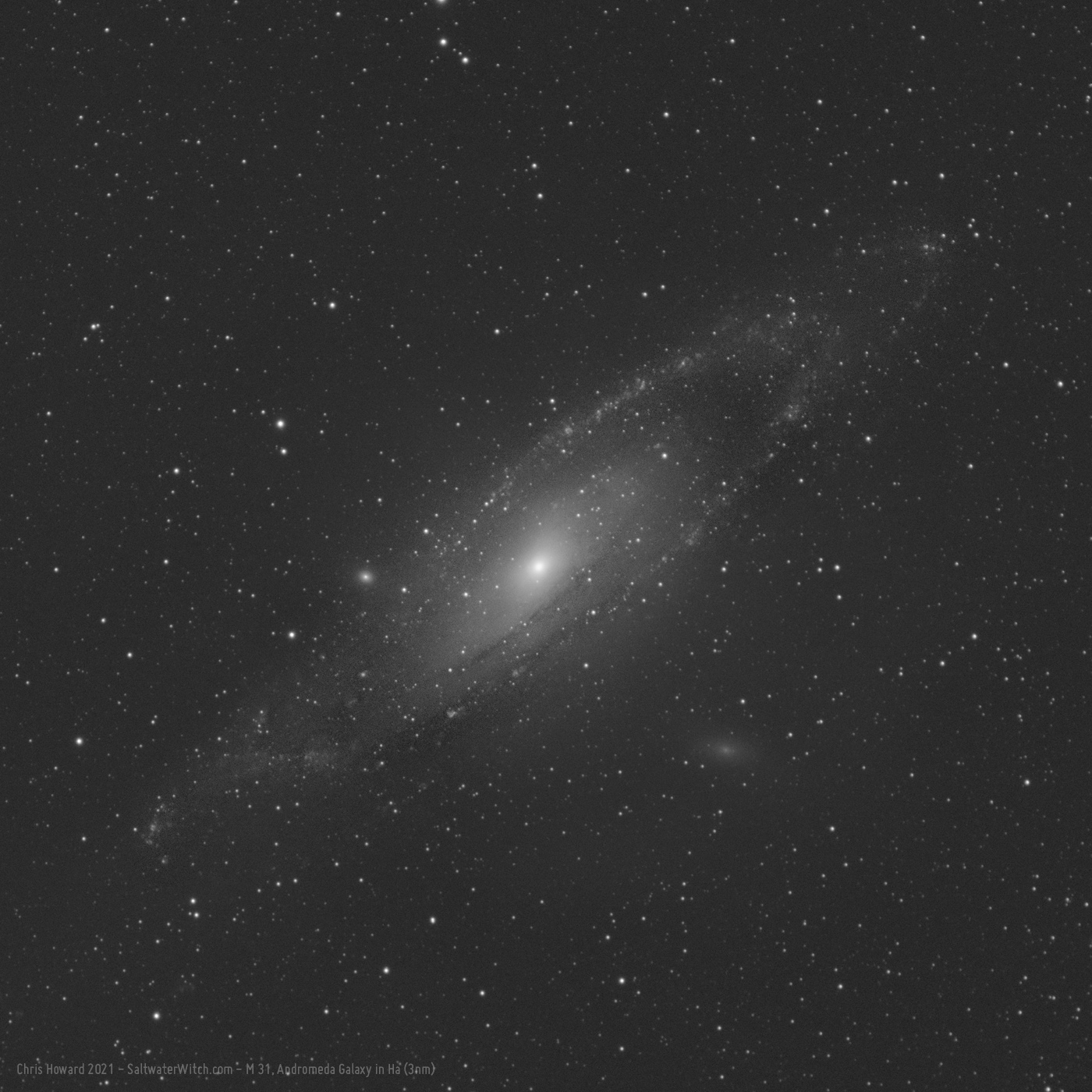
Andromeda never gets old
Here it is in hydrogen-alpha, just the one narrowband slice of the spectrum. Andromeda Galaxy, Messier 31, is probably the first target for northern hemisphere astrophotographers--well, it's either M31 or M42 Orion Nebula. Both are intensely bright deep sky objects you can see without a telescope, given reasonably clear and dark skies. I have captured M31 more times than I can count. The galaxy stands out in the night sky when it swings around every year, making it an easy target. Galaxies are also great full spectrum targets for color cameras, DSLRs and mirrorless cameras, but that doesn't mean you can't pull some awesome data out of Andromeda in narrowband or infrared. I captured M31 in near-infrared (longpass 850nm) a couple years ago, and last night I captured our galactic neighbor in very narrow hydrogen-alpha (3nm Ha), and this stacked set of 42 sub-exposures highlights massive HII regions, mostly emission nebulae, along the outer spiral arms, with dense bands of dust and debris ringing the galactic core. This will make a great red channel in an RGB image, or I may go with HaRGB.
Posted October 8, 2021
NGC 1499 in Hydrogen-alpha
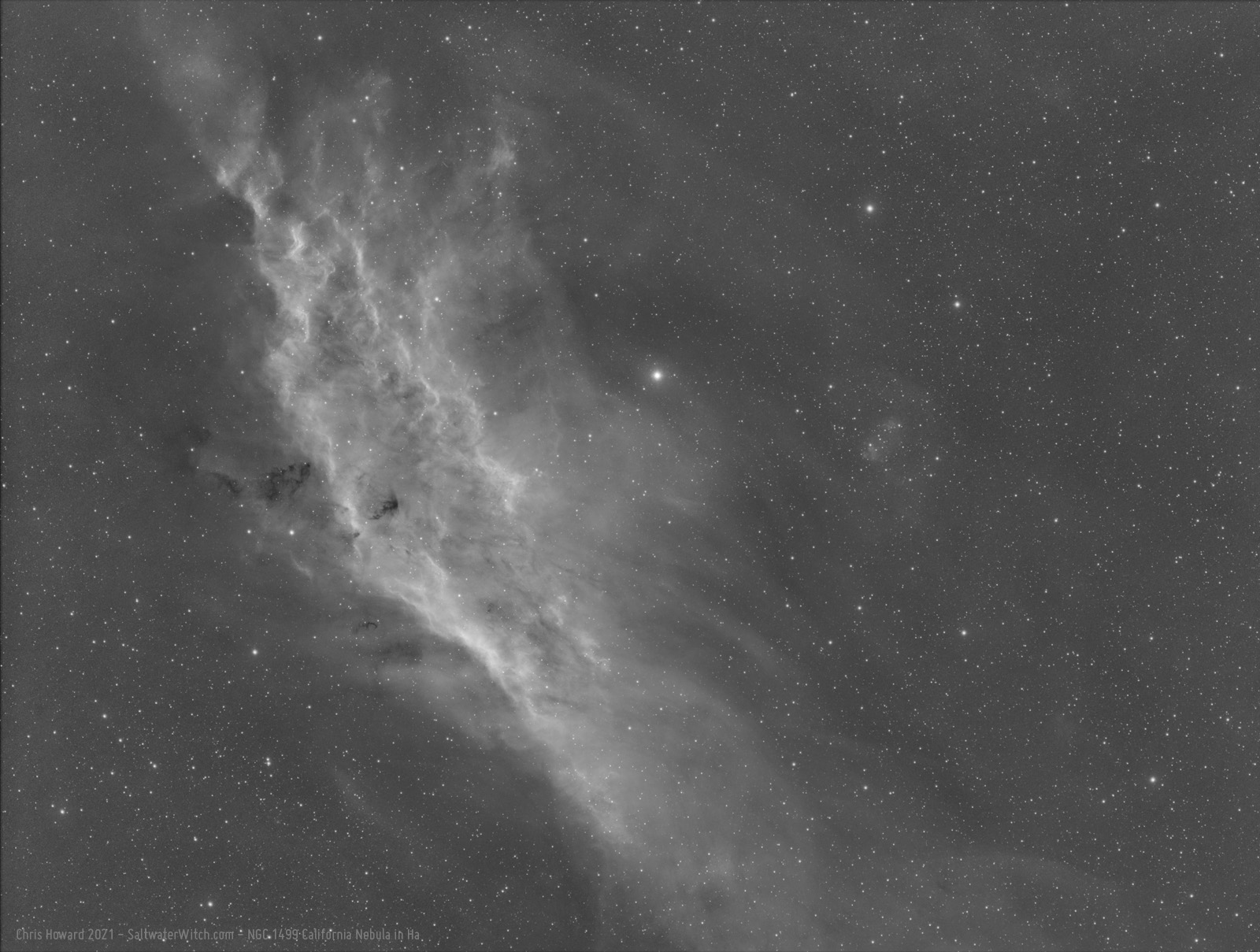
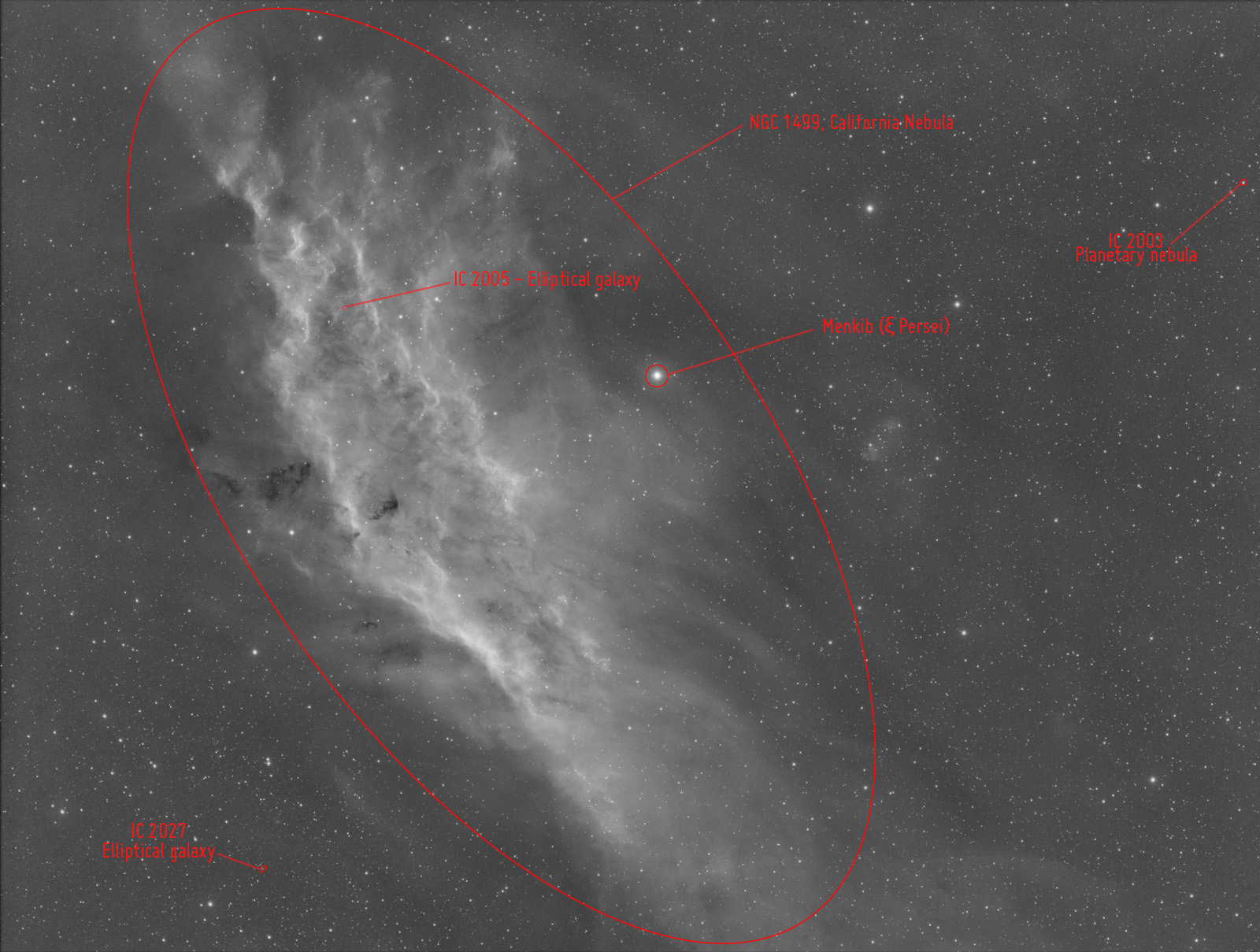
I started another narrowband imaging run of the California Nebula (NGC 1499), this time in 3nm. Here's my first pass of 100 x 240-second sub-exposures in hydrogen-alpha (Antlia 3nm Ha filter) with my ZWO ASI1600MM-Pro monochrome camera and William Optics SpaceCat 51 Refractor (250mm FL @ f/4.9).
Some notes on the image below:
NGC 1499, the California Nebula, is a large HII region and star-forming cloud in the Constellation Perseus. Its 100 lightyear length is roughly shaped like the State of California—I mean, you can see the San Joaquin Valley, the Sierras and where the land angles in for southern California and the L.A. Basin. So, the name fits the shape. NGC 1499 is east of the Perseus Molecular Cloud, a large star-forming region surrounding the star clusters, IC 348 and NGC 1333, but also includes a bunch of hot O-type stars on their own. The HI supershell in Perseus, a broader backdrop of atomic hydrogen and helium, encompasses the molecular cloud as well as the California Nebula. Almost every nebula I have ever imaged is within our galaxy, the Milky Way, but what's interesting with NGC 1499 is that our solar system and the California Nebula are both in the Orion Arm of the Milky Way, about 1200 lightyears apart. It's just up the galactic street from us. We're practically neighbors!
The O-type blue-giant star Menkib (the Bayer designation is ξ Persei) is 12,700 times brighter than our star, the Sun, and it's 30 times the mass. It's also seriously hot with a surface temperature around 35000 degrees kelvin. Compare that with 5778 k surface temp of the Sun. There's evidence that Menkib is a "runaway star" based on it's abnormally high radial velocity, which means it is moving away from its stellar association—where it originally formed—in a calculable direction and at an unusually high speed, as if it was ejected by some stellar event or disruption (e.g. gravitational interactions with other stars, supernova explosions, usually something violent and large-scale). The intense radiation from Menkib has carved out the hollow on one side of the California Nebula while lighting up (ionizing) the roughly 900 trillion kilometers of dense clouds of molecular hydrogen. Menkib is continuously bathing all of this hydrogen in radiation, and this is where ionization steps in to help us with our imaging. Electrons get a bit excited with all this loose energy about, and individual ions will lose electrons in the process. In this short-lived energized state a hydrogen molecule is unstable, and when an electron inevitably drops back into a stable position, its ground state, this transition energy causes a photon, a particle of light, to be released in the corresponding wavelength. That's the ionization part, but it's these photons, traveling 1200 lightyears, that we pick up with the digital sensors in our cameras. The simplest definition of astrophotography is catching photons from distant objects, usually either generated or reflected by them.
The elliptical galaxy IC 2005 is just a tiny smear of light in the East Bay area of the California Nebula. It's 279 million lightyears away us, but it's still bright enough to shine through the dense clouds of ionized hydrogen that make up NGC 1499. IC 2005 is 30,000 light years in diameter and it's moving away from us at just over 5800 kilometers per second, about 1.9% of the speed of light.
IC 2027 is an elliptical galaxy in the Constellation Perseus, about 287 million lightyears from our galaxy.
IC 2003 is a planetary nebula in Perseus, about a light year in diameter and 12,000 light years away, roughly halfway between us and the edge of our Galaxy.
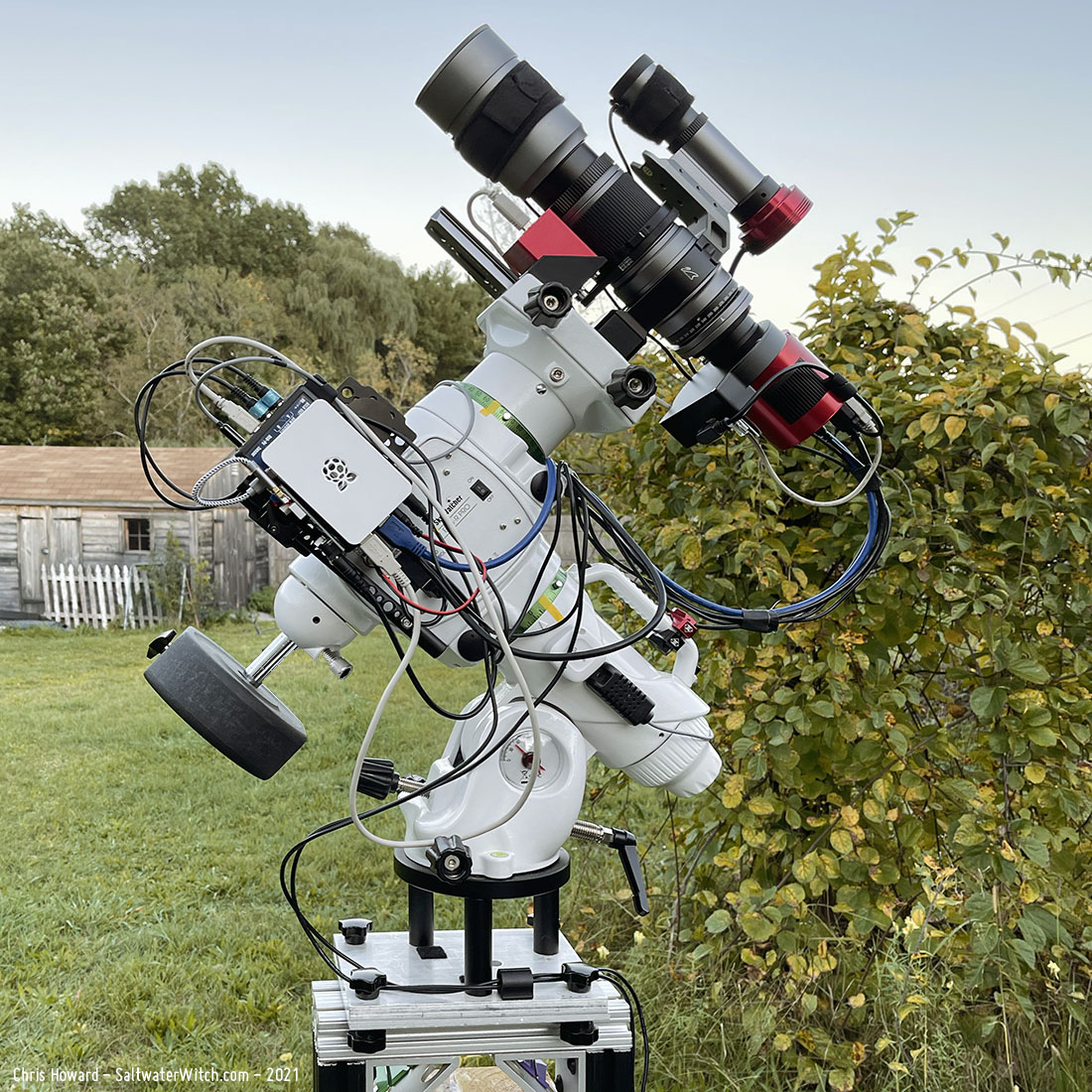
Here's my astro setup for the last couple nights, my wide-field narrowband rig, with the William Optics SpaceCat 51 APO refractor and the ZWO ASI1600MM-Pro monochrome camera, ZWO electronic filter wheel and autofocus. Sky-Watcher EQ6-R Pro equatorial mount. Controller: Raspberry Pi 4 4GB running INDI/Ekos/KStars.
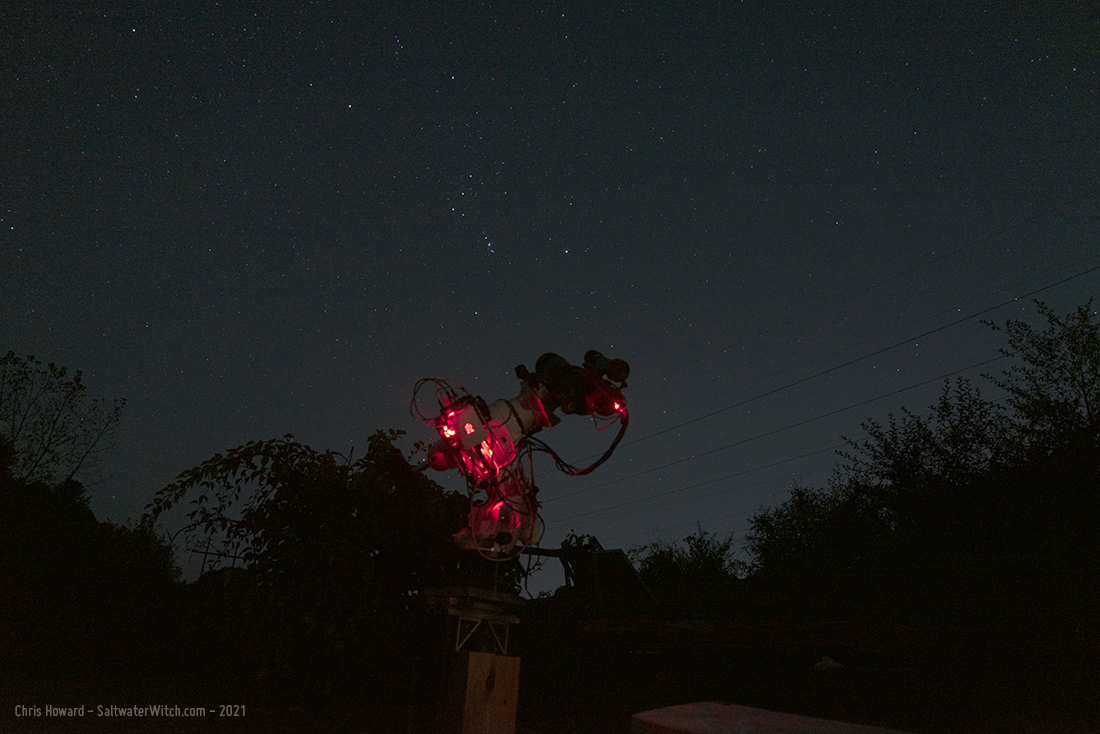
It was nice to finally have the new moon line up with some clear night skies! I'm shooting the Rosette Nebula in Monoceros, right next door to Orion, which I love seeing in the sky.
Posted October 8, 2021
Cygnus Wall in SHO
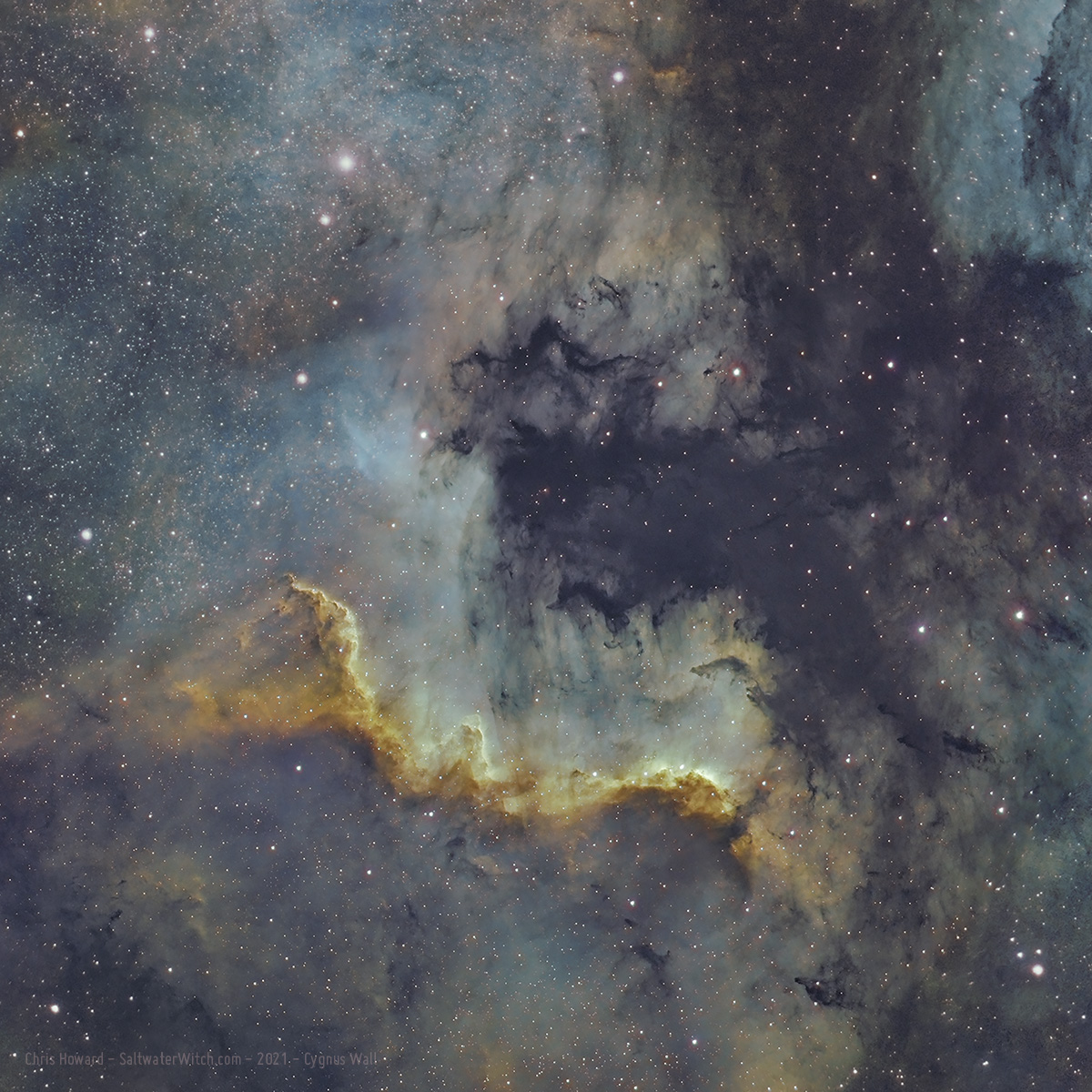
Narrowband North America Nebula (NGC 7000) in the Constellation Cygnus, with the "Cygnus Wall" across the lower third of the image. You're looking at about 130 trillion miles of dense clouds of ionized hydrogen, with a bit of oxygen thrown in. NGC 7000 is around 1600 lightyears aways, and the "Cygnus Wall" is about 20 light years long. Imaging notes: William Optics GT81 Apochromatic refractor, Astronomik 6-nanometer hydrogen-alpha (Ha), Oxygen 3 (OIII), sulfur 2 (SII) filters, ZWO ASI1600MM-Pro monochrome camera, QHY 5iii178 guide camera, Sky-Watcher EQ6-R Pro Mount.
Posted October 4, 2021
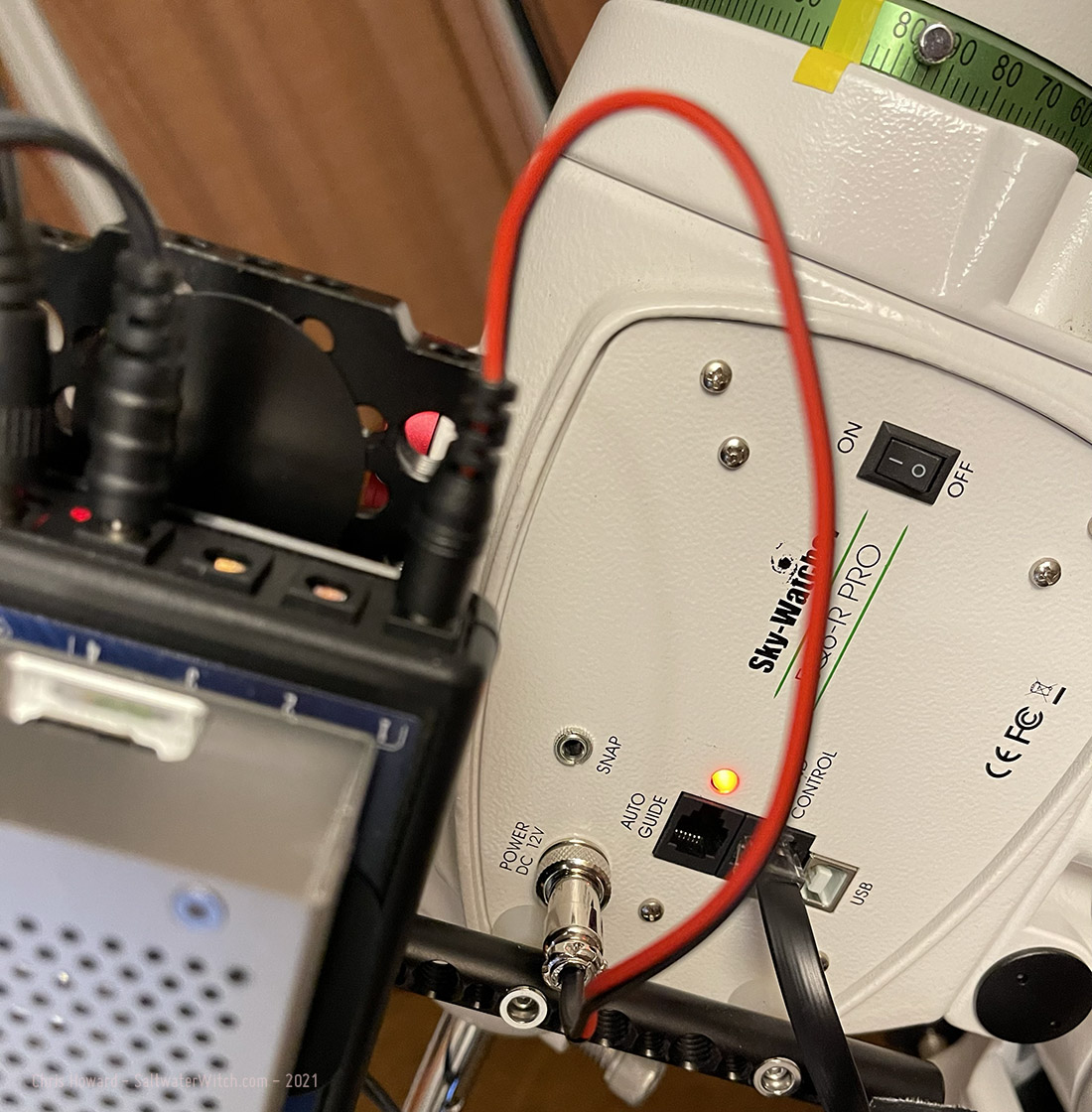
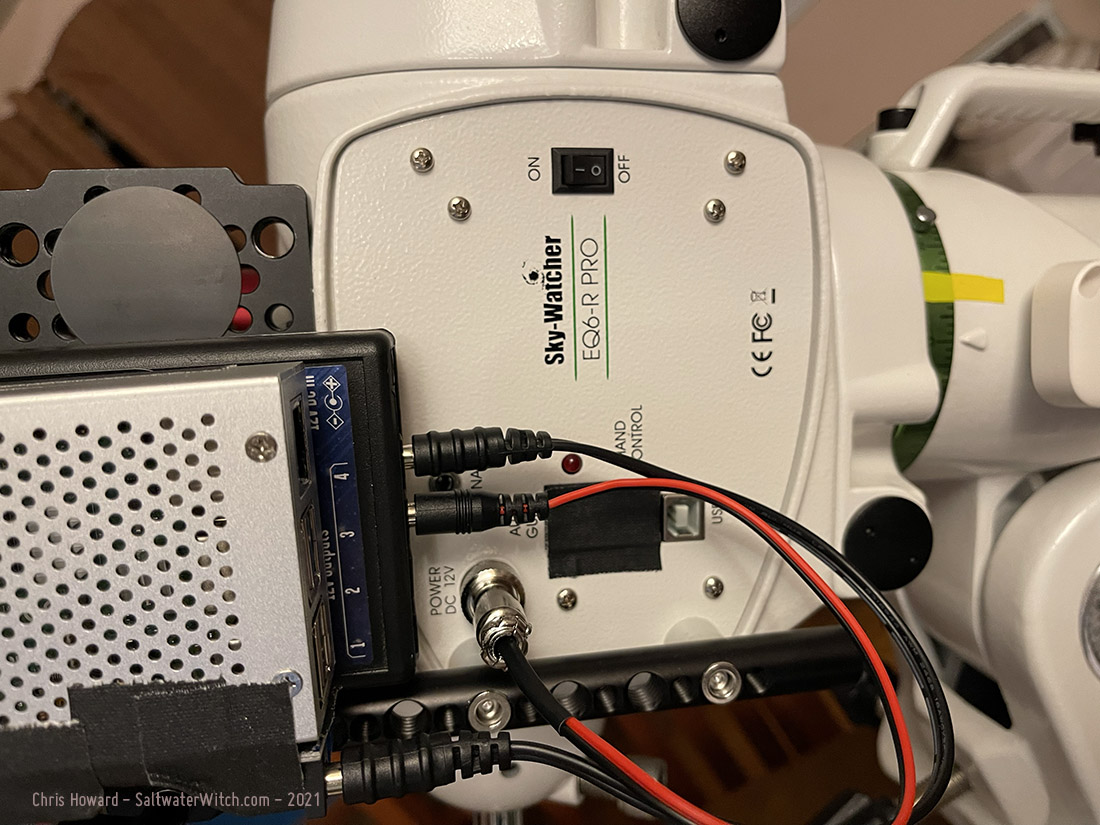
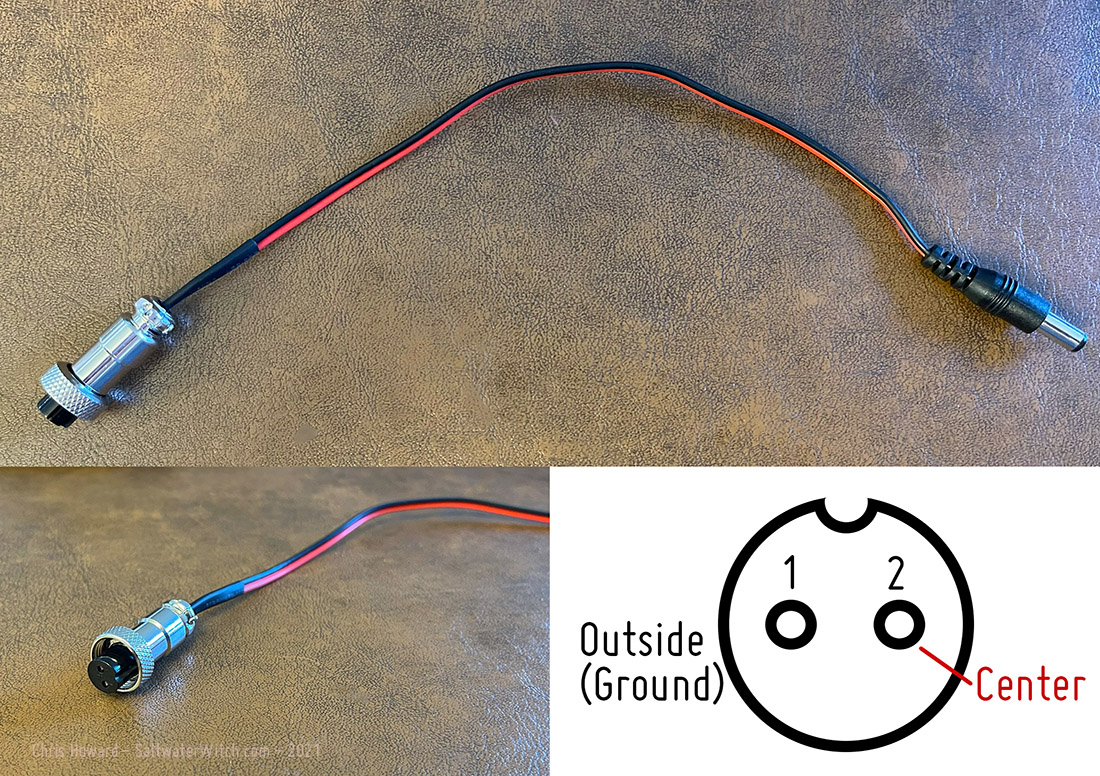
Custom power cable for the Sky-Watcher
Scrounged up a couple parts I bought a while back for this specific project, but just getting around to it now. The Sky-Watcher EQ6-R Pro telescope mount uses a 2 pin GX12-2 aviator plug for 12vdc power. I bought a couple off Amazon earlier this year, and today I soldered up the 5.5mm x 2.1mm power jack after testing which pin is ground and which has voltage. (https://www.amazon.com/dp/B07DC7KP8H).
I made this to supply power to the mount from my Pegasus Pocket Powerbox, which I have on a 15mm rail and SmallRig aluminum cheese plate (https://www.amazon.com/dp/B019C2ZM8Q).
Here's the cable plugged into the Pegasus PPB, powering the Sky-Watcher mount. Tested and woks beautifully!