M51 - Better Processing & More Info
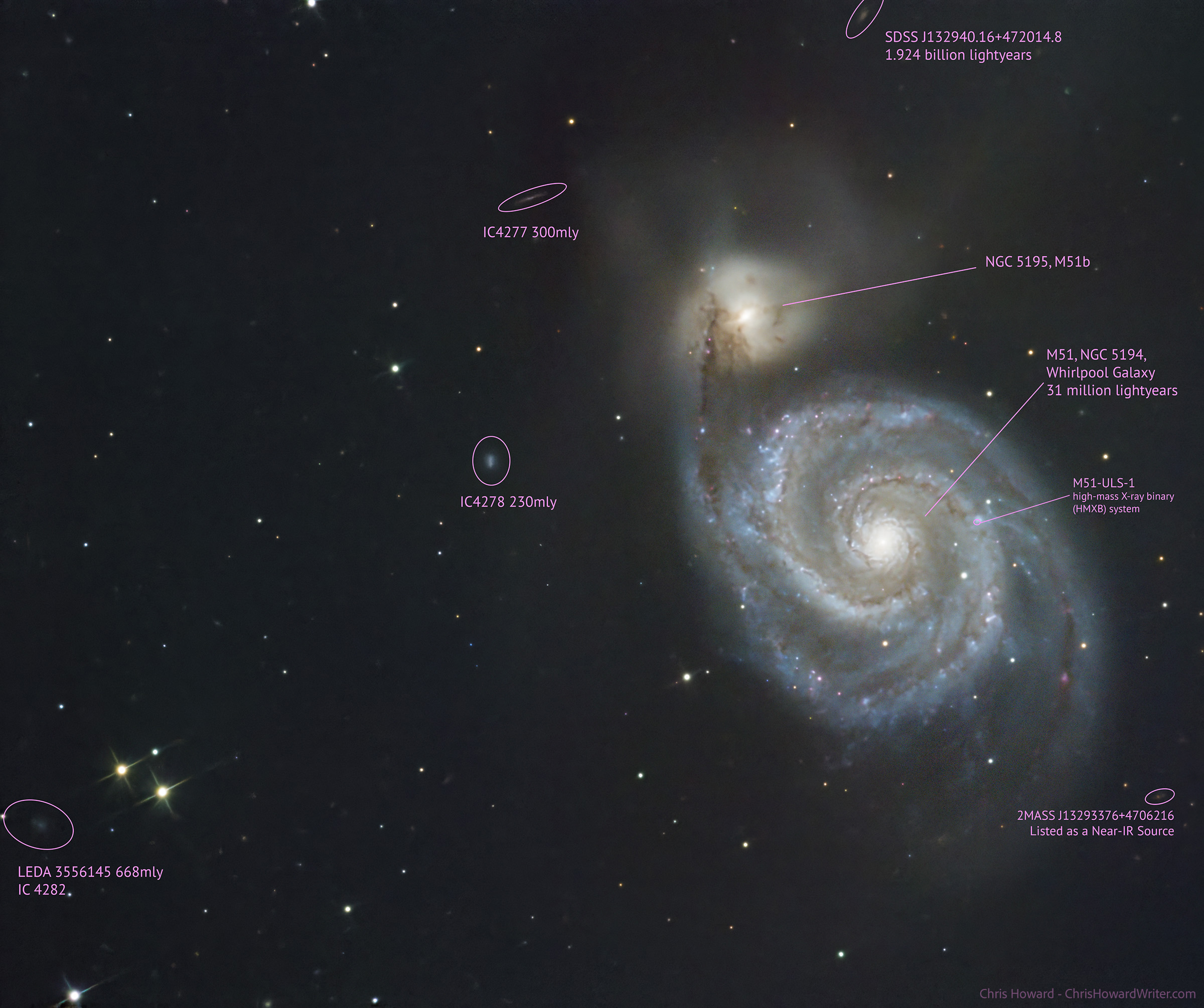
Same imaging data, better processing. I stretched the last one a bit too far, blowing out the galaxy core. M51 is bright, so you don't need really long exposures, and over a hundred two-minute subs is perfect for capturing all that dust and faint structure while keeping the bright core intact. The stars are still pretty wonky around the edges. That might be collimation, but I'm also not using a field flattener--didn't think I'd need it with the Sony IMX715 being such a small camera sensor.
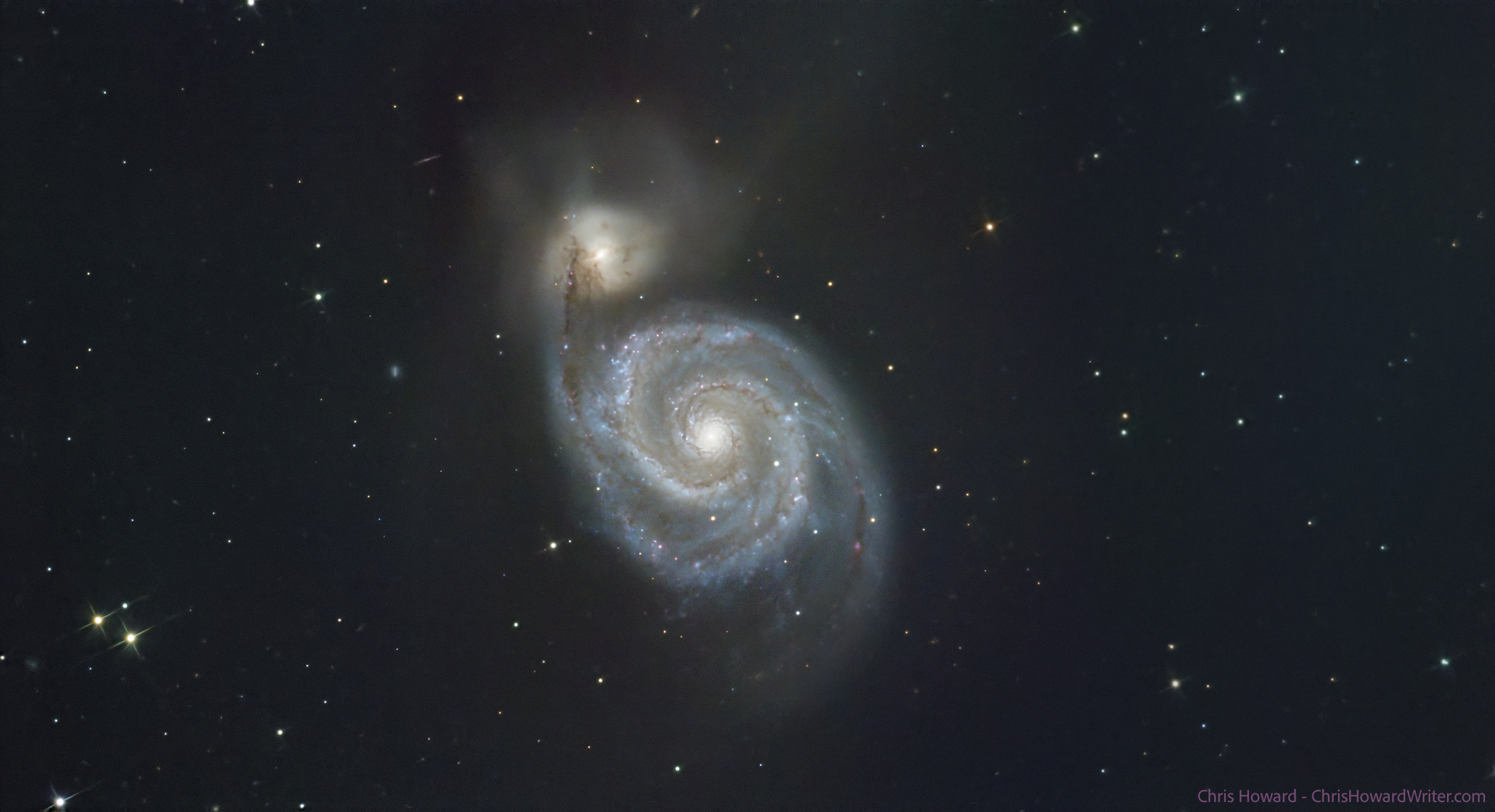
Other galaxies (and other interesting objects) in the frame
I started here: https://aladin.cds.unistra.fr/AladinLite/?target=ic455&fov=1.49&survey=P%2FDSS2%2Fcolor
IC4277 300mly (left, top of M51) edge-on spiral galaxy
IC4278 230mly (left of M51) smudged, vertical bar left of M51
SDSS J132940.16+472014.8, 2MASX J13294019+4720147, USNOA2 1350-08286567, PGC 3556035 1.924bly, mag 18 galaxy (top, middle, above M51, almost out of frame), http://ned.ipac.caltech.edu/cgi-bin/nph-objsearch?search_type=Near+Position+Search&in_csys=Equatorial&lon=13+29+40.19&lat=+47+20+14&radius=0.1
LEDA 3556145, SDSS J133119.76+471101.9, IC 4282 668mly (lower left in the frame) https://simbad.cds.unistra.fr/simbad/sim-id?Ident=LEDA%203556145%20
2MASS J13293376+4706216, Listed as a Near-IR Source (λ < 3 µm)
M51-ULS-1, RX J132943+47115, high-mass X-ray binary (HMXB) system, with candidate exoplanet named M51-ULS-1 b, https://en.wikipedia.org/wiki/M51-ULS-1, https://www.universetoday.com/articles/astronomers-might-have-found-a-planet-in-another-galaxy
Posted March 19, 2026
M51 - Whirlpool Galaxy
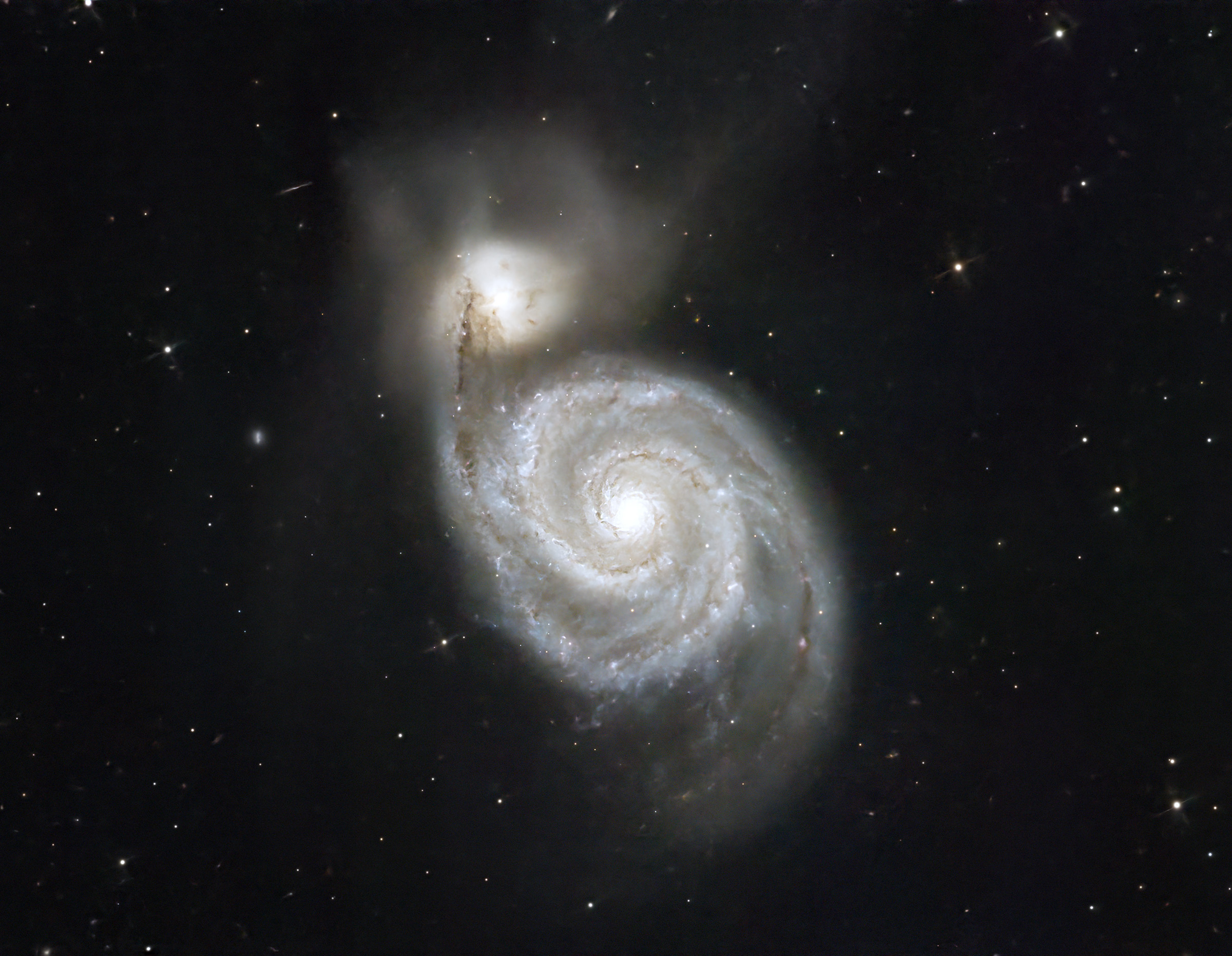
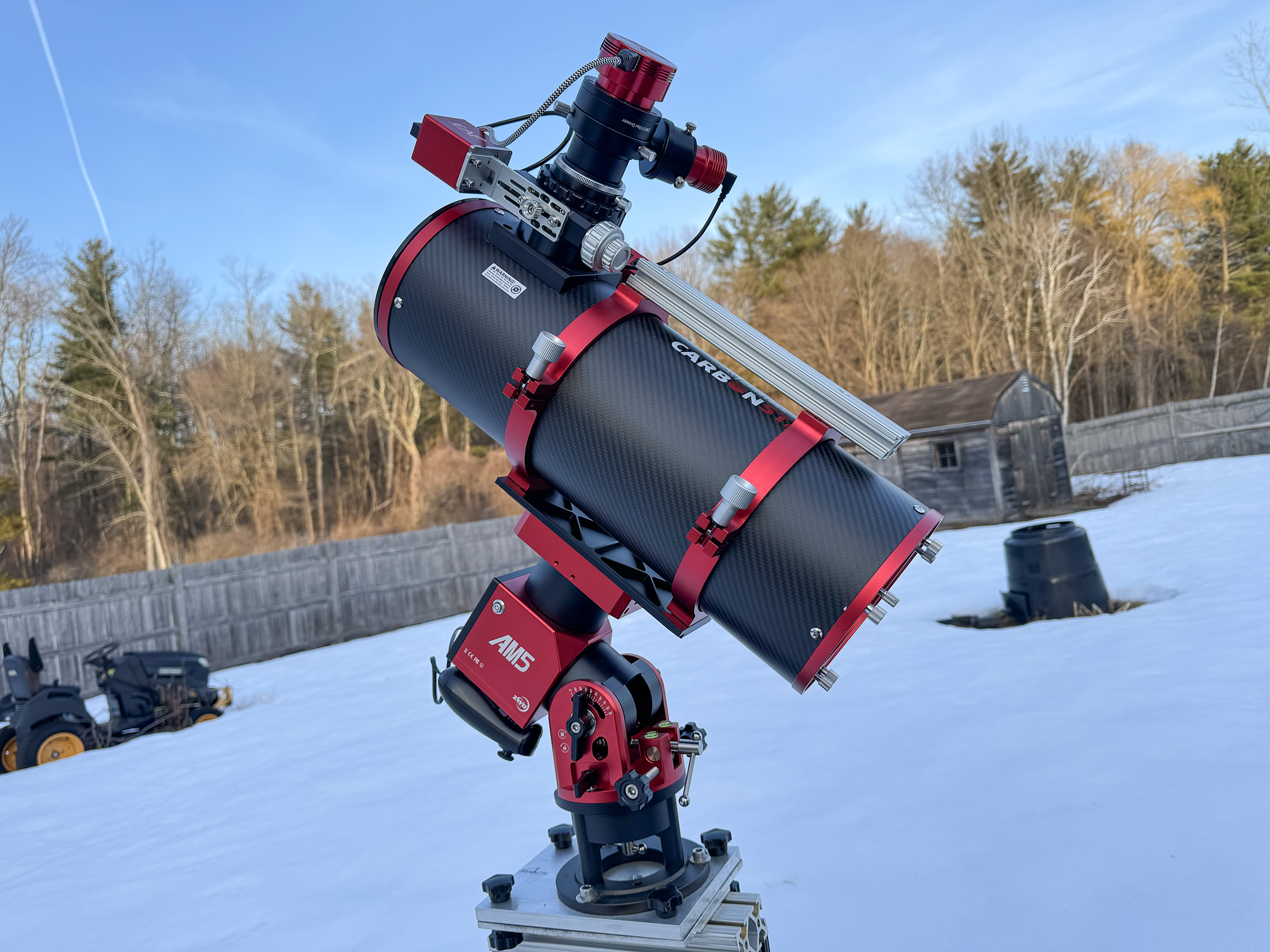
Whirlpool Galaxy from my backyard using a $229 color camera. I captured 133 120-second subs of M51 last night with the ZWO ASI715MC camera and the Apertura CarbonStar 150 (600mm focal length). I stacked 115 good subs, no calibration frames, and the result is pretty good.
Trouble I ran into with this combination--ASI715 + 600mm OTA:
- I had serious trouble plate solving with a resolution: 0.5"x0.5" per pixel and a Field of View of 0.54° x 0.3°. It may have worked once and I found my FL set to 505mm on the 600mm scope, but I couldn't get any plate solving to work for polar alignment or after a meridian flip. The ASIAir minimum FoV is 0.4° for solving (possibly 0.2°), and I don't see a way to help that out. I will try blind solving next time I'm out, setting the focal length for plate solving calculation to 0, which lets the ASIAir run through a series of FLs to solve.
- Focusing worked as well as can be expected with the 0.5 arcseconds per pixel resolution, but stars are bloated and very soft, oversampled.
Posted March 18, 2026
M51 - Whirlpool Galaxy
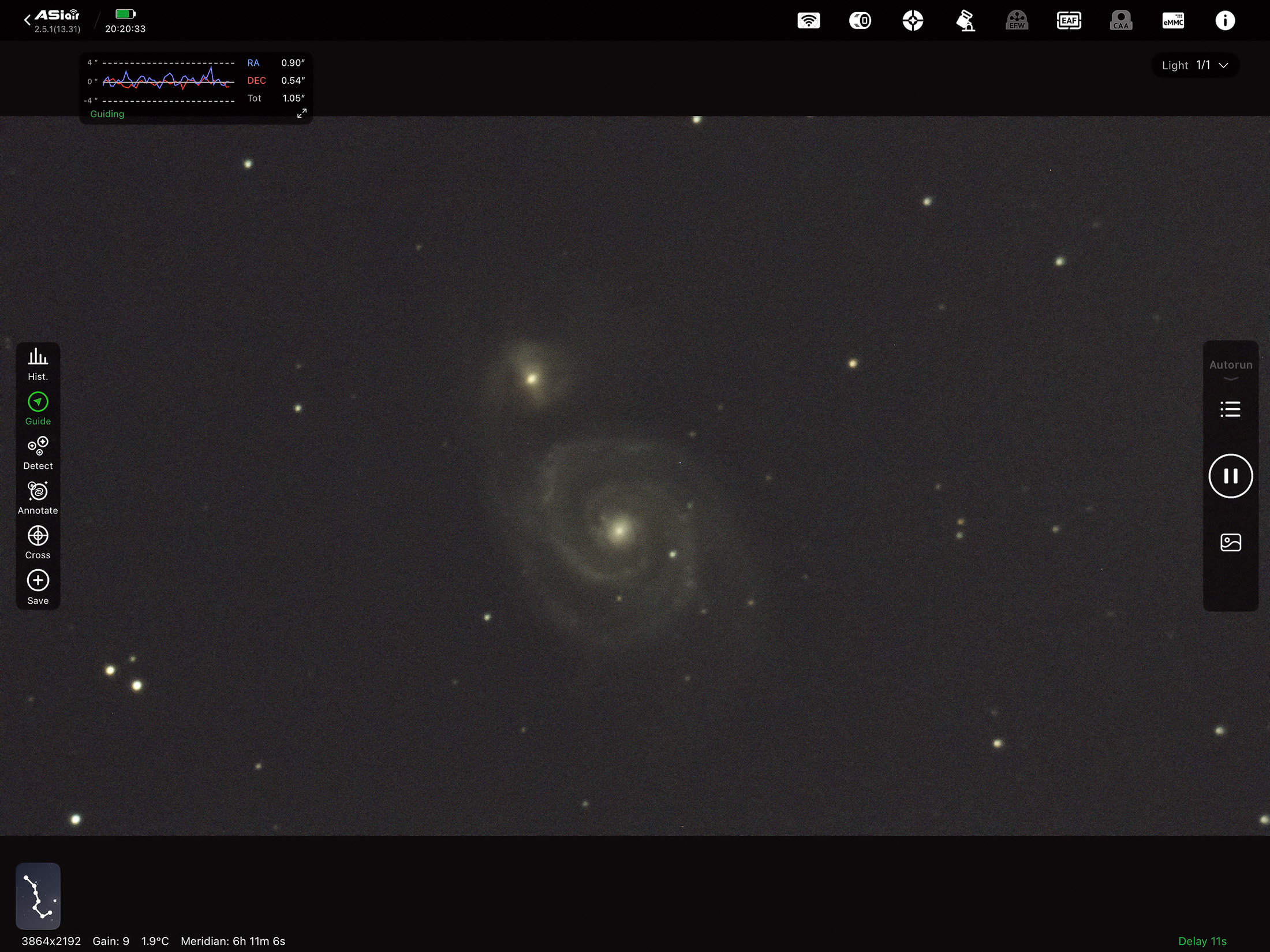
One sub from tonight's test session. I'm playing around with the ZWO ASI715MC on the 600mm focal length CarbonStar 150. Seeing is crap, guiding is terrible, but I'm going to take as many 120 second subs as I can and see how it turns out. M51 and it's companion galaxy (NGC 5195) are about 25 million lightyears away. With this camera-scope combination, I'm running at 0.5 arcseconds per pixel, which is why the stars are bloated. I'm 11 subs into this imaging run and the galactic structure is pretty good. Half the fun of astrophotography is trying some crazy camera and scope combos just to see it works.
Posted March 17, 2026
Astro Session, March 10
Astro setup tonight. We still have some snow, even with the warmest day we've had in a while, high of 74F/23C. I don't know if the weather's going to hold, but I might start on M51, Whirlpool Galaxy with the Apertura CarbonStar 150 (150mm diameter primary mirror, 600mm focal length at f/4) and the ZWO ASI715MC, which isn't the best camera for this, but we'll see how it does. I also have the ZWO ASI220MM off-axis and the 2inch Antlia UV/IR cut filter in the drawer.
Posted March 11, 2026
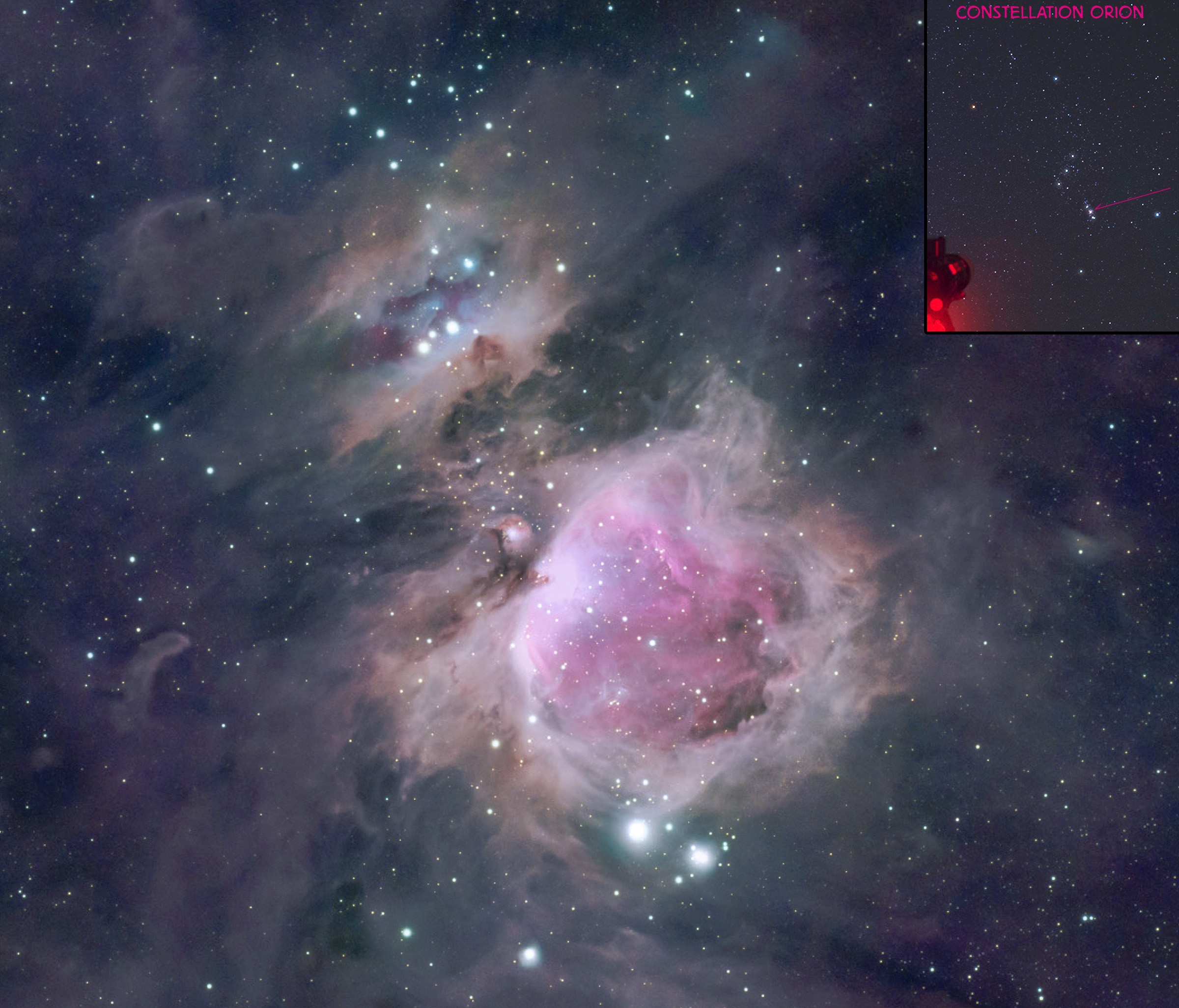
M42, Orion Nebula
I went through some of my astro imaging data and processed this set focused on M42 in the Constellation Orion. William Optics SpaceCat 51 and ZWO ASI071MC-Pro cooled camera.
Posted February 28, 2026
The Tulip in Hydrogen-alpha
The Tulip in Hydrogen-alpha: Tulip Nebula Sh2-101 and the surrounding HII region in Cygnus, centered on the open star cluster NGC 6871. Most of this is around six or seven thousand lightyears away from us, and to give you a sense of the size of this region: that bright tulip shape is over 600 trillion kilometers wide (top to bottom in this rotation).
Gear details: William Optics SpaceCat 51 Apochromatic refractor (250mm fl, f/4.9), ZWO ASI2600MM-Pro cooled monochrome camera, ZWO AM5 Harmonic Drive EQ mount, Antlia 3nm Ha filter, 60x300-second subs, 5 hours total integration time. Location: my backyard, coastal New Hampshire, US.

Posted August 3, 2025
Astro Session - August 1st
The Space Cat was already set up and ready to go, so that's what I'm imaging with tonight. The William Optics Space Cat 51, 250mm Focal length, F/4.9 Petzval Apochromatic Ref. and the ZWO AM5 Strainwave EQ mount on the backyard pier. I have the ZWO ASI2600MM-Pro Monochrome camera with the 3nm narrowband 48mm filter set on tonight, Ha, OIII, SII, but haven't picked a target yet!


Posted August 1, 2025
IC1396 in Cepheus
The IC1396 Region with the Elephant's Trunk in HaOIIISII narrowband. The view from my backyard, given a specific set of equipment, time, and clear skies: around 60 x 300-second exposures for each of the 48mm Antlia 3nm Ha, OIII, SII filters, ZWO ASI2600MM-Pro monochrome camera cooled to -10C, William Optics Space Cat 51 apochromatic refractor (250mm FL @ f/4.9).

