SpaceCat 51 Autofocus
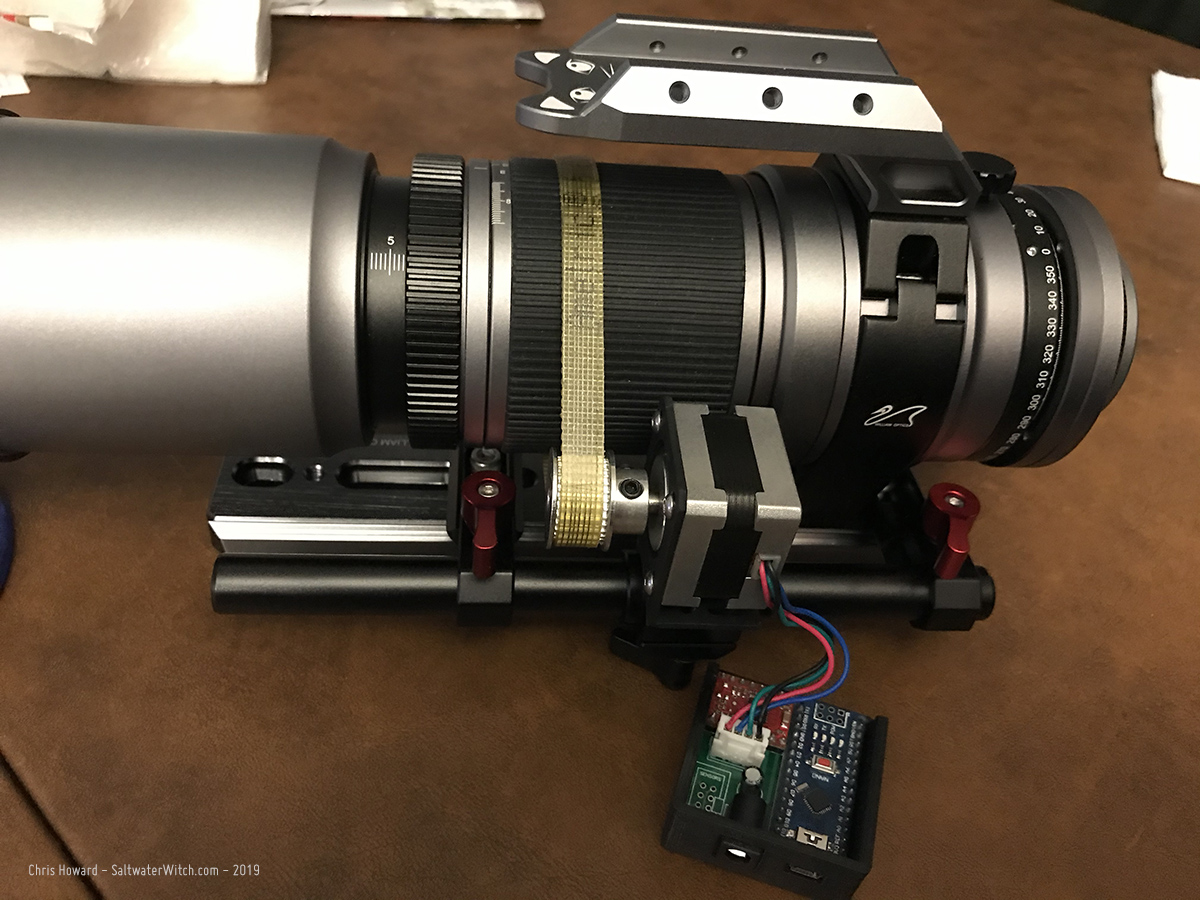
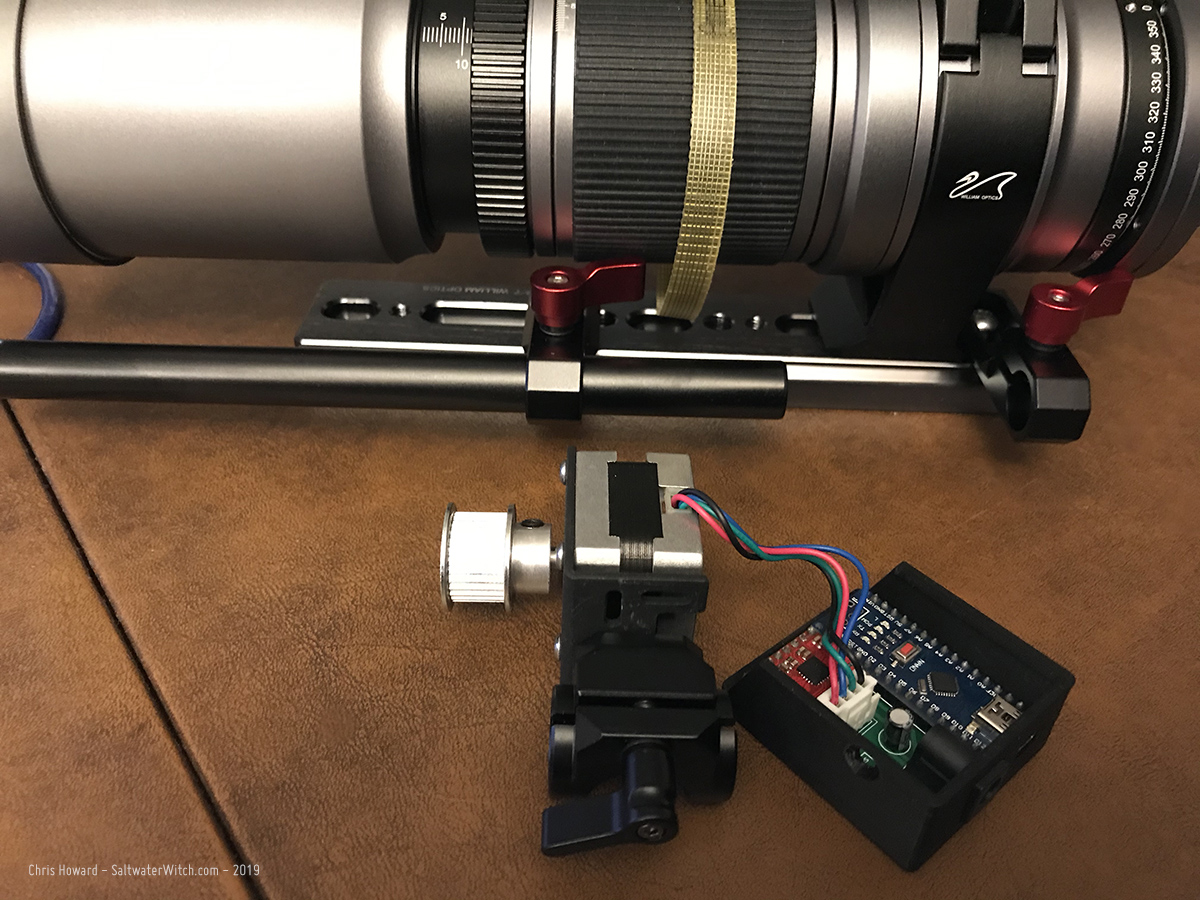
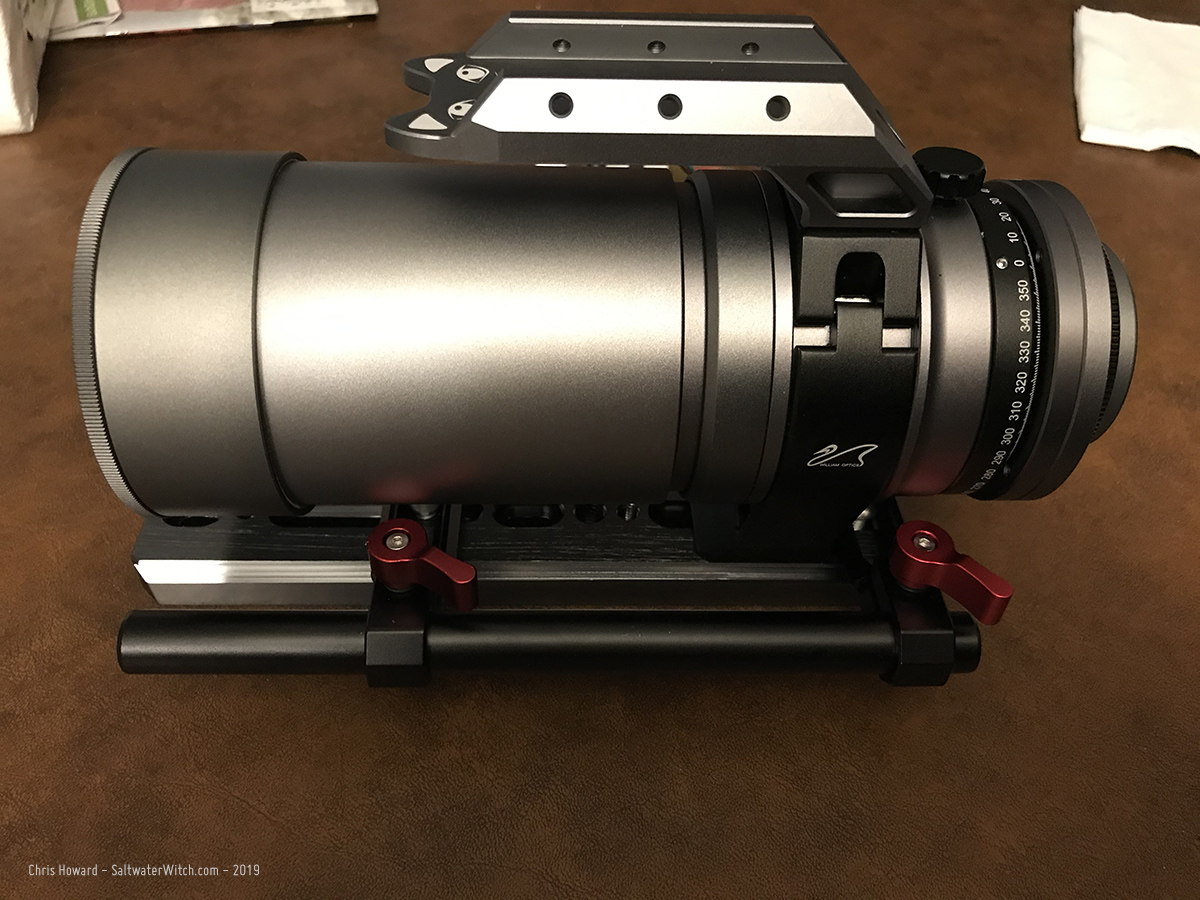
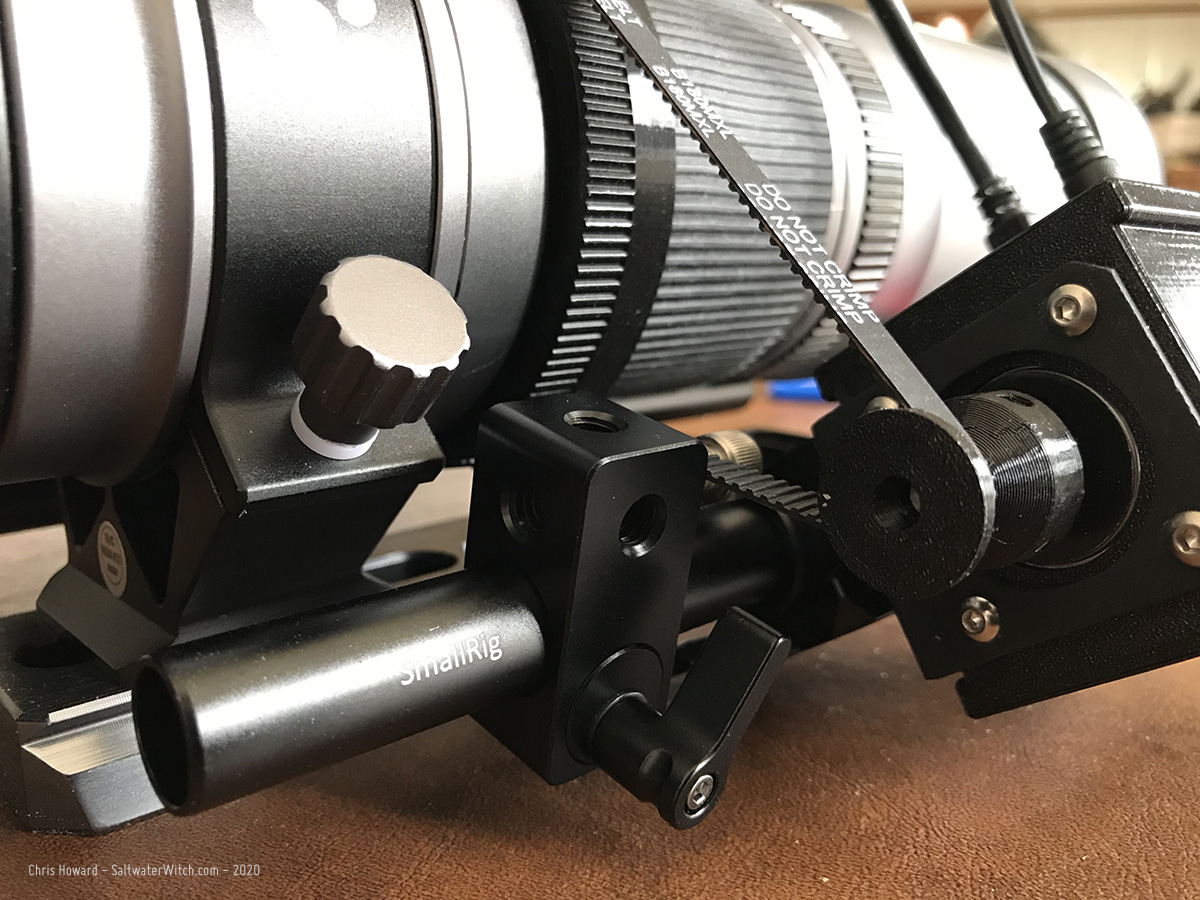
Another autofocuser configuration I'm trying out with the William Optics SpaceCat51 and the Deep Sky Dad AF3 stepper and focus ring. The goal is portability, and I have the motor and controller bolted to a guide-scope shoe that can be easily added or removed from the scope. I 3D printed a tension adjustment bracket--that's the gray half-cylinder piece on the opposite side of the handle.
Posted May 9, 2020
Andromeda from the Galactic Edge
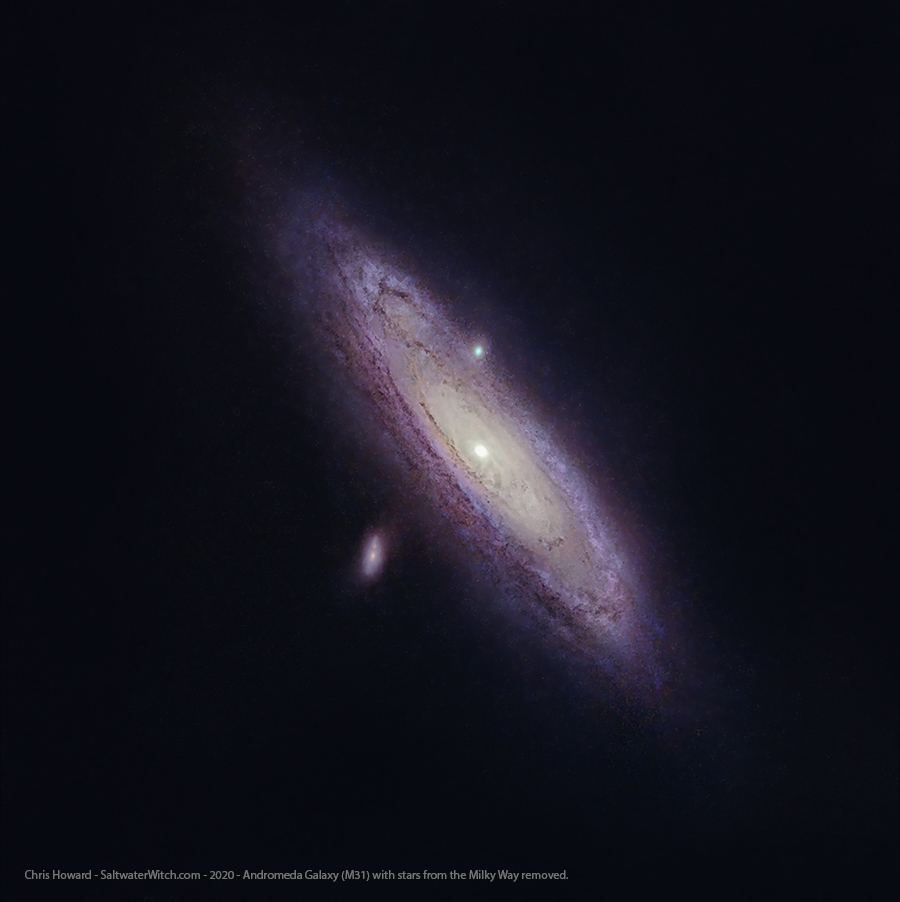
Here's the Andromeda Galaxy (M31) without the stars and other clutter from our own galaxy in the way. I have processing tools that will algorithmically remove stars from an image, and it does a reasonable job. What I'm showing here is what Andromeda would look like if you could travel from our location on the Orion Spur (a minor branch off one of the Milky Way's spiral arms), pass through the Perseus Arm, to the edge of our galaxy, and then take some pics of M31. Our star, the Sun, sits in the middle of one side of our galaxy. We are so used to seeing a star field in astro images we do not realize all the stars we can see in the night sky--with our eyes, are in our own galaxy. Some of those pinpoints of light are galaxies themselves but are so far away they appear no different from stars to our eyes. In this image of M31 the two star-like objects above and below Andromeda are M110 (larger, below) and M32 (above). These two are actually satellite galaxies that orbit Andromeda. Yes, just as stars have planets, and planets have moons, large galaxies can capture other galaxies in their gravitational pull. Our galaxy, the Milky Way, has several in orbit, including the Large and Small Magellanic Clouds.
Posted April 28, 2020
Updated William Optics SpaceCat 51 setup with Autofocus
If you have seen some of my videos and blog posts on the Cat you know I have two astro camera trains, one color, one narrowband. This one consists of a ZWO ASI1600MM-Pro mono, ZWO ASI filter wheel with Astronomik 6nm HA, OIII, and SII filters, along with a CLEAR in slot one, and a near-IR filter in the fifth position.
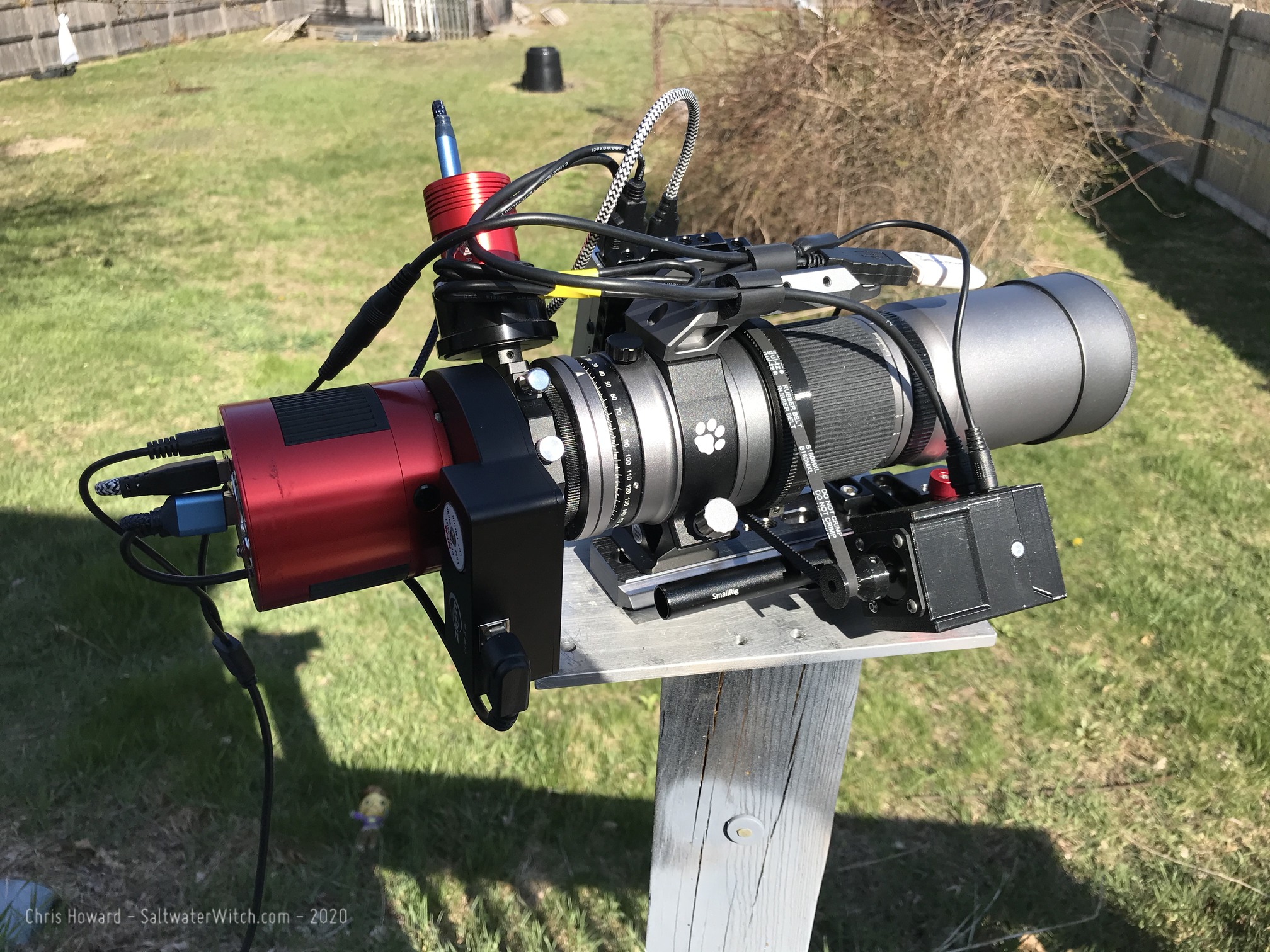
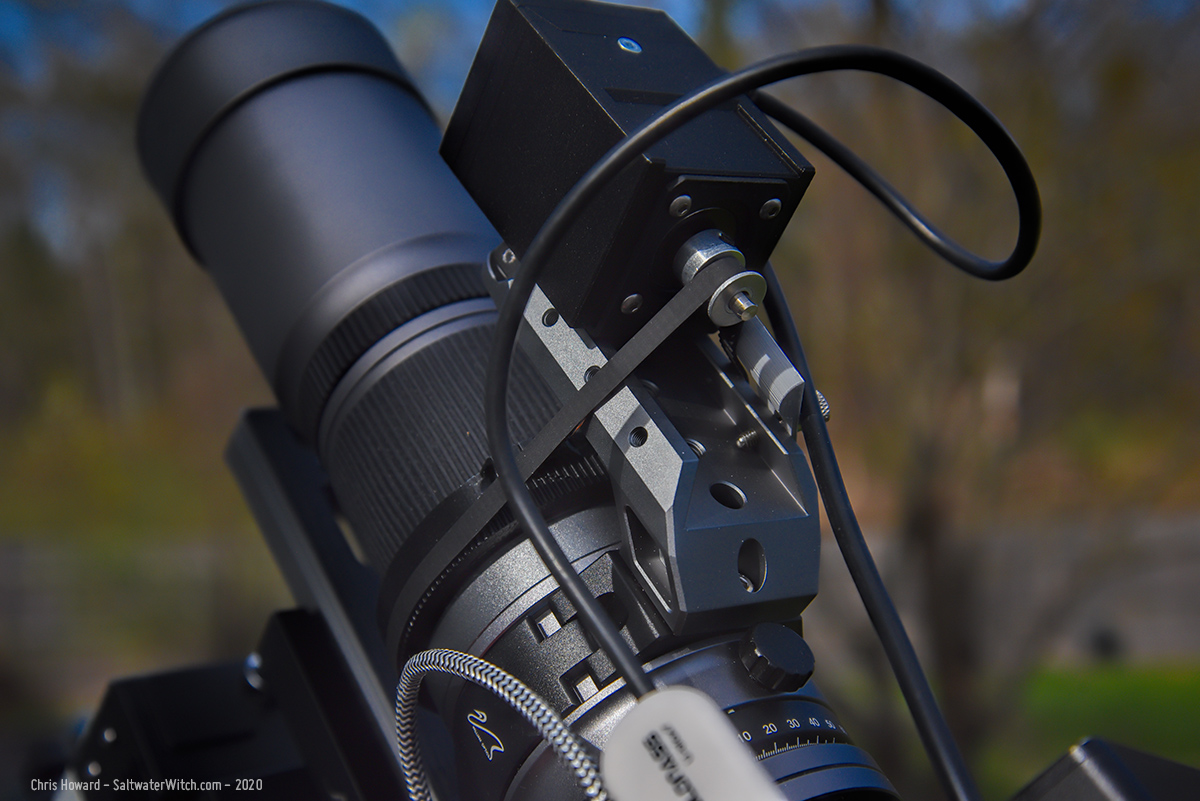
Another reason I want to show off this setup is the single-power wire config. Everything else is on the scope or controlled wirelessly--for example, the iOptron CEM25P or my Orion Atlas can be controlled by Ekos through wifi or bluetooth.
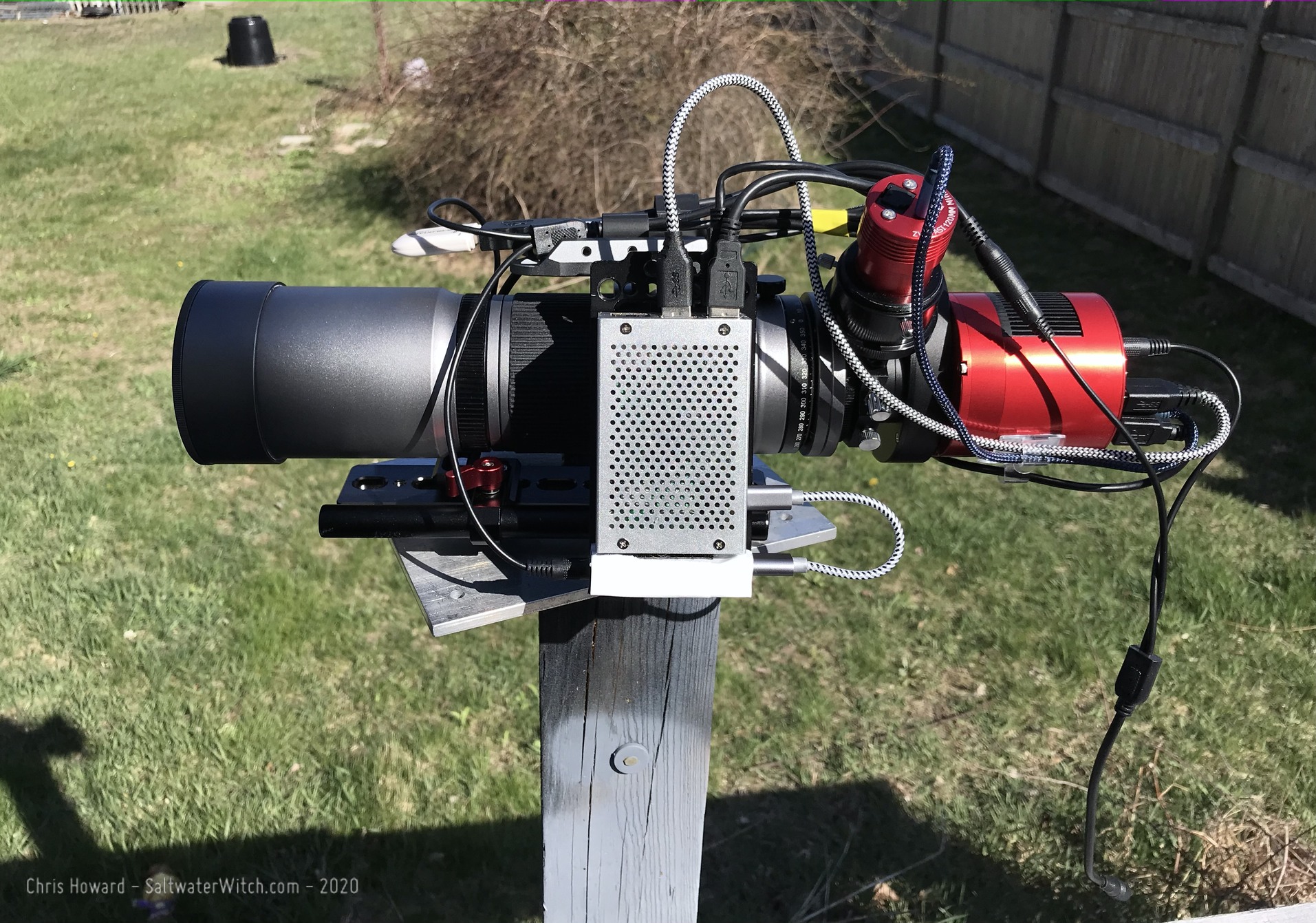
I shot some beautiful color images earlier this year and late last. I'll show M31 and a couple others later, but with that color setup I was running multiple power cables and a heavy duty USB cable to the scope, and although this is setup, which I will try out as soon as it clears up, looks a bit cluttered, I want fewer cables running from cameras, controllers, focusers, and other devices. Fewer cables reduces the chance of one of them hanging up on the mount, or swinging just enough with a gust of wind to throw guiding off.
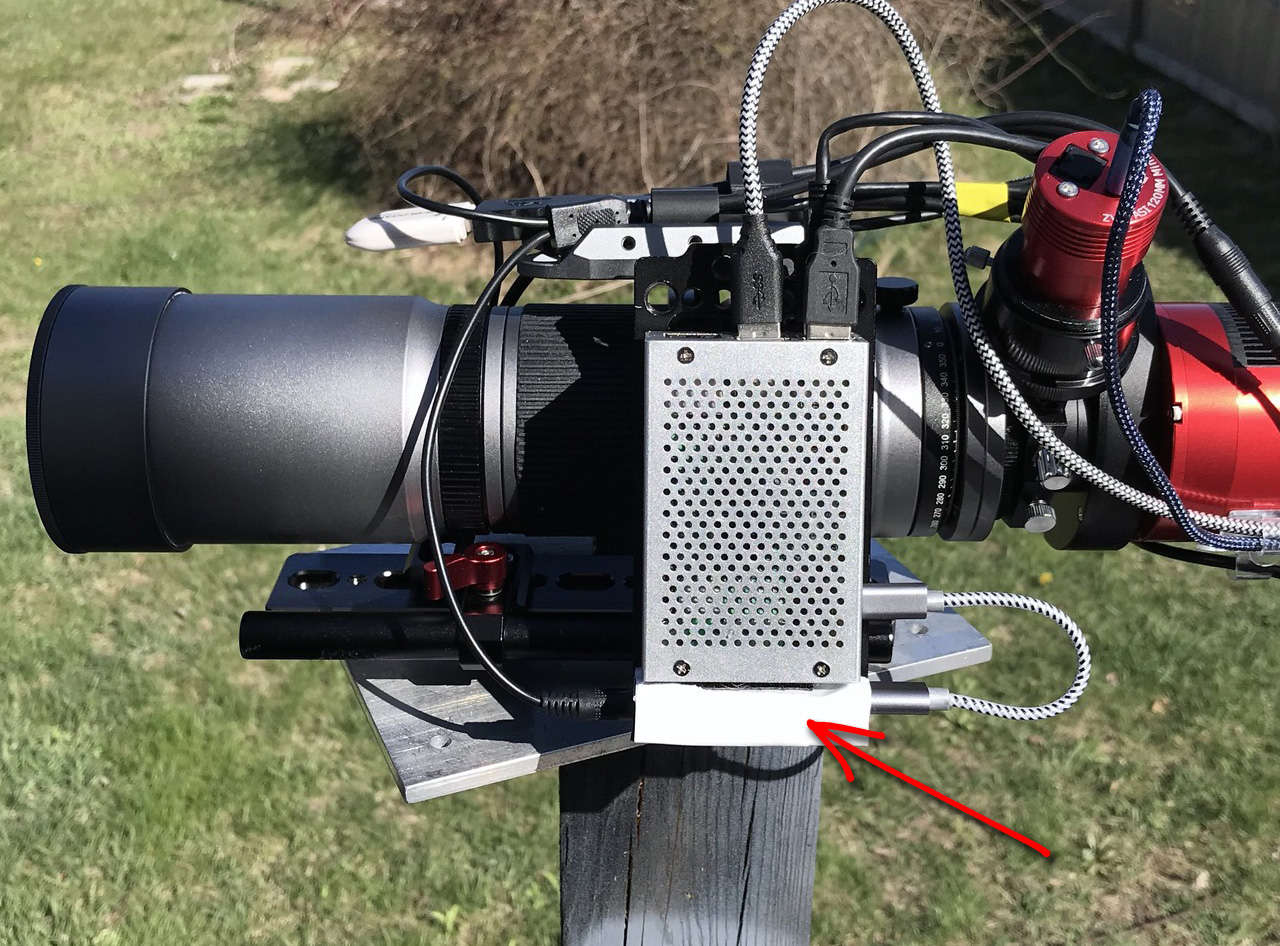
The controller--the aluminum box on the left side is a Raspberry Pi 4 with 4 gigs, running INDI, Ekos, KStars. I remote into this just like I would with with Windows to run Sequence Generator Pro. The only difference is this box is mounted to the scope. I am looking at running my Windows-based astro controller and sequencer stuff on a similarly small single board computer, and then I can just swap out one system for another. 4 USB ports on the Pi, though, really does make things easier.
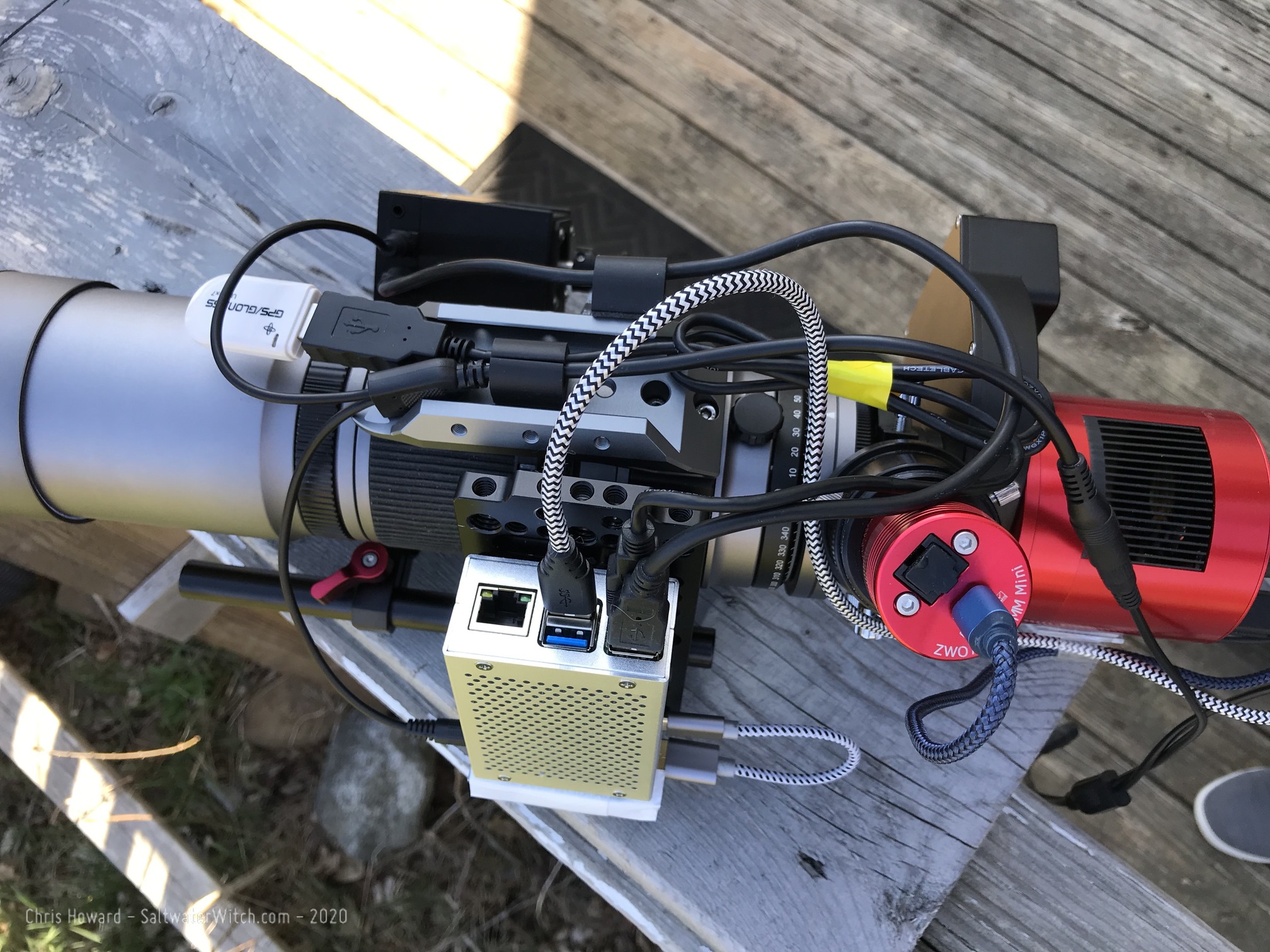
I am using the DeepSkyDad AF3 belt-drive autofocus, with the helical focuser timing belt ring made for the cat. I think Pavle at DeepSkyDad sells the components by themselves if you're interested in doing something like this. The rest of it is made up of various SmallRig camera rails, clamps, and support pieces.
I also have GPS via a USB dongle to automatically get accurate date, time, longitude, latitude, and altitude for Ekos and KStars.
Of course, as is typical, I'm ready to go and the weather's supposed to cloud over in the next couple hours, right around sundown. Hmmm. It's almost as if there's a conspiracy.
I don't normally need dew control this time of year and maybe halfway through the summer, but I will add a dew heater when I need to, but still keeping with a single 10 - 15 amp 12 volt dc line in, and I'll see if that's enough to drive all the devices. Planning this stuff out is half the fun.
That white rectangular shape under the Raspberry Pi is a DC step down converter, taking 12v dc to 5v at 5 amps. The Raspberry Pi 4s need a bit more current then the older 3s.
Before I pack it up, I want to show off a couple astro images from a couple different imaging runs.
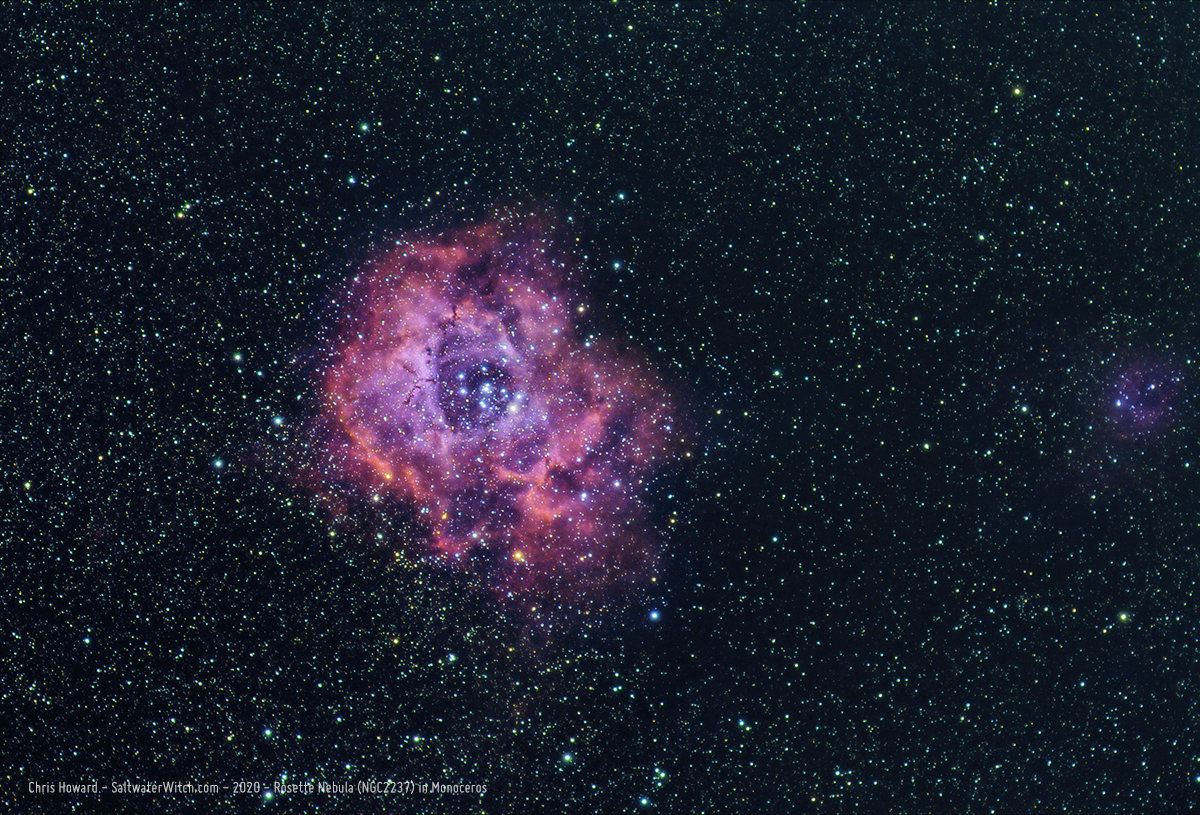
The first is the Rosette Nebula NGC 2237 in Monoceros, a large circular HII region. The open star cluster NGC 2244 has formed out of—and continue to form out of—the Rosette's abundance of hydrogen and other materials. NGC 2237 is about 5000 lightyears away from us, and it's about 130 lightyears across. That's Sh2-280 on the right, a dim diffuse nebula. Another one from my backyard with the William Optics SpaceCat 51 250mm FL APO refractor, iOptron CEM25P EQ mount, ZWO Astronomy Cameras ASI071MC cooled color camera, Celestron UHC/LPR filter. 13 x 2-minute exposures, 4 x 8 minute exposures.
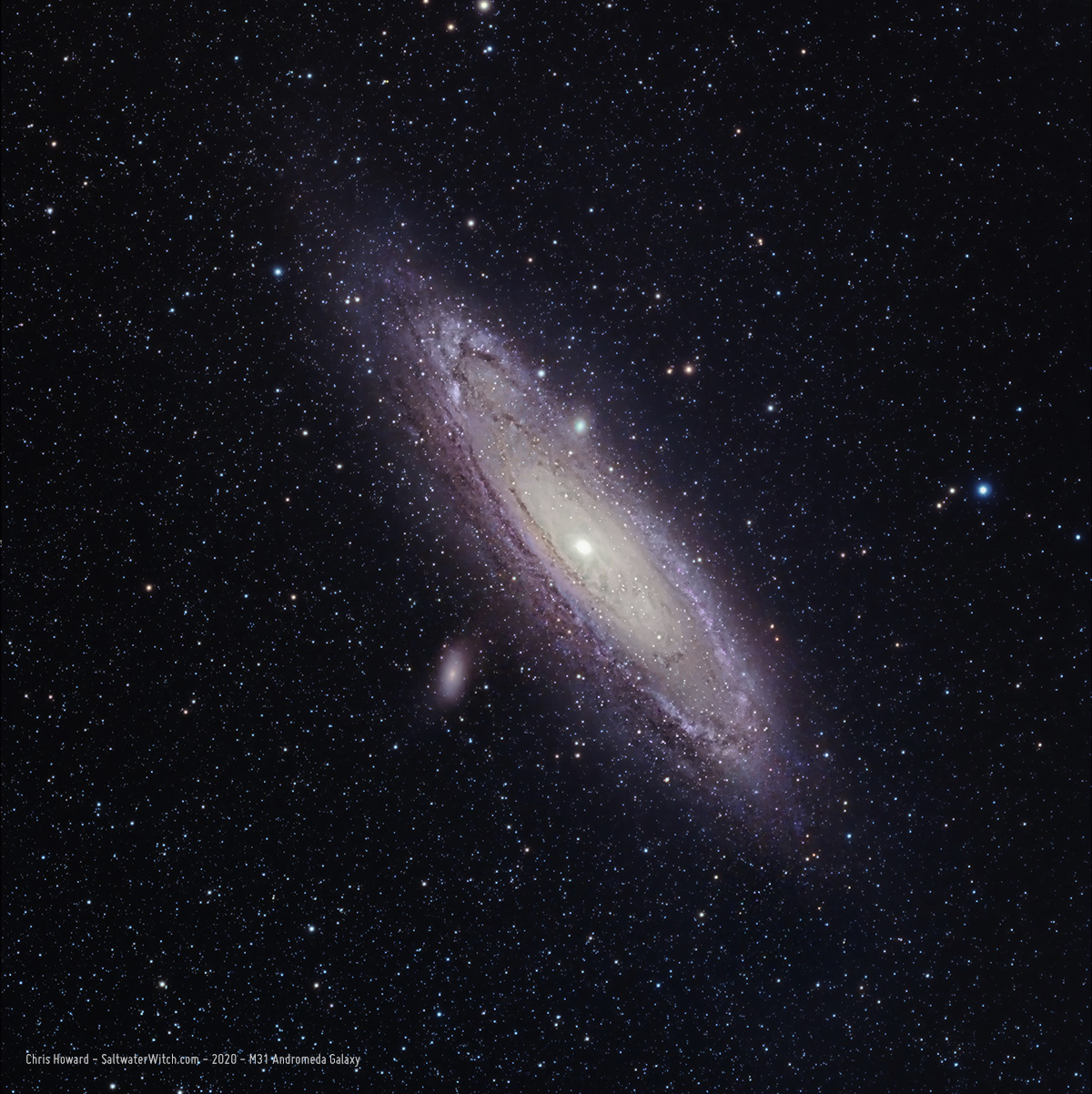
One more from my backyard with the WilliamOptics SpaceCat 51 refractor and the ZWO ASI071MC camera: the grandest of the galaxies, Andromeda, M31. Of course, there are millions of incredibly beautiful and strange—and even downright bizarrely structured galaxies out there in the universe, many within normal telescope distance, but in my opinion they don't come close to M31. You could argue the Pinwheel Galaxy (M101) is in the running because it is so perfectly positioned from our perspective, a wonderful top-down view of a spiral galaxy. But Andromeda is like the Platonic ideal of a spiral galaxy. M31 also happens to be our largest galactic neighbor. So at 2.5 million lightyears away, it's close by. It's also much larger than M101, with a trillion stars and a hundred thousand lightyear diameter. This is probably one of the first objects an astronomer or astro-imager in the northern hemisphere is going to view or capture. You can see it without a telescope on a clear dark night. Andromeda Galaxy was first documented by astronomer 'Abd al-Rahman al-Sufi in 964. He described it as a "nebulous smear" in his famous Book of Fixed Stars, which is exactly what it looks like without a telescope—and if you know where to look. It's in the constellation Andromeda, so that should get you pointed in the right direction if you're inclined. Note: This image is a combination of RGB color and near-infrared frames I captured earlier this year and late last year. I'm just getting around to processing them!
Okay, so that's it for now. Just a quick walkthrough of my narrowband rig with the William Optics Space 51 and autofocus. And with a single cable running to the setup. So, this setup really is plug in the power, polar align, and start taking subs.
Well, we'll see how easy it is once we get some clear night sky!
Posted April 26, 2020
The Wizard
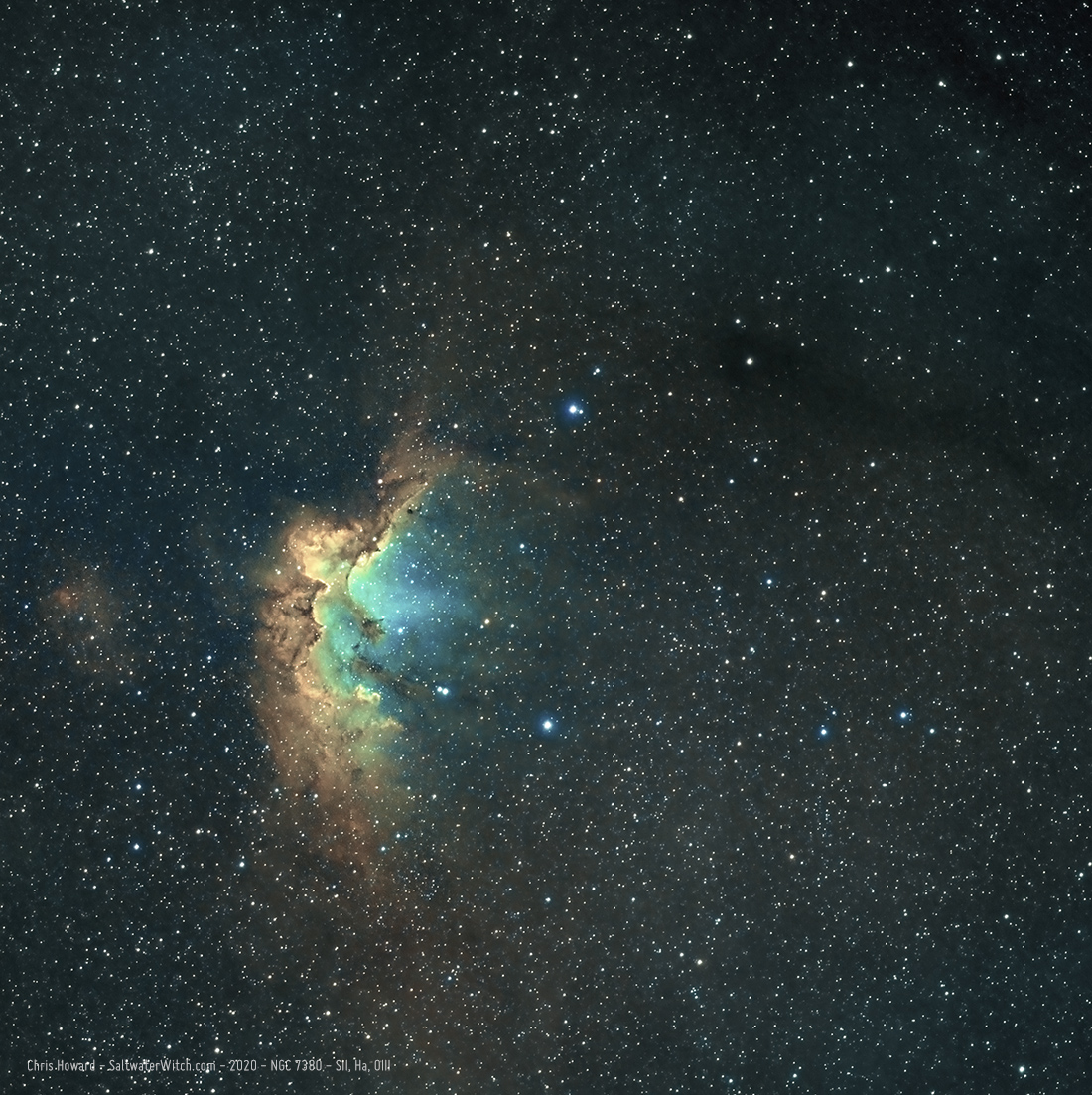
The Wizard Nebula in Cepheus surrounds the star cluster, NGC7380, discovered by Caroline Herschel in 1787. The Wizard is between 7000 and 8000 lightyears away from us, and the core star forming region is about 100 lightyears across. Notes: Shot from my backyard with a William Optics GT81, iOptron CEM25P EQ mount, Moonlite Focuser, ZWO ASI1600MM-Pro Monochrome Camera, Astronomik 6nm narrowband filters.
Posted April 25, 2020
Orion's Belt Region
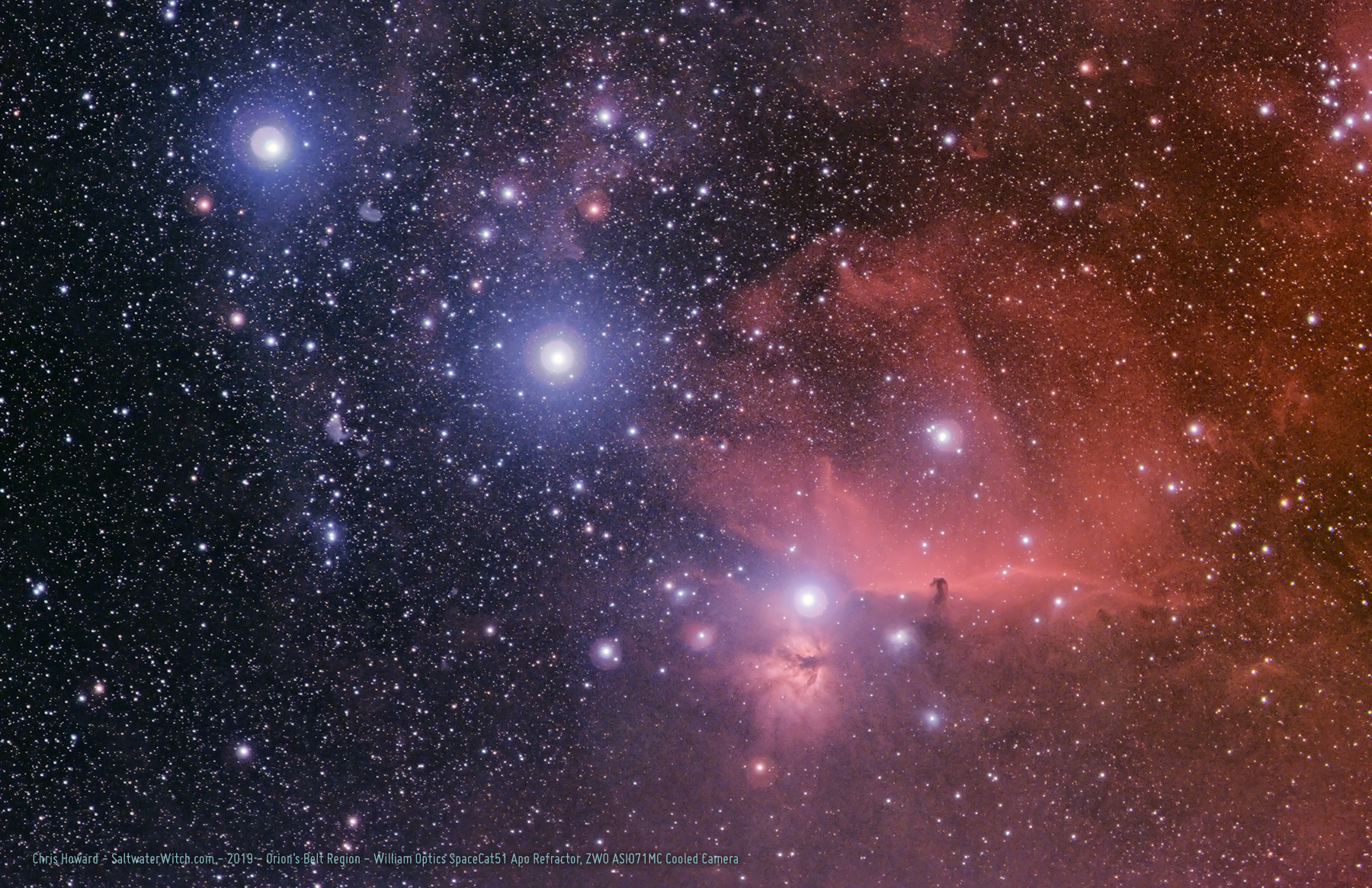
Here's another shot from last night's imaging with the William Optics SpaceCat51 Apo Refractor and ZWO 071MC cooled camera, a wide-field shot with all three primary stars in Orion's Belt or the Three Sisters, Alnitak, Alnilam and Mintaka. I say "primary" because Alnitak (bottom one in this rotation) is a triple-star system, Alnilam (in the middle) is a supergiant on it's own and is 375,000 times more luminous than our star, the Sun. Mintaka (top) is a double-star system and the two stars orbit each other every 5.7 days. So yeah, I'd like to see that up lose--two massive stars spinning around each other that quickly. Bottom right you can see the Horsehead Nebula (Barnard 33) and NGC 2024, the Flame Nebula to the left and a bit lower than the Horsehead with Alnitak between them. I used the Celestron UHC/LPR filter for these subs, and that's causing the halos around the brighter stars. I know the sticklers out there will think these are an abomination, but I'm okay with them, and I don't see halos as that much different from the diffraction spikes we get with our SCTs or Ritchey-Chrétiens. I mean the freakin' Hubble has diffraction spikes on the stars. I can deal with some haloing.
Posted November 3, 2019
Triangulum Galaxy
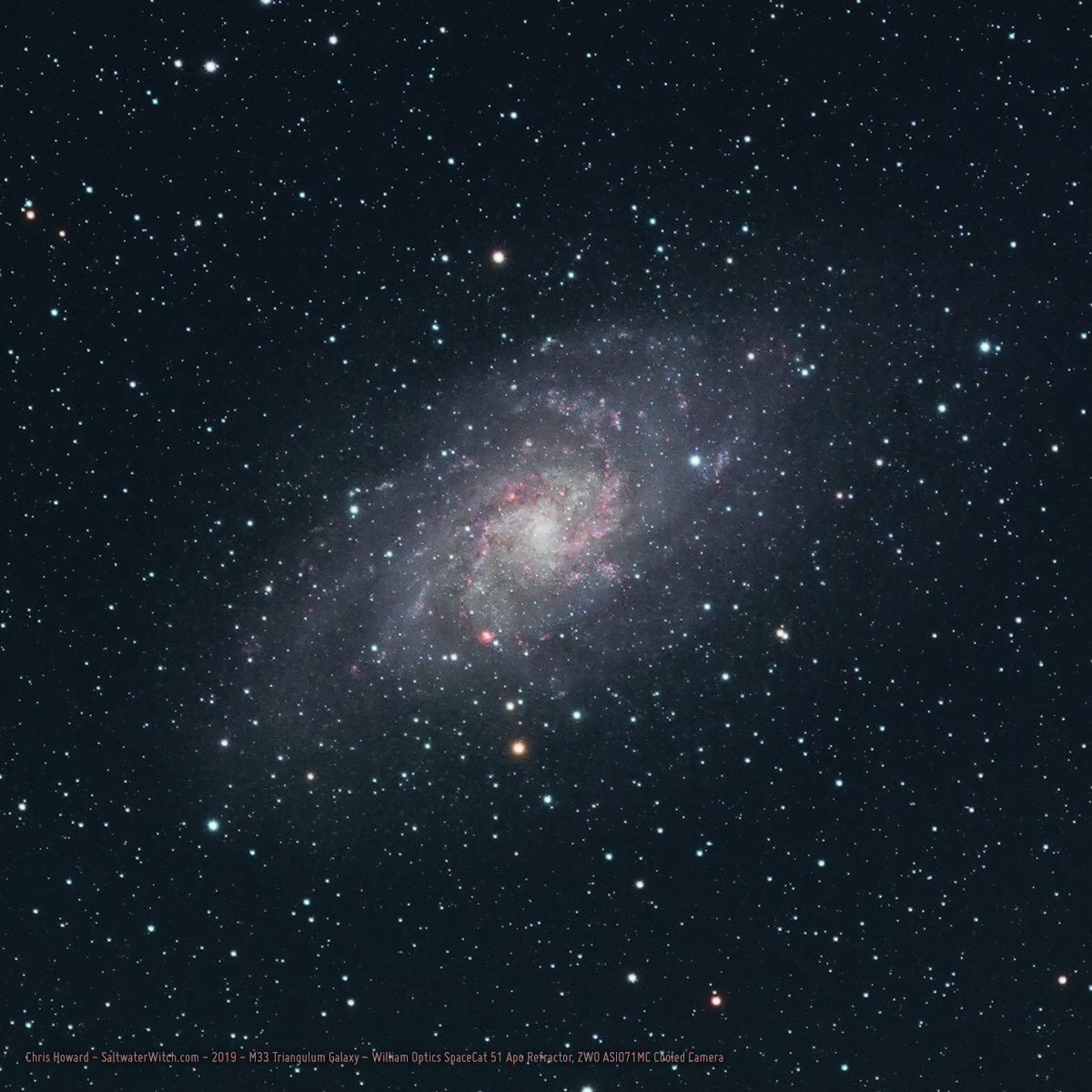
M33 Triangulum Galaxy with the William Optics SpaceCat and ZWO ASI071 Cooled Camera and a really old Celestron UHC/LPR filter with longpass bands at 450-550 and 600-700--not exactly the dual narrow band passes of a high-end color filter like the STC Astro Duo-NB, but the results are still pretty good. The filter does a decent job of bringing out the OIII and Ha color ranges, which would be washed out in the full mix of broadband with the IR/UV Cut filter (my normal broadband color config). M33 is about 2.7 million light-years away from us, and it's about 600,000 lightyears across, with 40 billion stars. With this bi-color filtered view the Triangulum shows off dozens of large HII regions at the red end of the spectrum--those are the red and pink masses distributed around the galaxy's spiral arms. My conclusion: you know there's some kick-ass deep sky astrophotography going on right now in any of the developed civilizations in M33. Not that we'll ever know for sure, you know, outside our light-cone and all that stuff. Well, not until we crack that thorny faster-than-light travel problem.
Posted November 3, 2019
More Color with the Cat
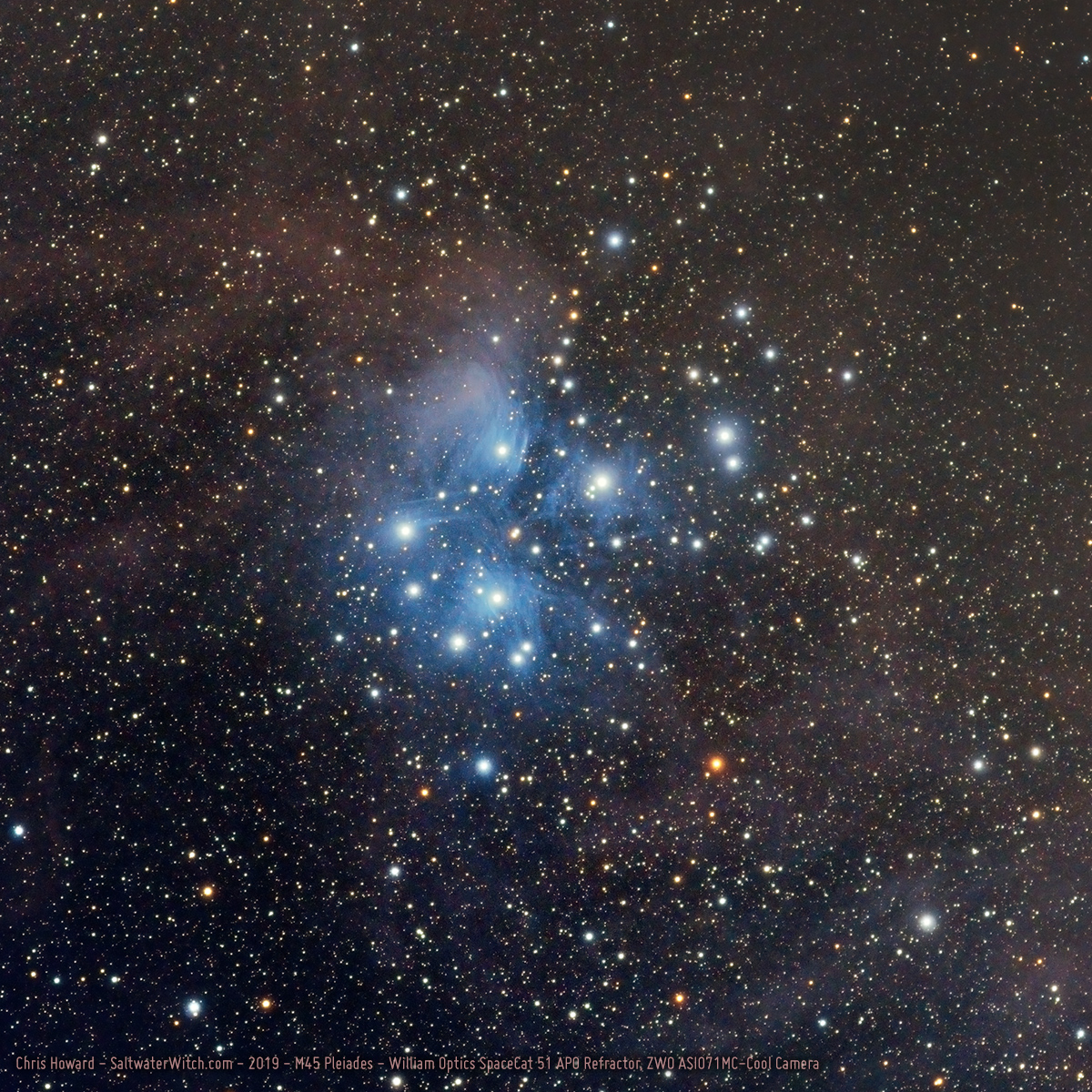
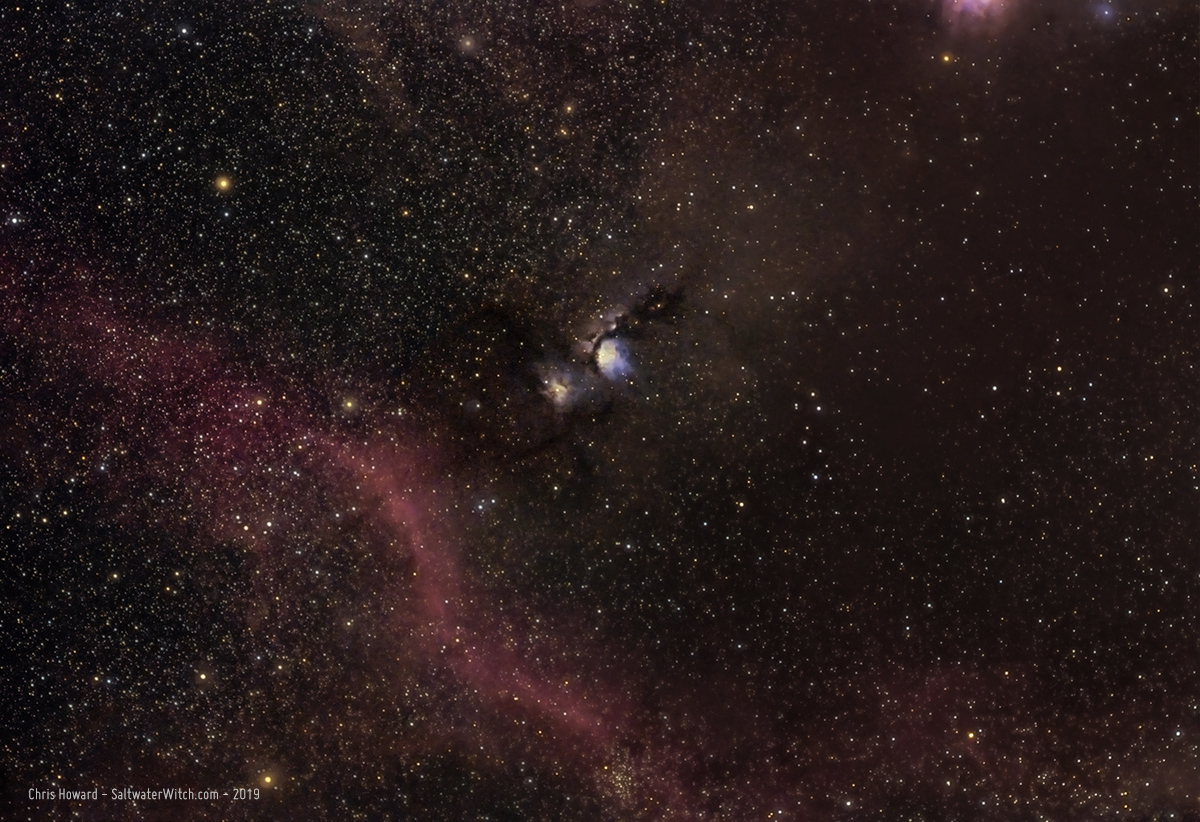
This was an especially busy week at work, a lot going on all around, including my son with an especially bad cold that developed into pneumonia--he spent the week recovering, so it was nice to be able to relax on a Friday night with clear skies, and schedule a somewhat unplanned and wayward imaging run across the autumn night sky. Two of the targets I focused on were M45, the Pleiades, and the M78 reflection nebula in Orion. I was trying out 8-minute exposures with both of these, and they both turned out well. It's always nice to have an early setting moon--or new moon where I can use my ZWO ASI071MC cooled color camera with a normal UV/IR cut filter, and not have to plan around our star's light reflecting off our disproportionately large moon. I shot the following stacked and processed sub-exposures with the William Optics SpaceCat 51 APO Refractor, ZWO ASI071MC camera, on an iOptron CEM25P mount, with 28 x 480 and 600 second subs for M45, and 27 x 240 second subs for M78.
The constellation Orion holds a special place in my astronomy-shaped heart, from Barnard's Loop (Sh 2-276) to the Witch's Head (IC 2118) across from Rigel, to the pair of stars at Orion's shoulders, Betelgeuse and Bellatrix, and of course, M42 the Orion Nebula, which we really should continue to call the "Great Orion Nebula" because, well, it's great and arguably magnificent. Among all of Orion's well studied and photographed nebulae is another favorite, the mysterious Messier 78 (M78), an almost violently colored and shaped reflection nebula coiled in dark clouds of interstellar dust that makes it look like it's poised to attack Barnard's Loop. (What is "astronomy-shaped" you ask? Probably something like a refractor telescope shape, or possibly like the stacks of money I have spent on telescopes, cameras, mounts, and other equipment).
Posted November 2, 2019
William Optics SpaceCat 51 Focuser Experiment 3
I'm working on a motorized focuser for the SpaceCat / RedCat. I saw that K-Astec is using a timing belt flipped inside out--brilliant. I've also seen DeepSkyDad's version, with the 3D-printed gear ring--very cool. I just ordered a couple test belts with a 2.5 mm pitch to see if that will work with the Cat's focus ring.
Right now I'm using my AF1--dismantled a bit--to test the belt tension and torque.
UPDATE: I was just emailing with Pavle at DeepSkyDad.com, and I ordered their latest AF3s motor/controller combination with the Cat timing belt ring, belt, custom pulley and L bracket. After a few days trying to get the 2.5mm pitch timing belt to work with the Cat's focus ring--with a lot of slipping and different configurations, different step sizes, speeds, etc., I went ahead and got the DSD working set. I'm pretty sure part of the problem is the softness of the Cat's focus ring, so that even with a timing belt with matching pitch it wasn't going to behave like a pulley, just not rigid enough--made for human hands to grip and adjust. I was going to have to go with supplemental gearing, either a reversed timing belt glued-down like K-Astec, or with the 3D printed rigid ring developed by Pavle. https://deepskydad.com/autofocuser/redcat. I went with the standard enclosure instead of the RedCat mount so this should work well with the camera rail.