DIY Power for Astrophotography

The problem I want to solve is supplying 12v dc power to my astro setups away from mains/grid power, for example, a 110v ac line running from the house. I want enough storage to last a full night with everything--even the big power drains like thermo-electric cooling and dew control covered by the system. Of course there are off-the-shelf solutions for this, but I wanted a little more versatility, a system that I can upgrade, add more batteries if needed, and this is much cheaper than the portable power options out there. It's also specific to my needs: a handful of 12vdc devices, with varying current requirements. (I don't need a built-in flash light or an inverter to power AC devices--things that plug into a wall socket).

Here's what I've put together and successfully tested so far:

I bought a small deep-cycle 35 amp-hour lead-acid (AGM) battery, which will get me completely through a night of astro-imaging: through evening setup, an entire night's imaging run with a cooled camera (TEC set to -20C) and dew control running the whole time. In my first tests I discovered I would not go any smaller than the 35Ah @12v dc battery, because I ended the night with it pretty close to completely discharged. Keep in mind the charging cycle with AGMs is a gradual process that uses lower power. Absorbent Glass Mat batteries are safer to use, but require a slower, steadier charging cycle. 

Everything I purchased for my power box was perfect except I went underpowered on the charger. The NOCO chargers are awesome (https://no.co). I bought the NOCO Genius G1100 (1.1 amp) and I should have gone with with the G3500 (3.5 amp)--for $20 USD more. The G1100 will charge my NPP NP12-35Ah AGM battery from dead to full in 18 hours. Yeah, see the problem? That's not going to work with more than one clear night in a row. The G3500 will charge the battery in less than 6 hours.

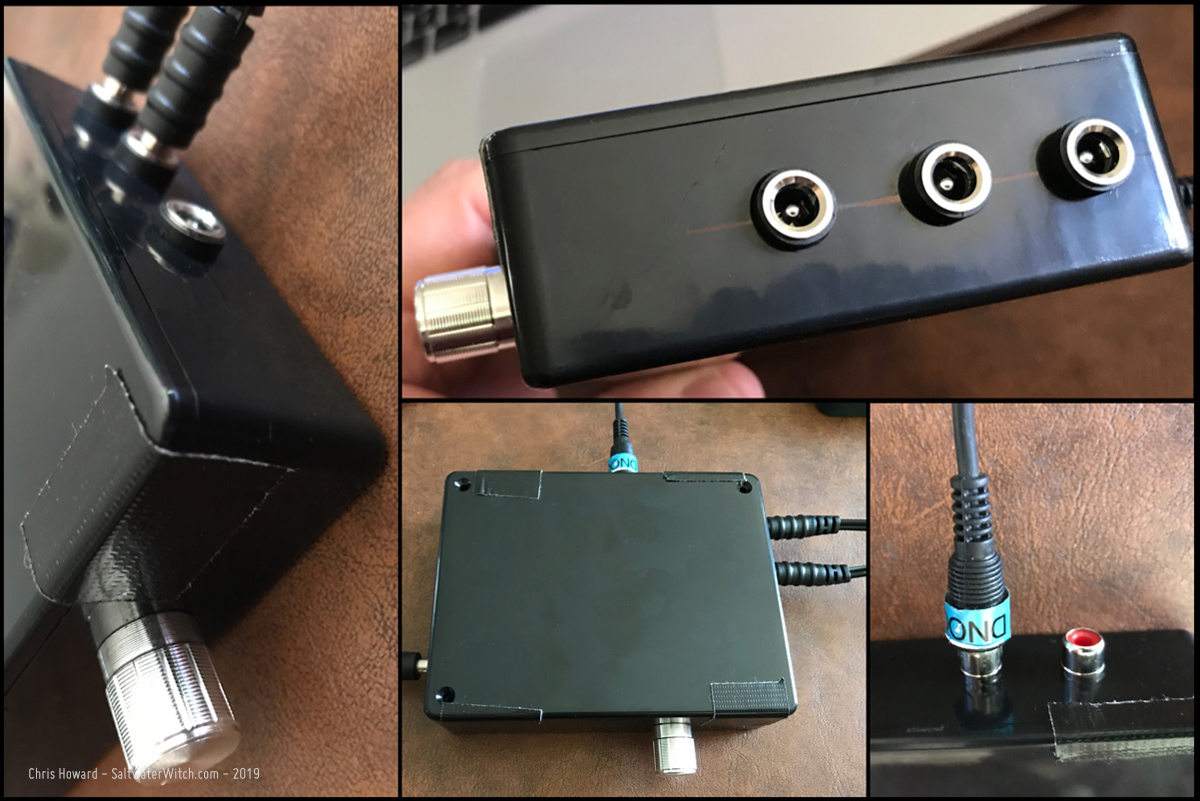
I have everything housed in an old milk crate--an original from the early '80s. But you can buy similar containers today--at Amazon, the Container Store. I attached two pieces of scrap acrylic to two sides. I have my Fanless Windows 10 box secured to one, and I drilled out the other side for my battery power cut-out. I added this so there was no draw on the battery--even minimal. The three switches on the rocker panel are lit when they have power, even when they're off. They have a small LED bar that shows that the switches are functioning, and a brighter red LED when they are powered on. The cut-out also allows me to completely separate the lines running to my gear from the NOCO charging line, if I want to.  

Tools: wire cutters, wire stripper, soldering iron + solder, and the crimping tool for the connectors (link below)

NOCO chargers https://no.co

NPP NP12-35Ah Rechargeable AGM Deep Cycle 12V 35Ah Battery with Button Style Terminals
https://www.amazon.com/gp/product/B01LW19AOE

Rocker Switch Panel 
https://www.amazon.com/gp/product/B075V4CZLF

NOCO GC018 12V Adapter Plug Socket with Eyelet Terminal
https://www.amazon.com/gp/product/B00G8WLW2Y

NOCO Genius G3500 6V/12V 3.5 Amp Battery Charger and Maintainer
https://www.amazon.com/gp/product/B004LWVEKS

Car Battery Switche MAX 50V DC 50A 
https://www.amazon.com/gp/product/B01GDYGQJA

Insulated Wire Electrical Connectors Assortment
https://www.amazon.com/dp/B078PMWNJC

Ratcheting Crimper Tool - for the connectors above
https://www.amazon.com/dp/B01IQIALJC

Primary Wire, 14-Gauge Bulk Spool, 100-Feet, Red & Black
https://www.amazon.com/dp/B016TQKT9K

3 x 6ft 2.1mm x 5.5mm Extension Cable, 18AWG for 12V
https://www.amazon.com/dp/B079P842DK

Power Pigtail Cables, 12V 5A Male and Female Connectors
https://www.amazon.com/dp/B07QH8VNY7

Posted June 16, 2019

More from Cygnus: Crescent and Tulip Nebulae

The Crescent Nebula, NGC 6888 (top right) is an emission nebula in the constellation Cygnus, about 5000 light-years away. Like most of this region around Cygnus, you can't do anything in hydrogen-alpha or sulfur2 without wading through clouds of the stuff—billowing, eddying, and general nebulousing. It's beautiful. There's a Wolf-Rayet star, WR 136, at the lower left edge of the Crescent Nebula (from this angle), and it's stirring up violent stellar winds and blazing quickly through its life; it's expected to go supernova in a couple hundred thousand years, and it's only a four or five million years old. WR stars are unusual: they're very bright--thousands of times brighter than our sun, and they burn much hotter, thousands of times hotter than almost all other stars. And they have very short lifespans.

Notes: 31 x 240 sec Ha, 33 x 240 sec OIII, 29 x 240 sec SII,  Astronomik Ha, OIII, and SII filters, William Optics GT81 at f/4.7 with WO 0.8x Flat6A II, Moonlite focuser, ZWO ASI120MM OAG, Imaging camera: ZWO ASI1600MM Pro cooled mono on an iOptron CEM25P mount.

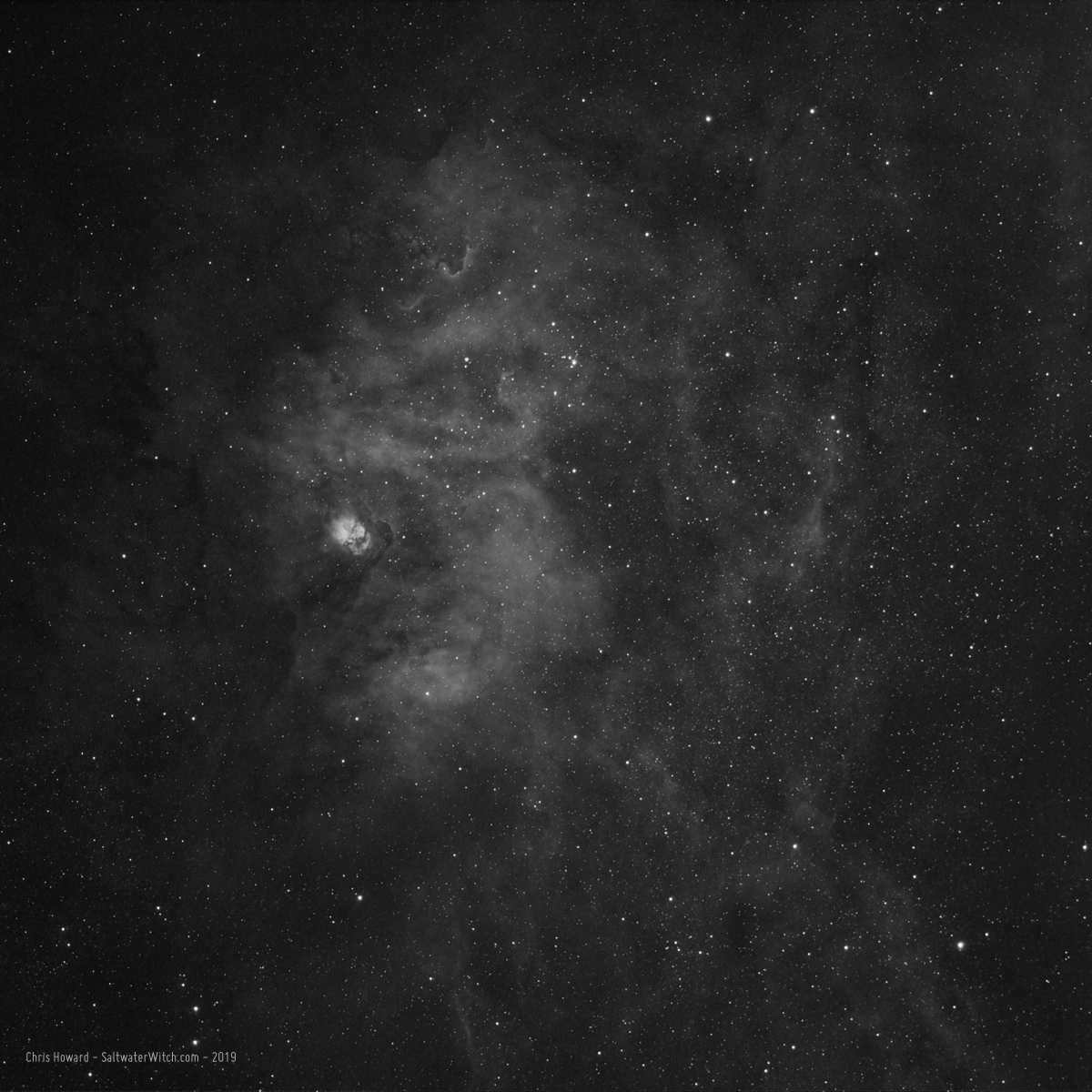
Sharpless 2-101, the Tulip Nebula (top left) is an emission nebula in Cygnus, about 6,000 light-years away. The microquasar Cygnus X-1 is the bright star just above the top point of the Tulip in this image. Cygnus X-1 is famous for being one of the first suspected blackholes, as well as a famous bet between physicists Stephen Hawking and Kip Thorne over that possibility. Hawking conceded to Thorne in 1990 as evidence for a blackhole mounted. Although the Tulip (Sh 2-101) stands out brightly with oxygen in blue, the whole region around the constellation Cygnus is cloudy with interstellar dust and gas. Notes: Astronomik Ha, OIII, and SII filters, William Optics GT81 at f/4.7, ZWO ASI1600MM Pro cooled mono camera, on an iOptron CEM25P mount.


Posted June 12, 2019

North America Nebula (NGC 7000) and the Pelican Nebula (IC 5070, IC 5067)

I spent most of last night's imaging run, about 5.5 hours, on this two-panel mosaic of NGC 7000, the North America Nebula and IC 5070, IC 5067 the Pelican Nebula. NGC7000 and this whole area is one of those deep sky objects with which you can do amazing things in narrowband or broadband color, and turns out beautifully in RGB, bi-color Ha and OIII, even Hydrogen-alpha by itself. For this shot I went with the Hubble Palette in SHO, mapping SII-Ha-OIII to RGB, Sulfur = Red, Hydrogen = Green, Oxygen = Blue. This is why you see aqua and gold standing out in many of the Hubble images. It also affects star color, and you end up with some shade of purple.

Here's an update with the two-panel mosaic of the North America Nebula (NGC 7000) and Pelican Nebula (IC 5070, IC 5068). I fixed the stars and toned down the whole image

Posted June 9, 2019

Broadband color targets - Iris nebula

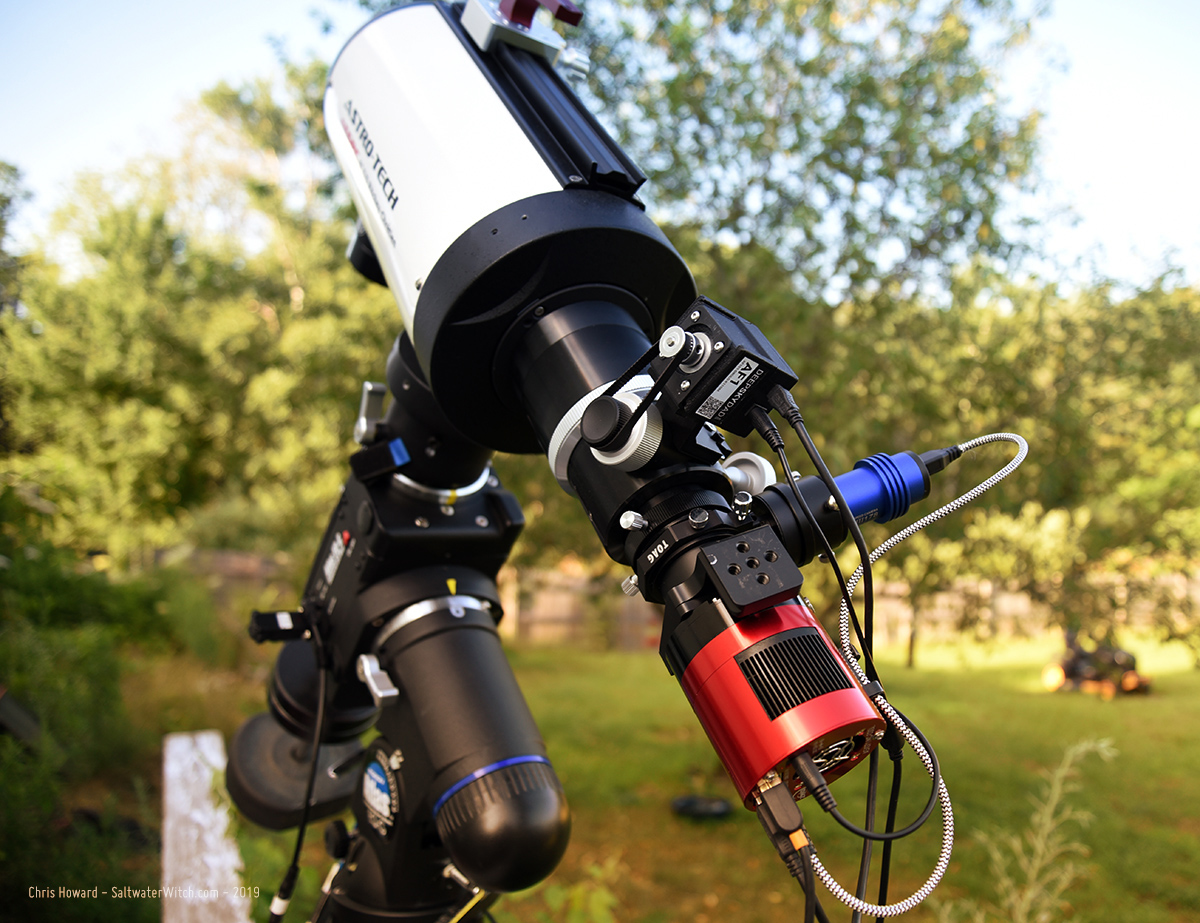
Yesterday I set up for a couple broadband color targets, and went with the Astro-Tech 6" f/9 Ritchey–Chrétien with 1350mm focal length. I paired the RC with the ZWO ASI071MC cooled color camera. And this is the first time I'll be using the DeepSkyDad Autofocuser AF1, which fits perfectly on the stock Crayford focuser--although you can't see it in this shot because I have the focus knobs vertical on the right site of the scope. Not using an OAG with this setup, but going with the William Optics 200mm guide scope and ZWO ASI120MM-S mono camera.

NGC 7023, Iris Nebula is a beautiful reflection nebula in Cepheus, about 1,300 lightyears away.

Posted June 7, 2019

Cygnus and Cepheus Imaging Run - June 6th, 2019

The star Sadr (gamma Cygni) is the center point in the Cygnus Cross, and is surrounded by the emission nebula IC 1318. Here's the Sadr Region in bi-color, Ha and SII. - Ha 12 x 300 second exposures, SII 17 x 300 second exposures.

Crop of the above image of the Sadr Region:

Capturing Sadr - First target of the night. That's Jupiter, the point of light on the right.

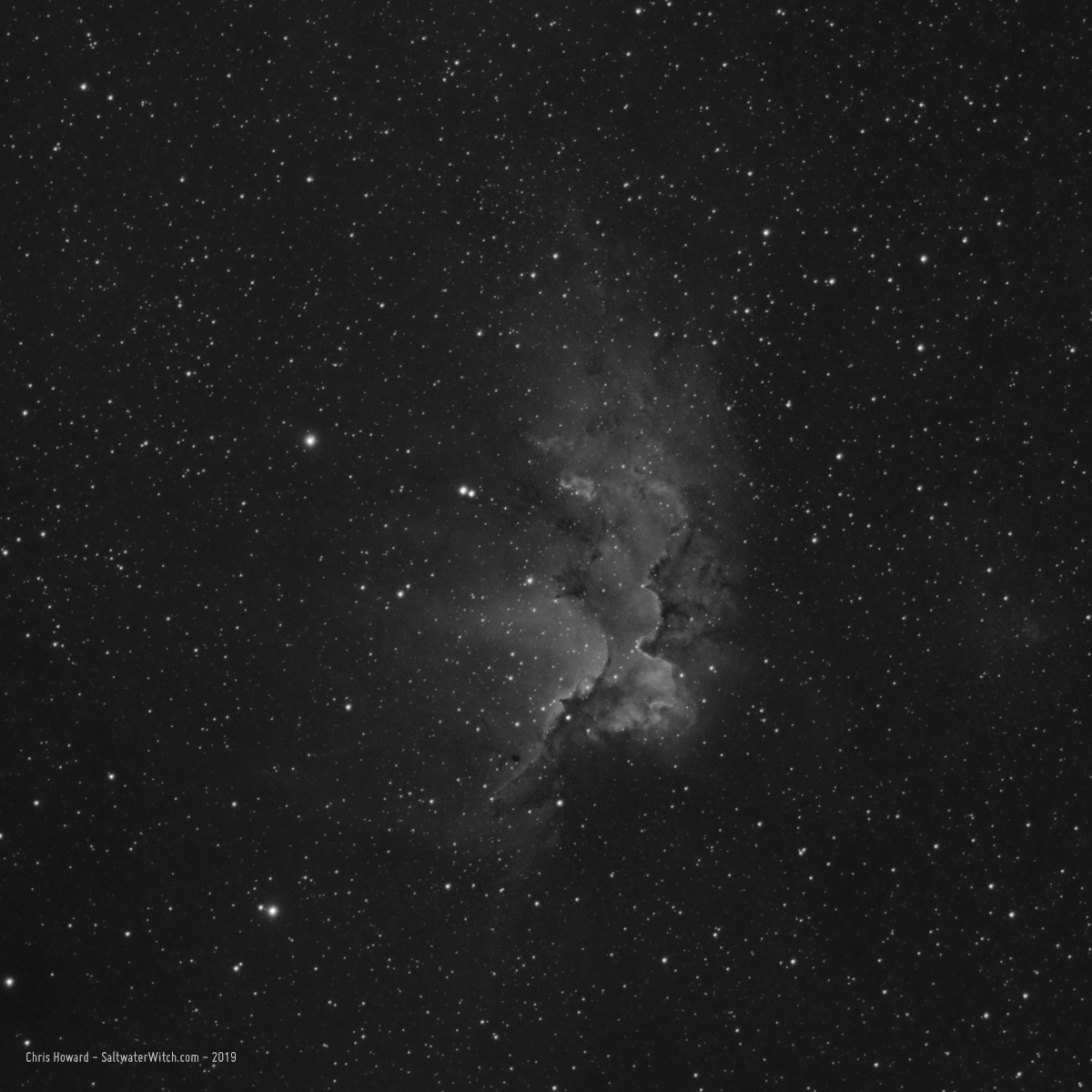
On May 25th I captured the Eastern Veil Nebula in bi-color Ha and OIII. Last night I came back and captured the Western Veil Nebula with its distinctive "Witch's Broom" (NGC 6960). WilliamOptics GT81 APO Refractor and ZWO ASI1600MM-Pro mono camera: 14 x 300 second exp in Ha, 15 x 300 second exposures in OIII, combining them into the entire Veil Nebula.

The complete Veil Nebula in the constellation Cygnus! This is a two-image mosaic that covers an area of sky about 3° across, an area into which you can fit 36 full moons. The Western Veil on the right is the "Witch's Broom" (NGC 6960) and various other bands of ionized gas and dust. Pickering's Triangle is that brighter wedge-shaped mass of hydrogen and oxygen at the middle top, and the Eastern Veil (NGC 6992, NGC 6995, IC 1340) is the large crescent on the left. The latest estimates put the nebula about 1,470 lightyears away from us. So, relatively close, and if you were around 6,530 years ago--and watching the night sky--you might have seen the massive supernova that created this beautiful nebula. (The supernova kicked off around 8,000 years ago, but the light and violence of the star's ending would have taken almost 1,500 years to reach us).

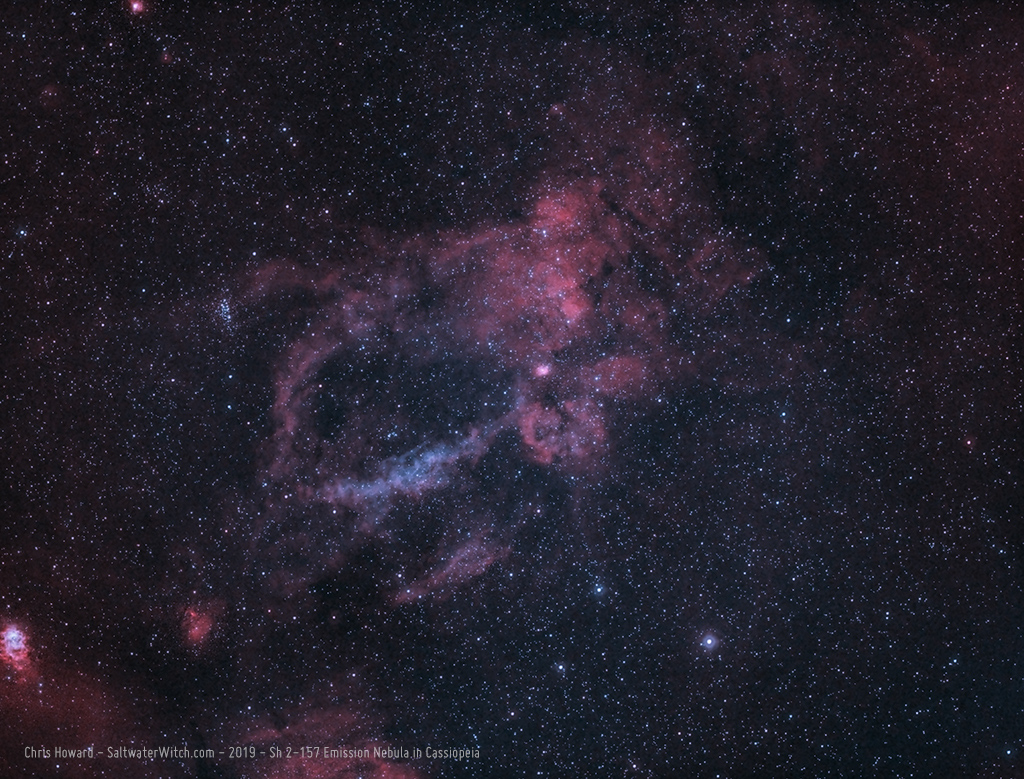
Third target for the night of June 6th 2019 - A group of Nebulae and other interesting structures on the border between the constellations Cepheus and Cassiopeia. The large tentacled emission nebula is Sh 2-157 (I've heard this called the "Lobster Claw" and the "Squid Nebula"), toward the top is the Bubble Nebula (NGC 7635), with NGC 7510, NGC 7538 (bright emission nebula on the right)

Another shot from the Wyze Cam I use to watch the system. Here I was checking that the mount was parked and everything is stopped. We're in New Hampshire, and this time of year I usually can't schedule anything after 3:30am. It's 4:07am in this shot and you can see the glow from the sun over the trees at the end of the property.

Posted June 4, 2019

So, Starlink is happening...

A few people have asked me for my thoughts on SpaceX's global high-speed internet service--literally "global" in that there will eventually be a constellation of satellites, numbering in the thousands, launched into LEO to support the entire system, and anyone just about anywhere on the planet should be able to access it.

As someone who spends a decent amount of time under the stars, taking very long exposure images of deep sky objects...I don't have a problem with Starlink. Starlink is just one more global data provider, along with Orbcomm and half a dozen others currently in orbit, and several more that appear to be duplicates of Starlink--OneWeb/Boeing is in the works, and Amazon is planning another. 

There are thousands of satellites orbiting our planet right now, and I see them all the time. I rarely image at less than 2-minute exposures, and depending on the narrowband filters I'm using I will go as high as 30-minute exposures for a single frame. The chances that something in the sky passes in front of my field of view are high. Depending on the focal length/FoV you're using you may never see them--long FL, very small FoV. Wide-field long exposure astro-imaging will probably pick them up. 

Just to settle some questions I keep seeing: four of the sixty Starlink satellites currently in orbit are "misbehaving" according to SpaceX President Gwynne Shotwell--she said this at a talk at MIT a couple days ago. SpaceX is working on those, and they're the four you see at dawn and dusk without a telescope. I am assuming that when any number are properly working you won't be able to see them at all. These 60 are also running a bunch of tests, ion-thruster burns to maneuver in orbit and all that. So I expect this--right now--is the worst as far visibility goes.

And then there's the Elon Musk statement that the ISS has lights. And yes, when the International Space Station passes overhead what you're seeing is the sun reflecting off the solar arrays. Not lights. However the ISS does have lights--and is just visible through a camera or telescope when they are on. But they only use them when astronauts/cosmonauts go out to maintain components, change batteries, etc., and that's not that often, so using the ISS as an example of what's in store for astronomers isn't a fair comparison on any side. It's massive and much brighter than these tiny Starlink sats, and there's only one of them--not thousands.

I get why astronomers are angry, especially the wide-field survey scopes that will probably have to do some fancy stuff to remove the growing number of satellites in any frame. I also understand the proponents with the argument that 3 billion people don't have internet access, and that most of the Earth doesn't have coverage at all without specialized and expensive satellite gear. 

At the end of the day, we live on a planet with an atmosphere with narrow windows of true astronomical night and crappy weather some of the time (or a lot of the time depending on where you live). Because of urban lighting 1/3 of all humans, roughly 2.5 billion, can't even see our own galaxy, the Milky Way. If you're against this from the clear skies side, light pollution from expanding cities is a far bigger problem for most people. (https://www.lightpollutionmap.info)

Posted June 2, 2019

Horsehead Nebula (B33) and NGC 2023

The Horsehead Nebula (B33) and the emission/reflection nebula NGC 2023 (below and left of the Horsehead) in the constellation Orion. With this field of view, you're looking at around 1.7 trillion miles from one side to the other. I captured a batch of narrowband data in Orion last year. Today, I reprocessed some of it, playing with contrast and color balance.

Posted June 1, 2019

Eagle Nebula - wide-field view with a side-order of infrared

Here's another one from last night's run, a wide-field view of the Eagle Nebula (M16, NGC6611) in IR-OIII-Ha with Ha luminance. From our perspective Messier 16--Eagle Nebula--sits just north of the Milky Way's dense core of stars, bands of clouds, dust, hydrogen, and other galactic detritus. I wasn't very hopeful with the IR subs, but the Ha subs were beautiful. The OIII frames were about what I expected--not too much but enough to include them. To brighten things up I went back and added the processed Ha stack as a luminance layer. Yes, this may be a spectacularly weird color arrangement, but we're working in false color imaging already, and this doesn't seem that far off from our galaxy's actual core colors--at least in terms of the bands of dust and ionized gases.

Here's the Ha stack:

For comparison (with NGC 6611 above), here's the processed version of the Eagle Nebula (M16) I took last year with a slightly different setup--same William Optics scope + Atik414EX mono CCD camera. This is a bi-color hydrogen-alpha and oxygen3. With this one I think I had my OIII frames mapped to G and B channels, and Ha mapped to the Red channel.

Posted May 25, 2019