So, Starlink is happening...
A few people have asked me for my thoughts on SpaceX's global high-speed internet service--literally "global" in that there will eventually be a constellation of satellites, numbering in the thousands, launched into LEO to support the entire system, and anyone just about anywhere on the planet should be able to access it.
As someone who spends a decent amount of time under the stars, taking very long exposure images of deep sky objects...I don't have a problem with Starlink. Starlink is just one more global data provider, along with Orbcomm and half a dozen others currently in orbit, and several more that appear to be duplicates of Starlink--OneWeb/Boeing is in the works, and Amazon is planning another.
There are thousands of satellites orbiting our planet right now, and I see them all the time. I rarely image at less than 2-minute exposures, and depending on the narrowband filters I'm using I will go as high as 30-minute exposures for a single frame. The chances that something in the sky passes in front of my field of view are high. Depending on the focal length/FoV you're using you may never see them--long FL, very small FoV. Wide-field long exposure astro-imaging will probably pick them up.
Just to settle some questions I keep seeing: four of the sixty Starlink satellites currently in orbit are "misbehaving" according to SpaceX President Gwynne Shotwell--she said this at a talk at MIT a couple days ago. SpaceX is working on those, and they're the four you see at dawn and dusk without a telescope. I am assuming that when any number are properly working you won't be able to see them at all. These 60 are also running a bunch of tests, ion-thruster burns to maneuver in orbit and all that. So I expect this--right now--is the worst as far visibility goes.
And then there's the Elon Musk statement that the ISS has lights. And yes, when the International Space Station passes overhead what you're seeing is the sun reflecting off the solar arrays. Not lights. However the ISS does have lights--and is just visible through a camera or telescope when they are on. But they only use them when astronauts/cosmonauts go out to maintain components, change batteries, etc., and that's not that often, so using the ISS as an example of what's in store for astronomers isn't a fair comparison on any side. It's massive and much brighter than these tiny Starlink sats, and there's only one of them--not thousands.
I get why astronomers are angry, especially the wide-field survey scopes that will probably have to do some fancy stuff to remove the growing number of satellites in any frame. I also understand the proponents with the argument that 3 billion people don't have internet access, and that most of the Earth doesn't have coverage at all without specialized and expensive satellite gear.
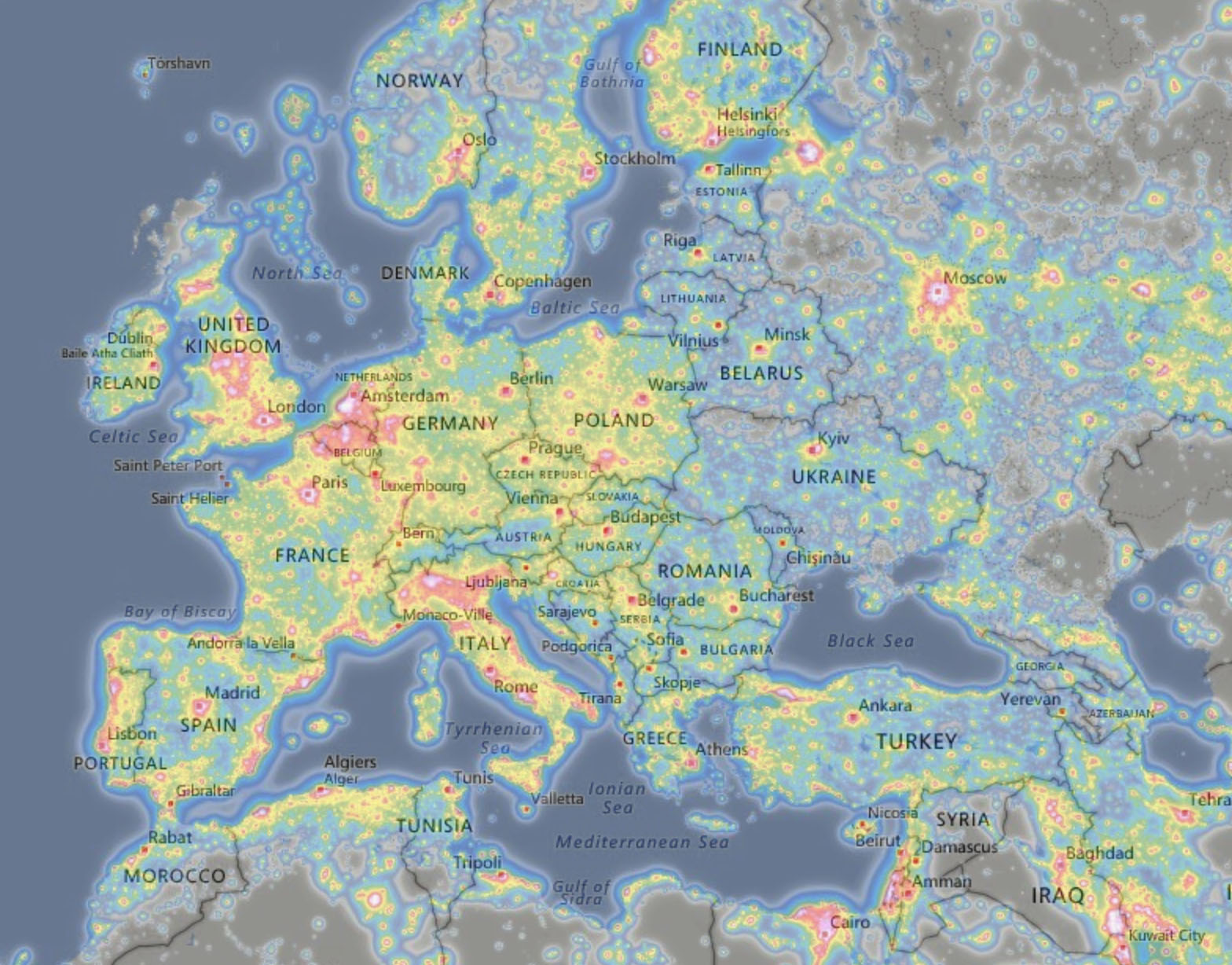
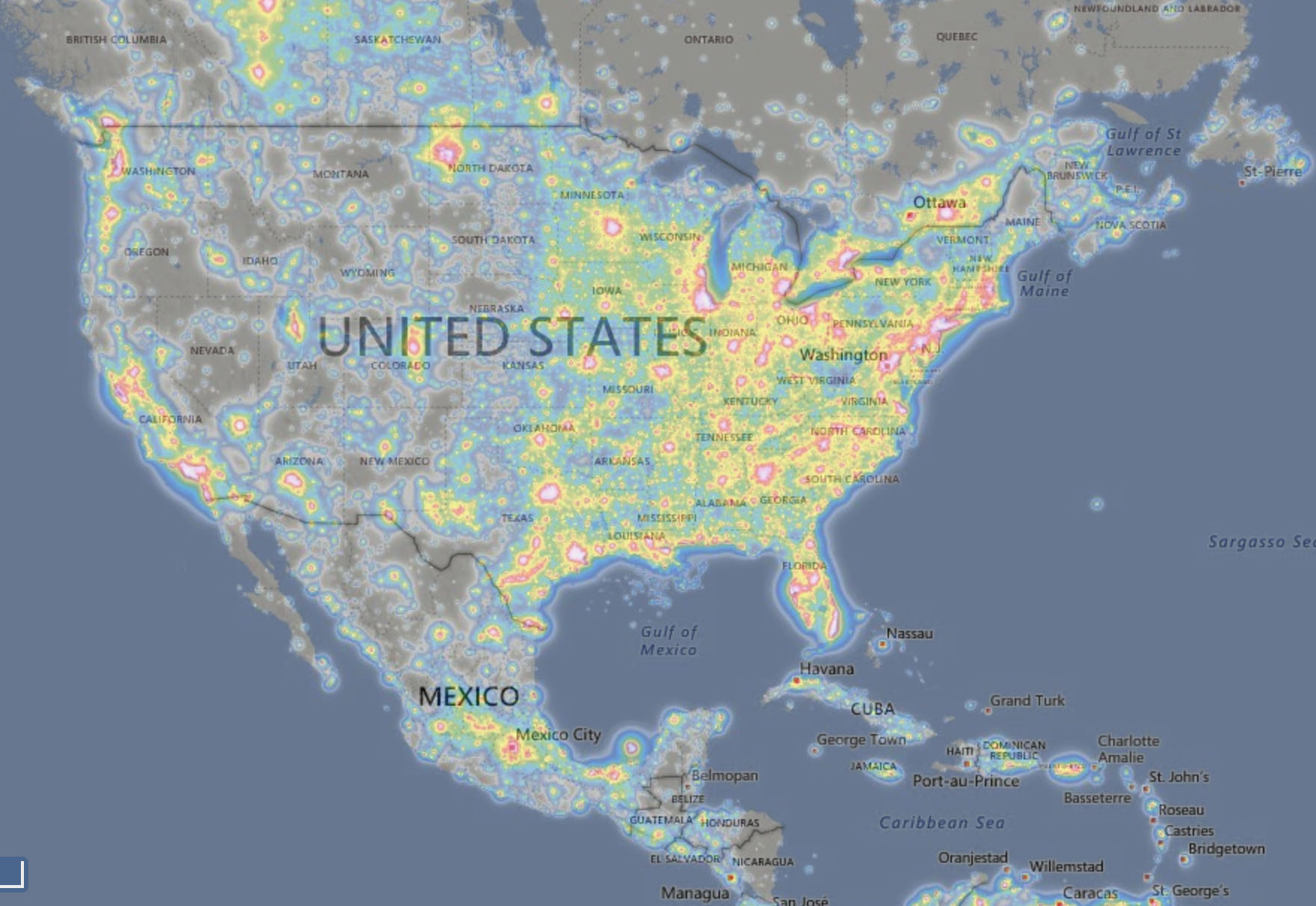
At the end of the day, we live on a planet with an atmosphere with narrow windows of true astronomical night and crappy weather some of the time (or a lot of the time depending on where you live). Because of urban lighting 1/3 of all humans, roughly 2.5 billion, can't even see our own galaxy, the Milky Way. If you're against this from the clear skies side, light pollution from expanding cities is a far bigger problem for most people. (https://www.lightpollutionmap.info)
Posted June 2, 2019
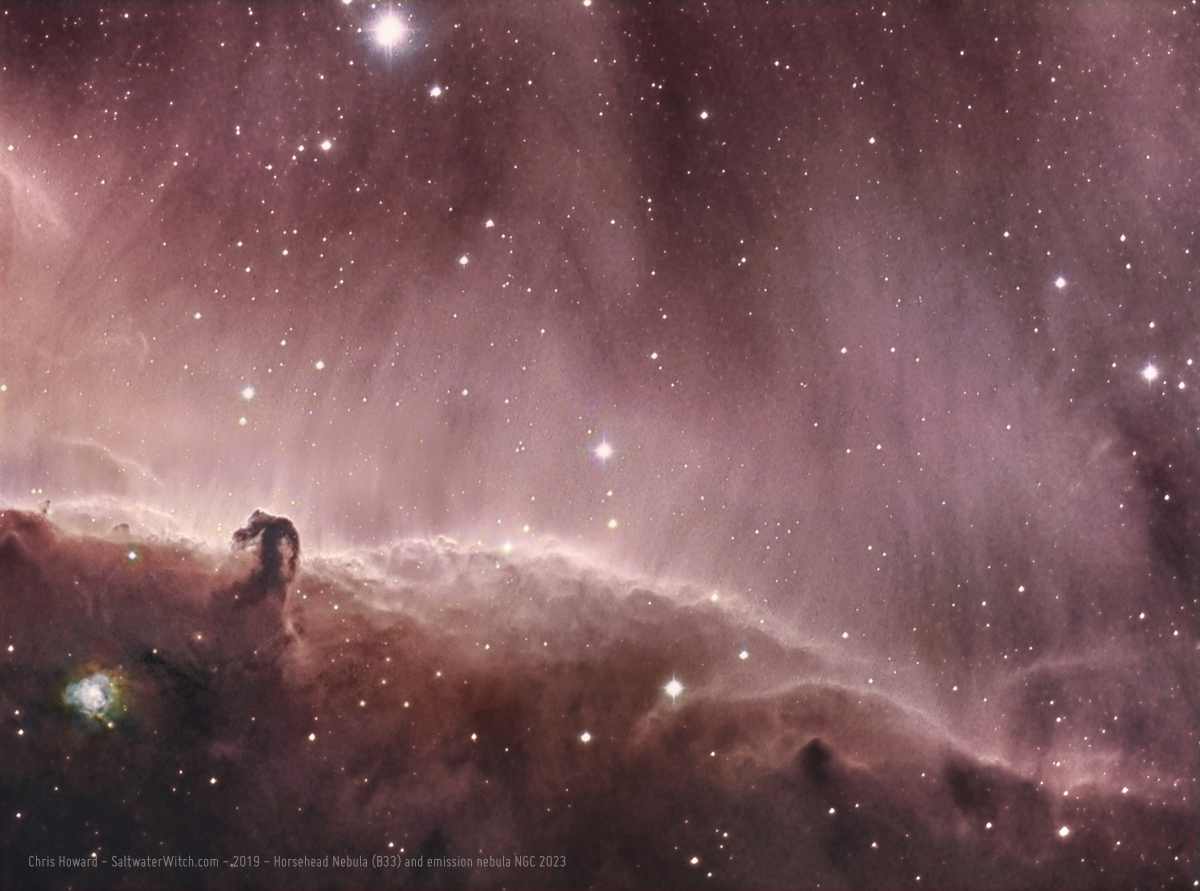
Horsehead Nebula (B33) and NGC 2023
The Horsehead Nebula (B33) and the emission/reflection nebula NGC 2023 (below and left of the Horsehead) in the constellation Orion. With this field of view, you're looking at around 1.7 trillion miles from one side to the other. I captured a batch of narrowband data in Orion last year. Today, I reprocessed some of it, playing with contrast and color balance.
Posted June 1, 2019
Eagle Nebula - wide-field view with a side-order of infrared
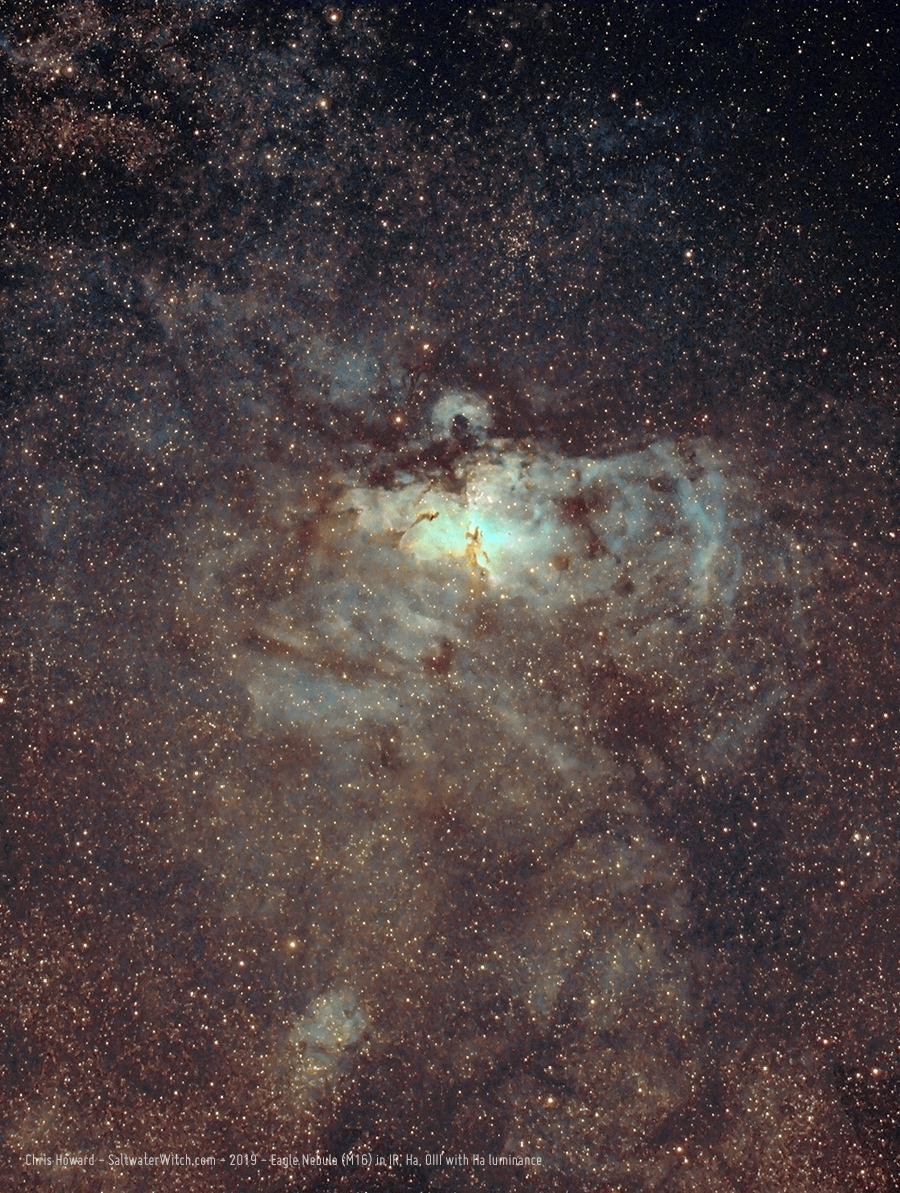
Here's another one from last night's run, a wide-field view of the Eagle Nebula (M16, NGC6611) in IR-OIII-Ha with Ha luminance. From our perspective Messier 16--Eagle Nebula--sits just north of the Milky Way's dense core of stars, bands of clouds, dust, hydrogen, and other galactic detritus. I wasn't very hopeful with the IR subs, but the Ha subs were beautiful. The OIII frames were about what I expected--not too much but enough to include them. To brighten things up I went back and added the processed Ha stack as a luminance layer. Yes, this may be a spectacularly weird color arrangement, but we're working in false color imaging already, and this doesn't seem that far off from our galaxy's actual core colors--at least in terms of the bands of dust and ionized gases.
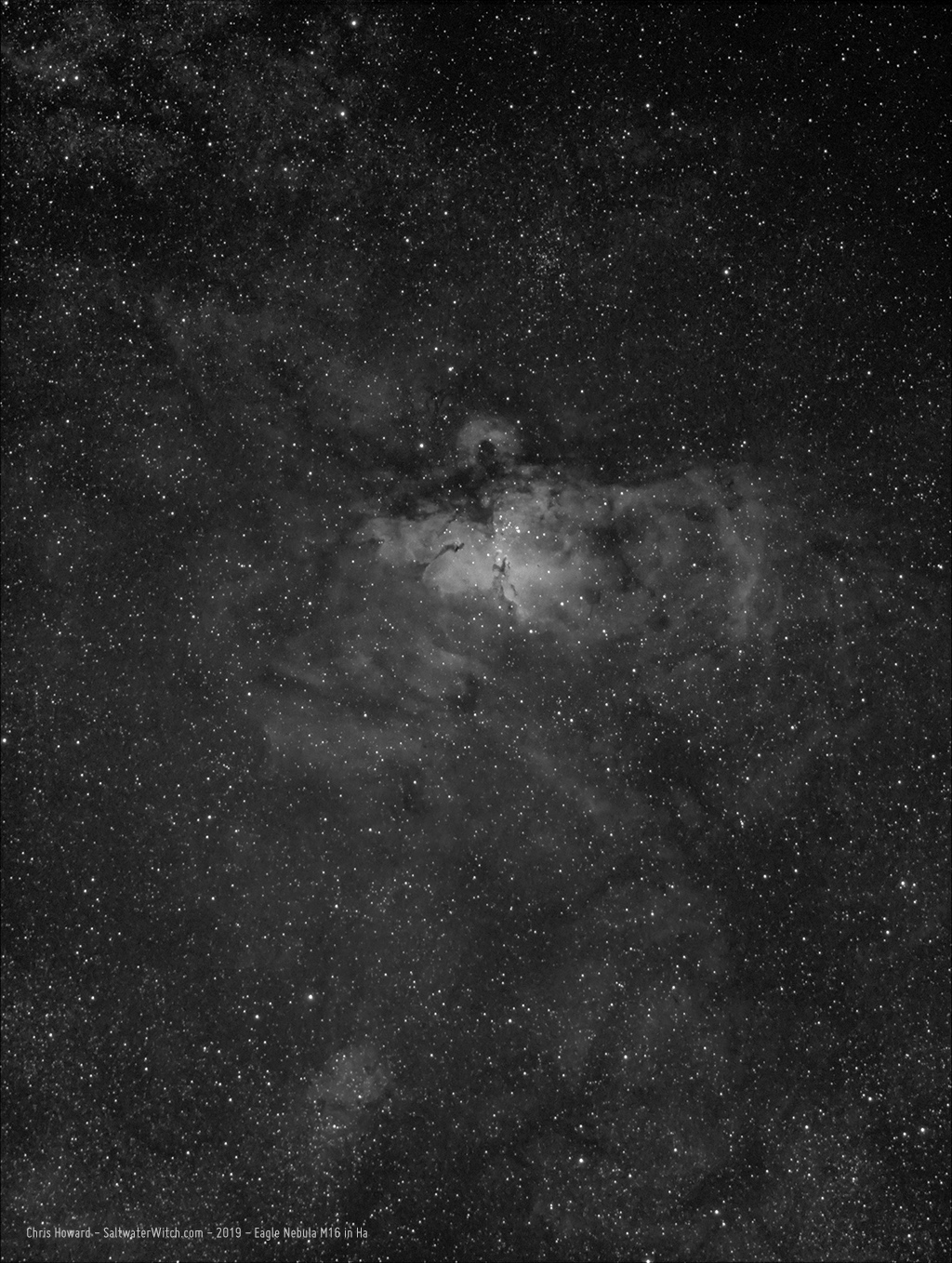
Here's the Ha stack:
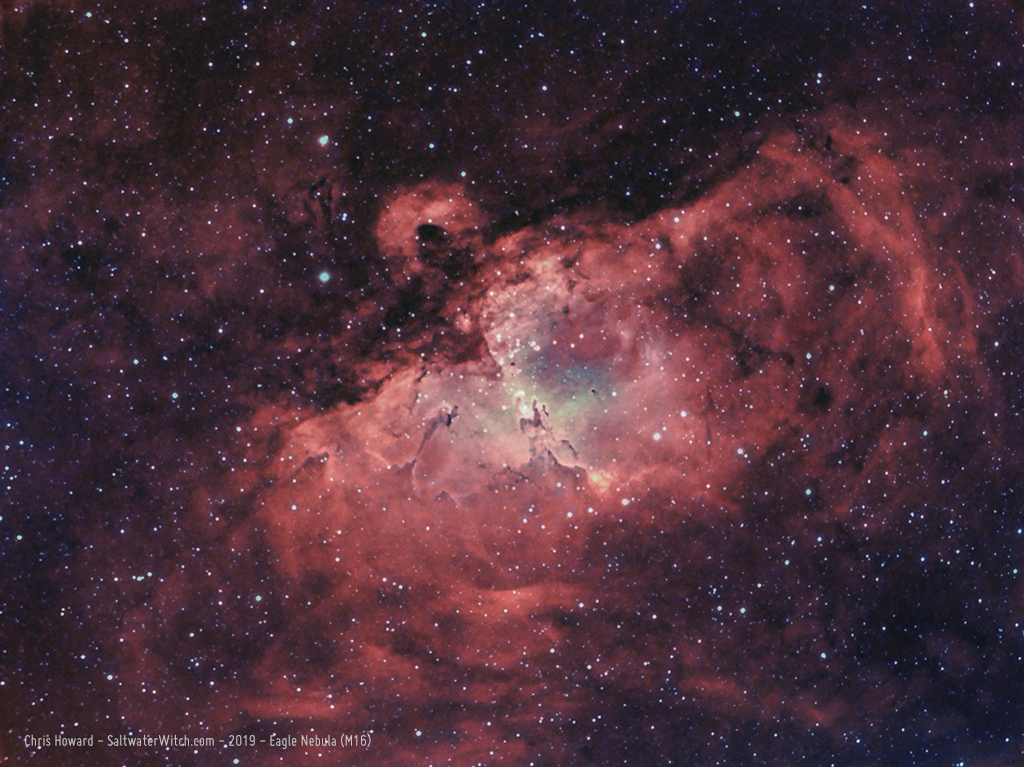
For comparison (with NGC 6611 above), here's the processed version of the Eagle Nebula (M16) I took last year with a slightly different setup--same William Optics scope + Atik414EX mono CCD camera. This is a bi-color hydrogen-alpha and oxygen3. With this one I think I had my OIII frames mapped to G and B channels, and Ha mapped to the Red channel.
Posted May 25, 2019
Veil Nebula--one side of it
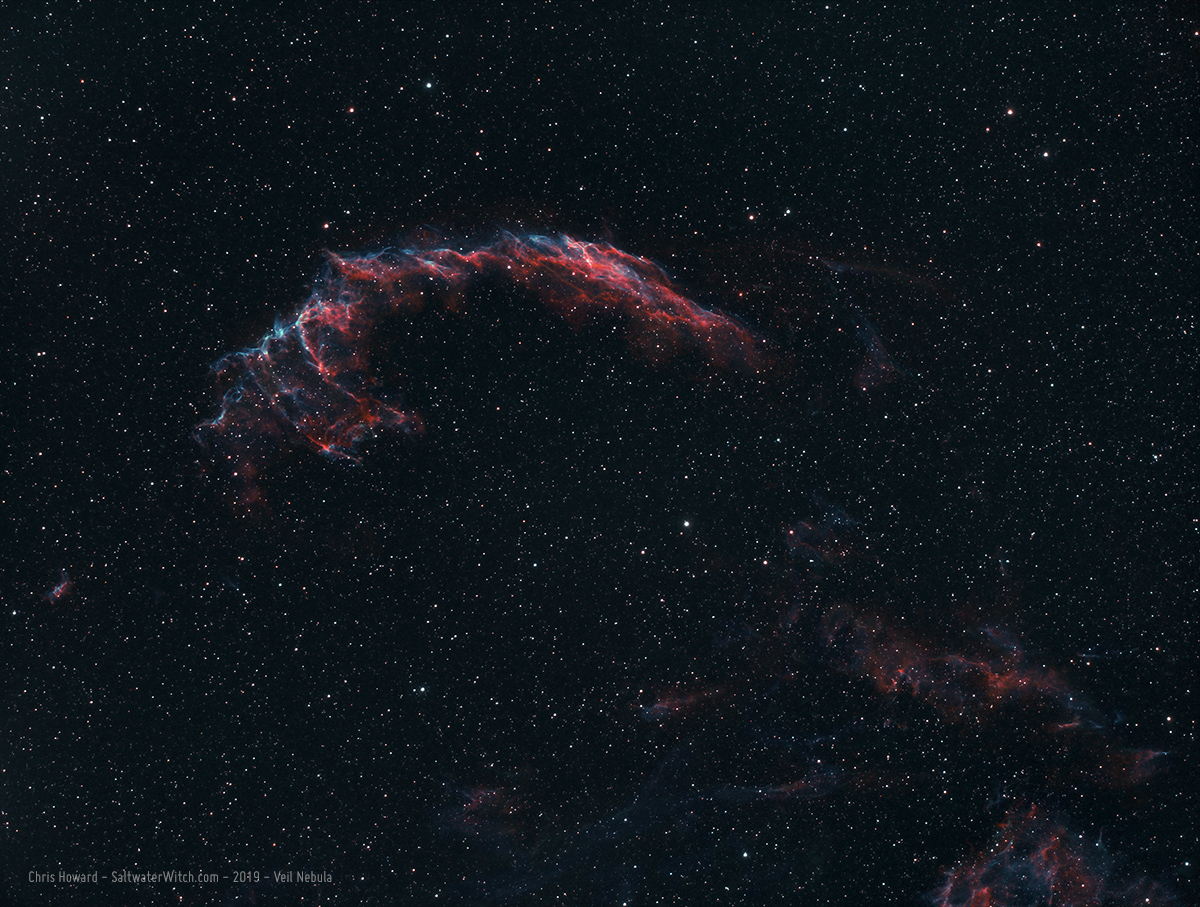
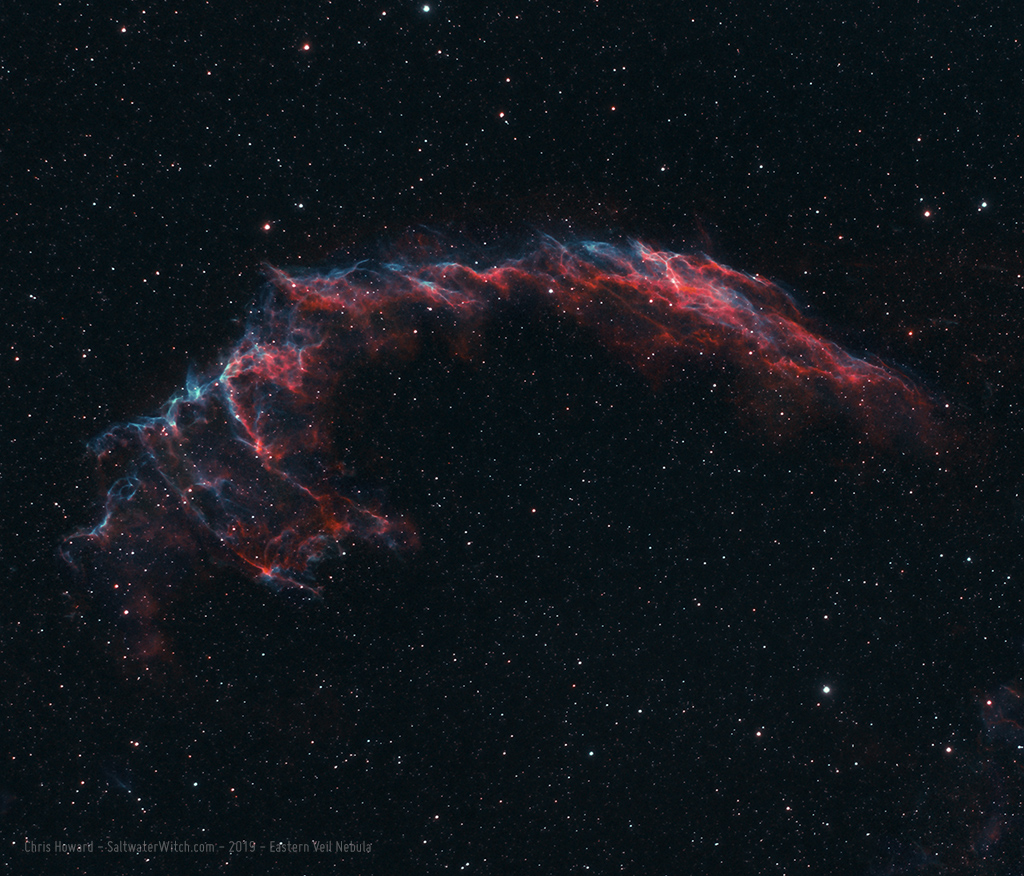
Finally a clear-ish night! I spent almost five hours capturing data, most of it after midnight, when the skies cleared noticeably. And I spent the majority of that time on the Eastern Veil Nebula (Caldwell 33). The big bright area is NGC 6992, and all of this comprises one side (east side) of the Veil Nebula, a supernova remnant from a massive star that ended it all around 8,000 years ago. I will come back on another clear night to get the brighter and larger Western Veil. And this nebula is large, roughly 3 degrees in diameter, covering 36 times the area of a full moon. I shot this in Ha and OIII, 22 x 5 minute exposures for each filter, with the WilliamOptics GT81 and ZWO ASI1600MM-Pro mono camera running at -20C.
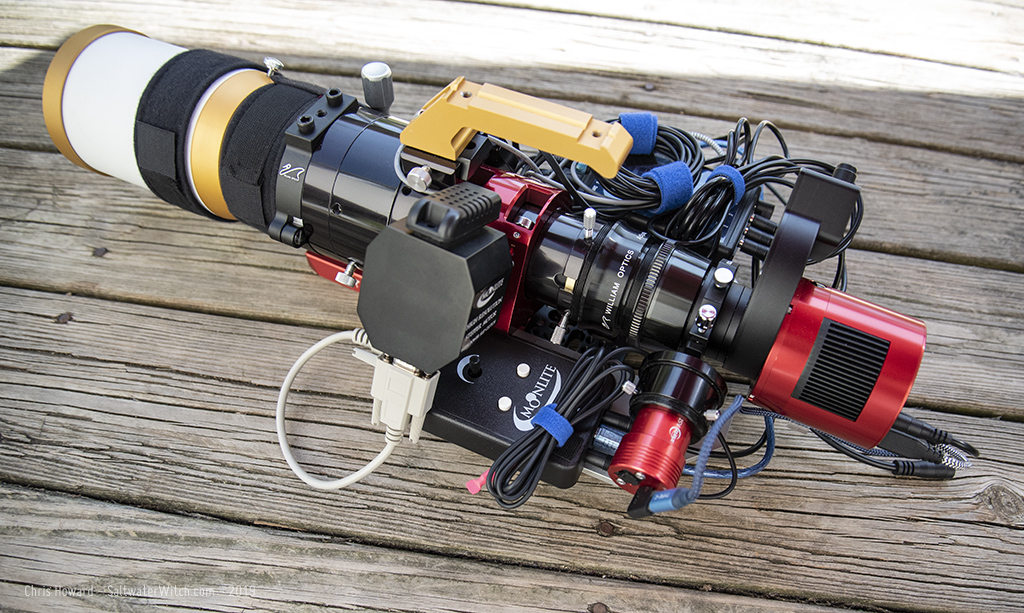
Here's the William Optics GT81 and ZWO cameras I'm using for narrowband imaging:
Here's a crop of NGC 6992, 6995, et. al. Eastern Veil Nebula is a supernova remnant in Cygnus, made up of clouds of dust and ionized hydrogen and oxygen.
Posted May 25, 2019
Guiding per-filter with an OAG or Guide Scope?
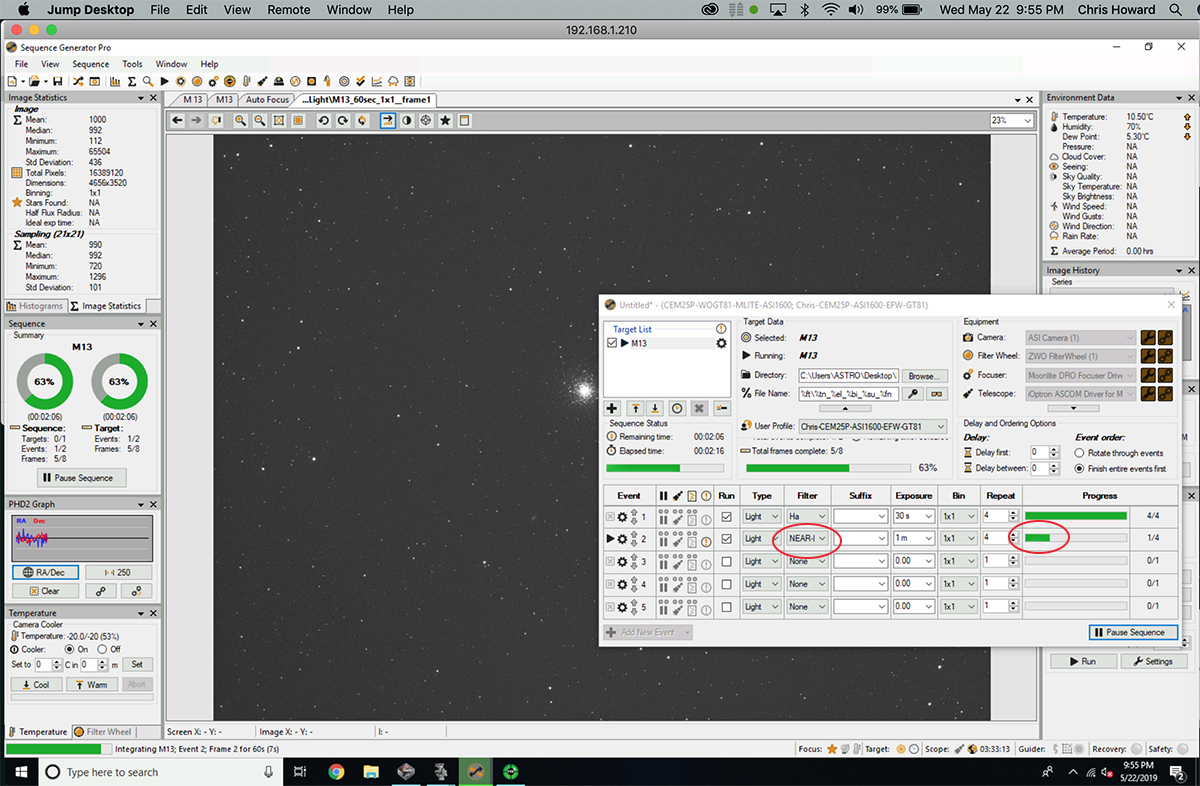
I ran into a funny situation with my off-axis guider and one particular filter, an Optolong 685nm longpass filter. The filter itself gave me some amazing shots of star clusters and even did well with IR emissions from nebulae and galaxies. I run a set of mid-range Astronomik narrowband filters in the ZWO EFW I have attached to the ZWO ASI1600MM-Pro mono camera, and within reason, they’re parfocal. In SGP I’m running the autofocus process every filter change anyway, but I don’t see much difference. The IR filter glass on the other hand is thick enough to move the focus far enough to affect the focus of the guide camera in my OAG. I had to go out to the scope and adjust the guide focus in PHD2.
One solution is to go with the guide scope when using the IR filter, but I don’t know if PHD2 can support this automatically, or if I have to stop, disconnect the OAG camera when switching to IR, and connect the camera on the guide scope. It will be an interesting workflow. I’m wondering if ASCOM/SGP can work with three connected ASI cameras? ASCOM’s approach seems to be to add a number after the device name, like ASI Camera [1], ASI Camera [2]. Will there be an ASI Camera [3]?
Although this sounds like a fun experiment, I’m going to stick with my OAG, and swap out the near IR filter at some point--maybe for a tighter Ha filter, a 3nm? Up to now I’ve never paid attention to the thickness of the glass for filters, but I’m going to look into that now.
Image: I got one frame into the IR sequence and PHD2 wasn’t happy:
Posted May 24, 2019
Messing around with Messier in Infrared
We finally had several hours of clear night sky--not spectacular, but I'll take what I can get this time of year. That whole “April showers bring May flowers” thing really applies to this region of the planet. I think we’ve had four or five full clear nights in the last couple months--and I can’t remember multiple clear days in a row, but I am looking forward to more opportunities to capture the night skies soon--early summer through the winter.
One of the paths I’m currently on is to be more productive--in very concrete terms. I simply want to produce more imaging data per night than I have before. One way to do this is to upgrade equipment and pile on new devices, which translates into an EQ mount with more capacity and another scope and camera to double the exposure time. In other words, spend more money, which I don’t want to do.
Another option is to improve the efficiency of my current setup and systems. This is where I’m presently spending my time and effort, squeezing out 5-10 minutes per hour I was losing with slower hardware and application workflows (per image download times, auto-focus and plate-solving routines, etc). I will test out NINA (https://nighttime-imaging.eu) at some point, because I’ve heard great things about its speed. I’m currently using Sequence Generator Pro 3 with my narrowband refractor setup (William Optics GT81, Moonlite Focuser, ZWO ASI1600MM-Pro mono, and ASI120MM-Mini Guide-cam), and with a few exceptions and idiosyncrasies, which often turn out to be ASCOM or device-specific weirdness, not an SGP problem, things are going smoothly.
I have been working through a couple different configurations of equipment, automation systems, and application workflows, mostly focused on building a narrowband setup with two cables--USB3 and a single 12vdc 10 amp line. For now, I’m using Windows 10 on a fanless Celeron-based system, which easily handles the processing load during capture and plate-solving. On the scope itself I have the Moonlite Focuser controller, a powered USB 3 hub, and all power, environment, and dew control functions managed through a Pegasus Astro Pocket Powerbox.
I ran my first in-depth test of this system last night, jumping all over the sky east of the meridian, taking several 1-minute subs of M3, M10, M12, M13, M51, and NGC 6826 (blinking planetary nebula in Cygnus). I have to say, my impression of SGP has not changed. I already had a high opinion of it, and coming back to it for version 3 has been fun and exciting--and more importantly, productive. I was skipping all over the sky last night, pulling up the Framing and Mosaic wizard half a dozen times, and appending new targets to the sequence. I would have kept going after midnight, but the clouds rolled in and shut the show down.
Near-IR filter notes--something to consider if you’re guiding off-axis: I’m using Astronomik 1.25” narrowband filters (Ha, OIII, SII) in this ZWO EFW, but I also have an Optolong IR 685nm longpass filter installed in the 5th place. I ran into a slight issue with off-axis guiding because the IR filter’s focal offset with the Astronomik’s is so great that it throws off the focus of guide camera. I have to plan to do any near-IR exposures at the end of any sequence because this forces me to adjust the focus in PHD2 for the ZWO ASI120MM.
Here are a few shots from last night, using the Optolong 685nm longpass filter.
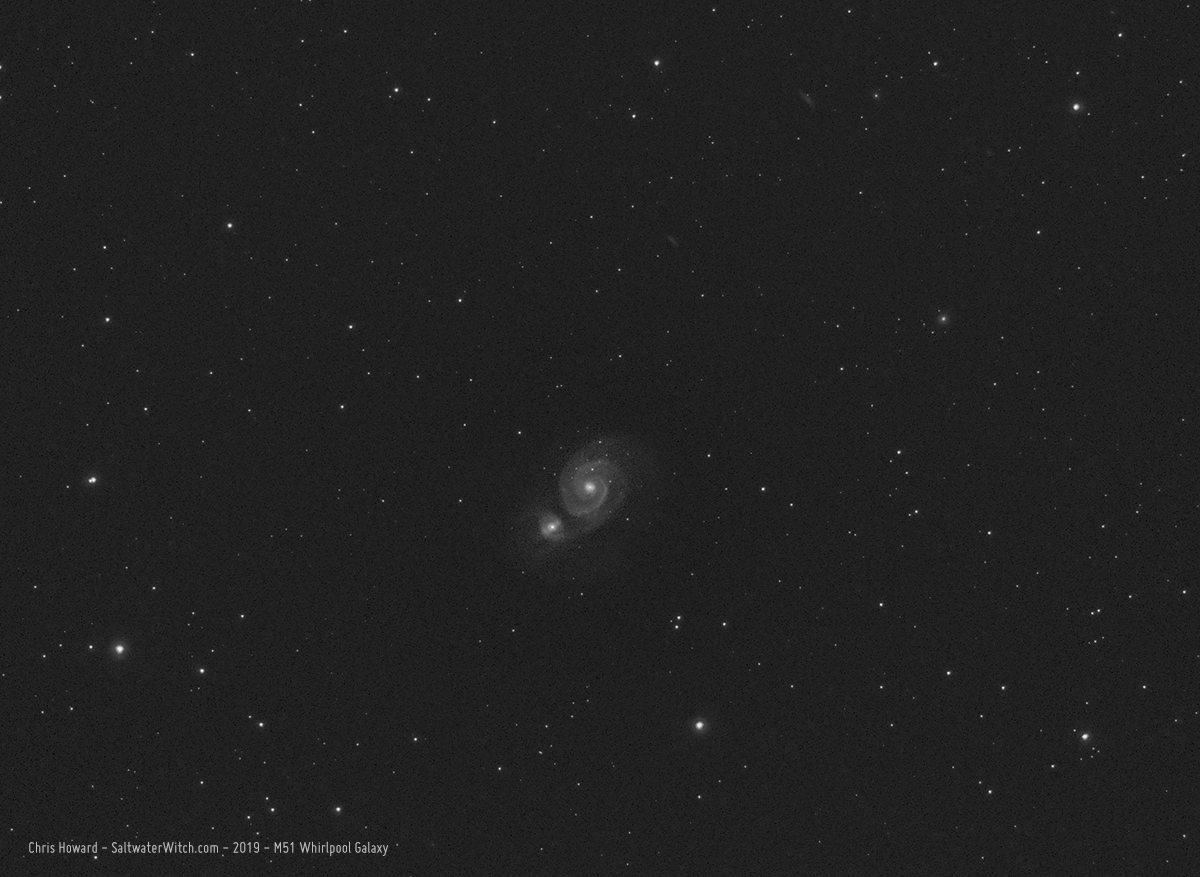
Whirlpool Galaxy (M51) in near-Infrared, WIlliam Optics GT81, ZWO ASI1600MM-Pro mono, 685nm Near-IR longpass filter. M51 is around 23 million lightyears away from us in the constellation Canes Venatici. It’s a tiny view of the galaxies, but I’m impressed with the trailing gas and dust that IR managed to capture.
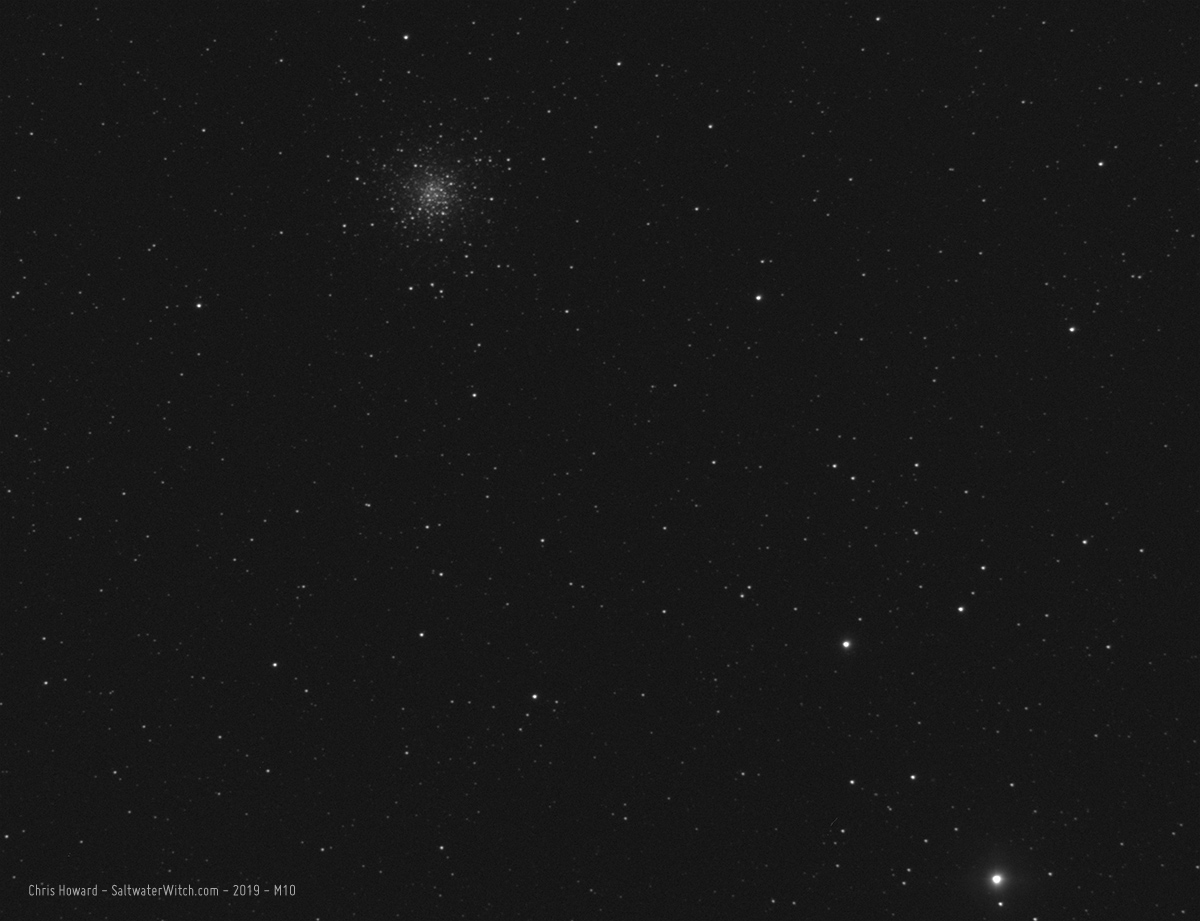
M10 (NGC 6254) is a globular cluster of stars about 14,000 lightyears away in the constellation of Ophiuchus. 4 x 60 second subs in near-Infrared, William Optics GT81, ZWO ASI1600MM-Pro mono, 685nm Near-IR longpass filter. In IR the stars are really distinct in the cluster, and I want to come back with RGB and use the IR frames for luminance, and see how that looks.
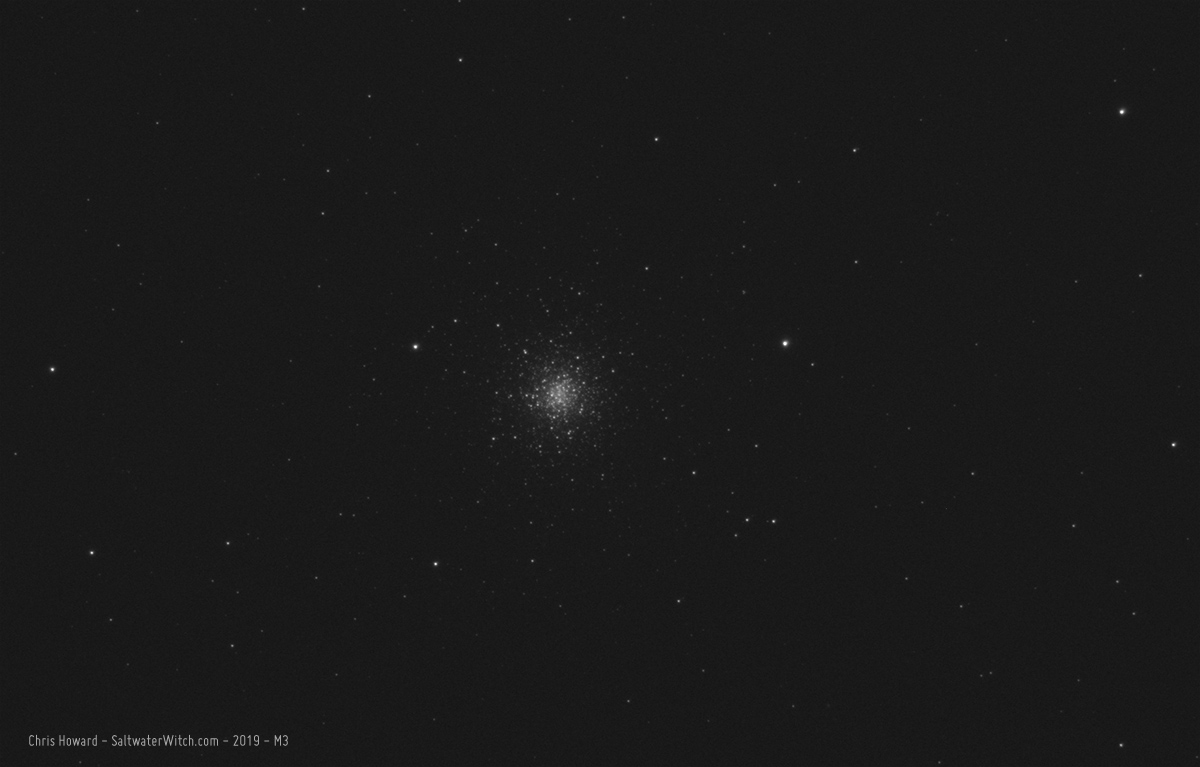
Messier 3 Cluster:
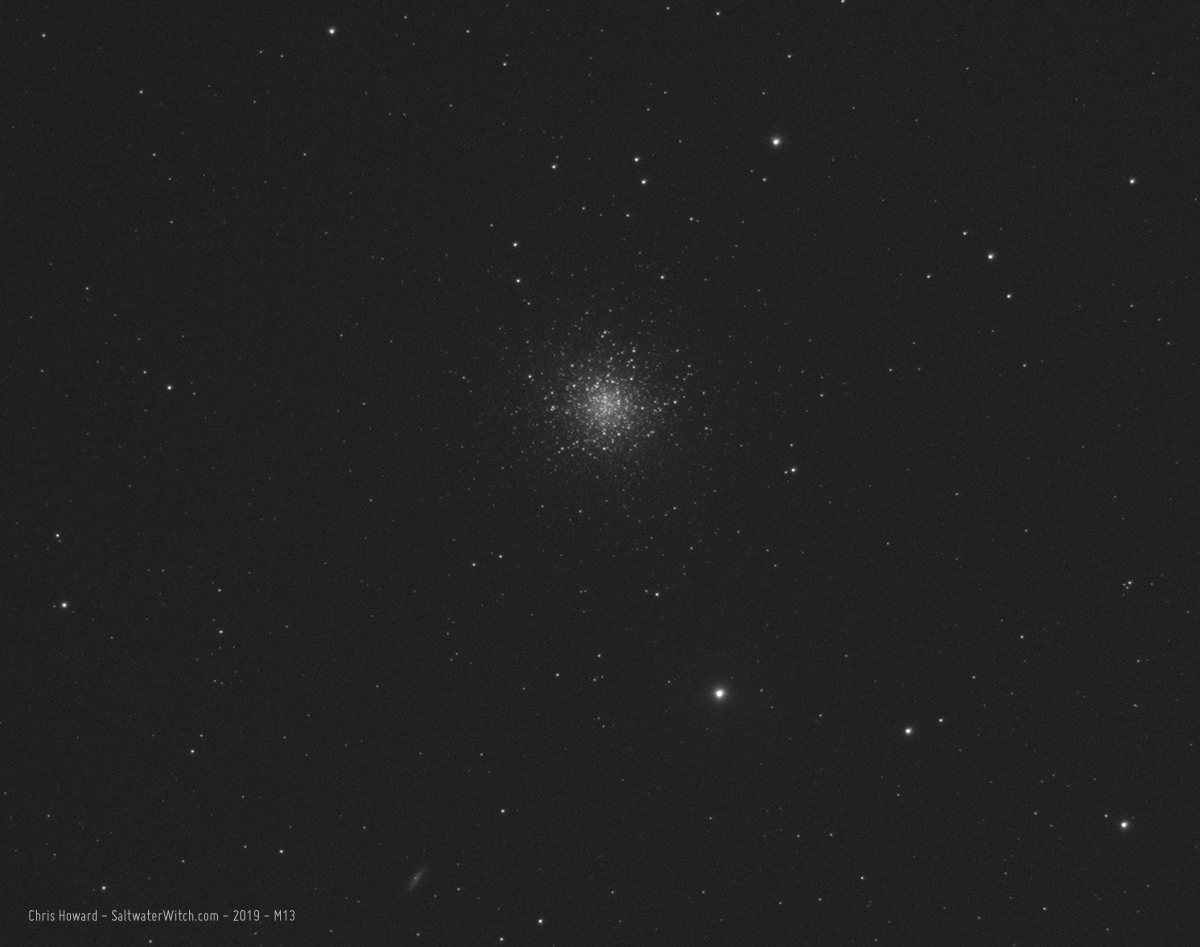
Messier 13 Cluster in Hercules:
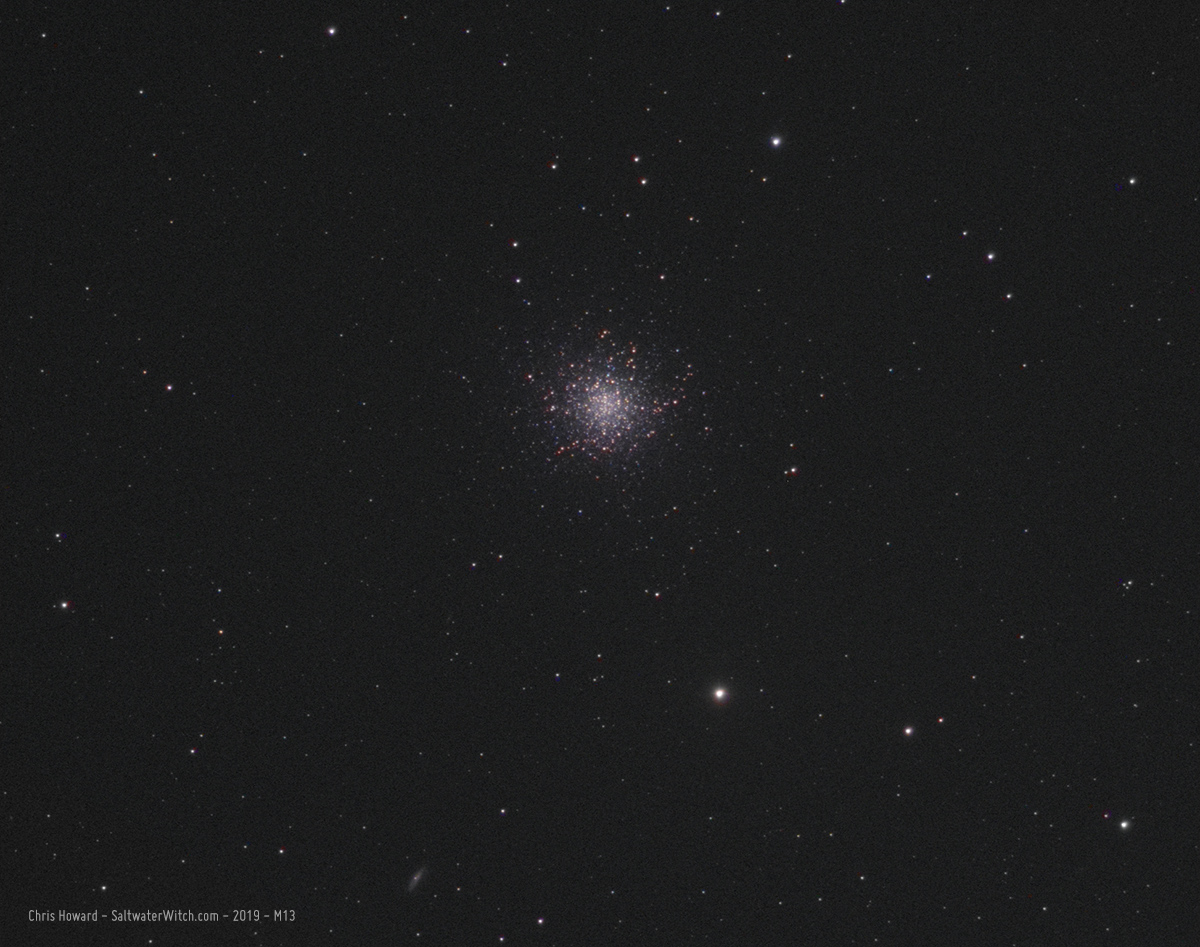
Messier 13, Hercules Globular Cluster (also NGC 6205) - using the IR image as luminance with an old RGB version of M13:
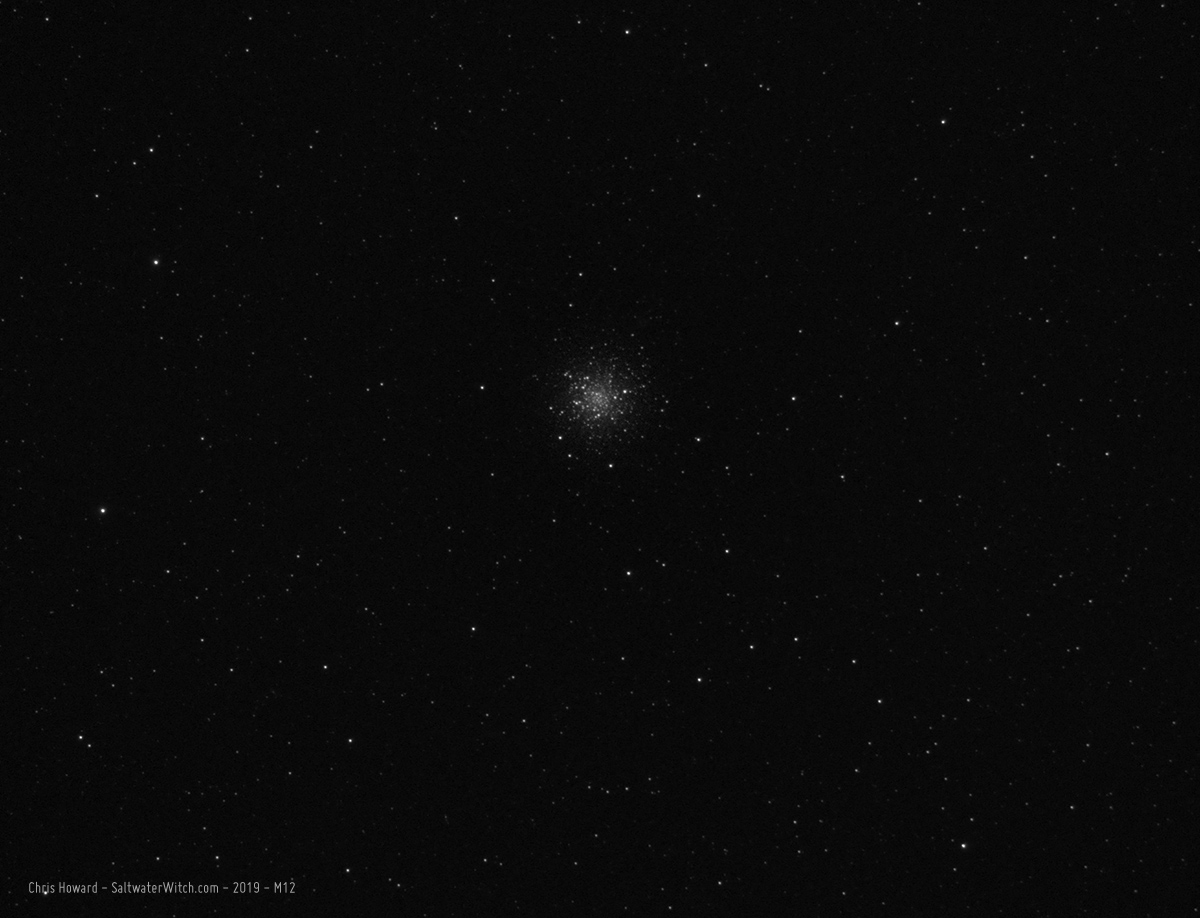
Messier 12 Cluster:
Posted May 23, 2019
SGP and N.I.N.A - Astro Software on Windows
I'm back on Windows to play around with Sequence Generator Pro (http://mainsequencesoftware.com/) and NINA (https://nighttime-imaging.eu/) NINA stands for Nighttime Imagine 'n Astronomy. I used SGP almost exclusively before moving to Ekos/KStars about two years ago. It's one of the most powerful astro apps on Windows, and I've always recommended it. I'm also going to be trying out the latest version of NINA, which just looks amazing. I can't wait to see where this app goes.
Equipment Setup Notes
ZWO ASI 1600MM-Pro
William Optics GT81 + WO 0.8x Reducer
Sensor: 3.8µ pixels, 4656 x 3520
Scale: 2.05"/pixel
f/4.7
FL 382mm
Ap: 81mm
ZWO ASI071MC + Nikon 180mm f/2.8
Sensor: 4.78µ pixels, 4944 x 3284
Scale: 5.47"/pixel
f/2.8
FL: 180mm
Ap: 72mm
ZWO ASI017MC + AstroTech AT6RC
Sensor: 4.78µ pixels, 4944 x 3284
Scale: .73"/pixel
f/9
FL: 1350mm
Ap: 152mm
Nikon D750 + AstroTech AT6RC
Sensor: 5.98µ pixels, 6016 x 4016
Scale: .91"/pixel
f/9
FL: 1350mm
Ap: 152mm
QHY5III178 + 50mm 1.4 lens
Sensor: 2.4µ pixels, 3096 x 2080
Scale: 9.89"/pixel
f/1.4
FL: 50mm
Ap: 36mm
Posted May 19, 2019
Swan Nebula (M17)
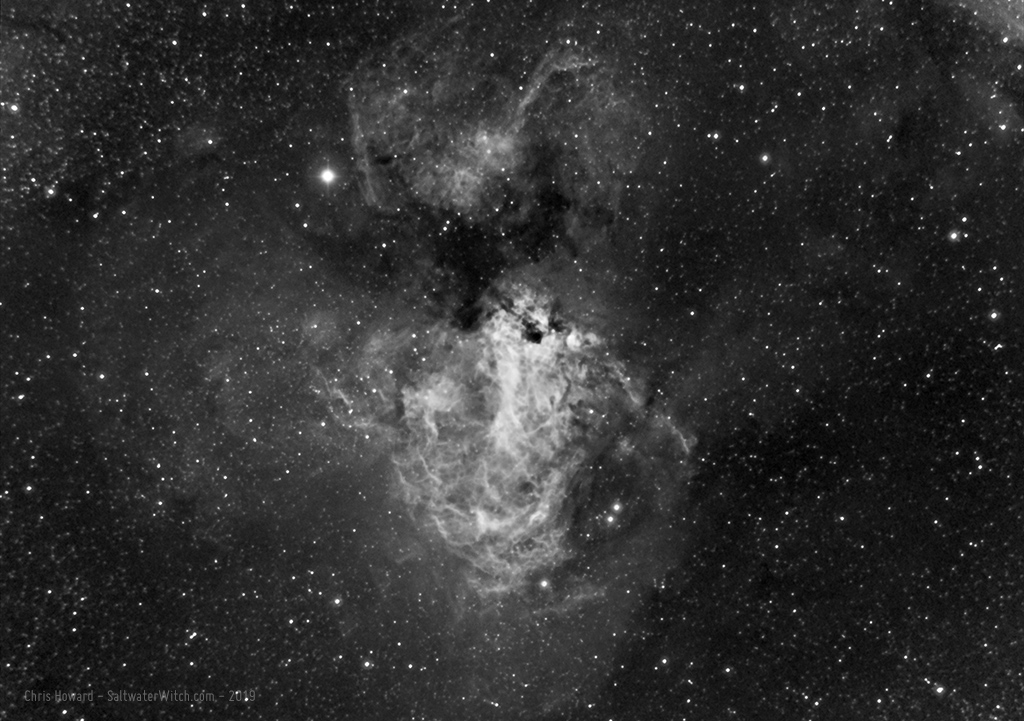
The Swan Nebula (M17) in Hydrogen-alpha (16 x 5 minute exposures with the WilliamOptics ZS61 and Atik414EX mono CCD camera). Reprocessing a set of frames I shot almost a year ago. You can really see the swan in this shot. Messier 17 is also called the Omega Nebula, but I see a swan, and I don't see an Ω. Not really, maybe that loop at the top, the swan's arched neck?