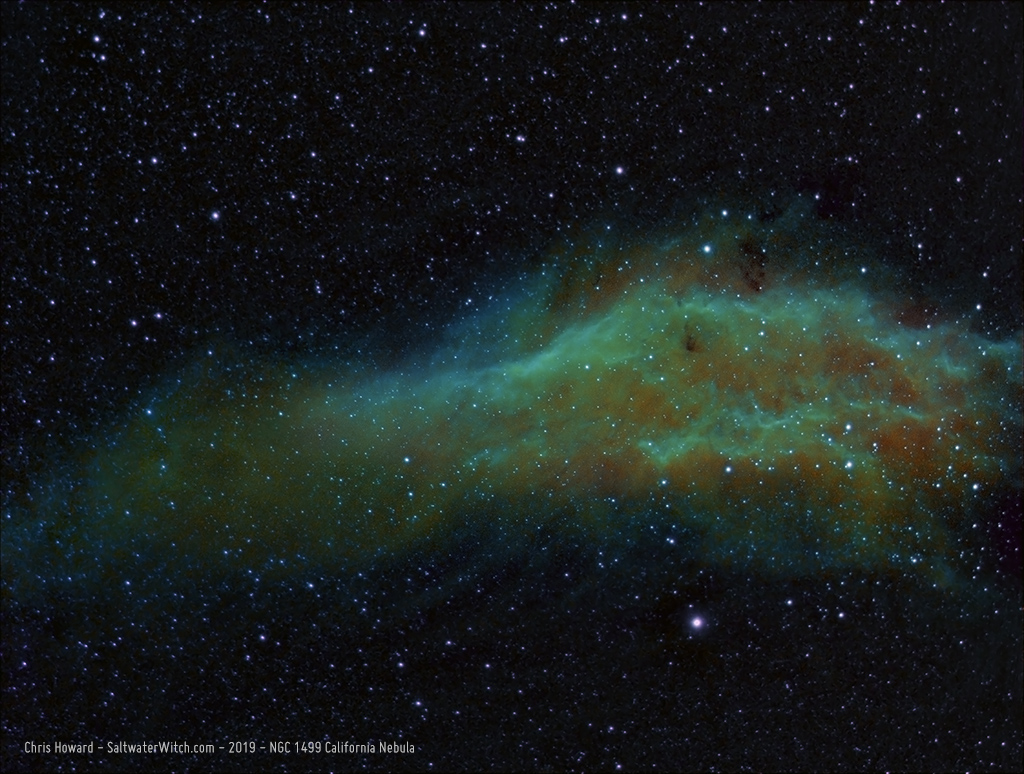
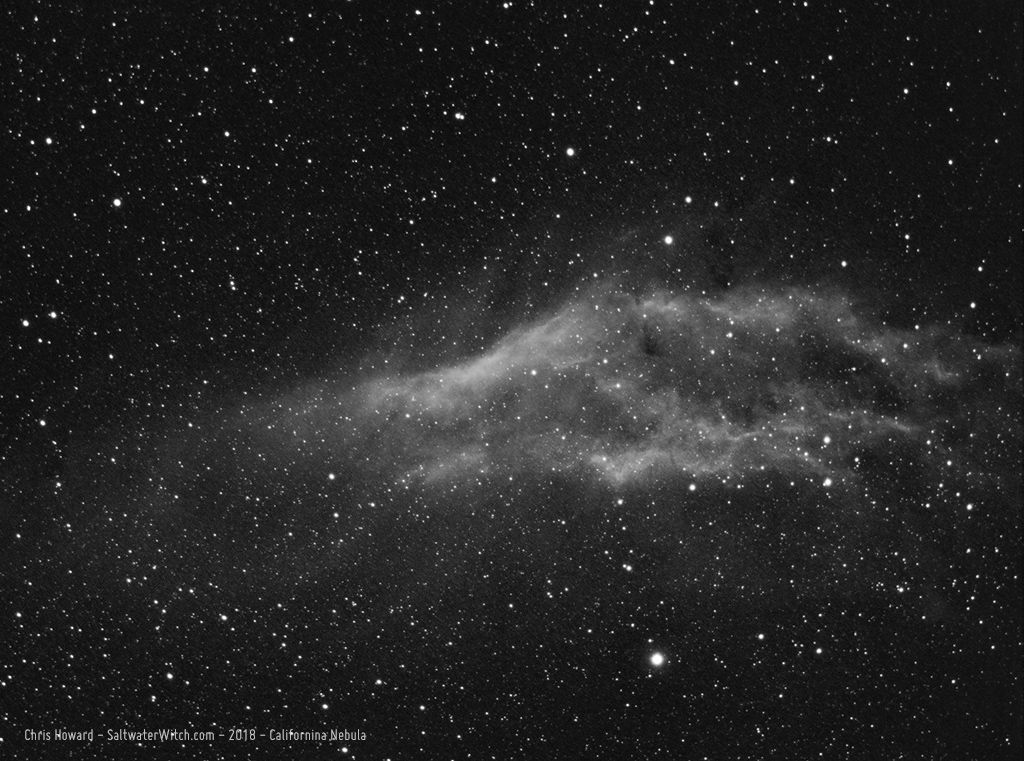
California Nebula - NGC 1499 Bi-color Ha + SII
NGC 1499, California Nebula in bi-color narrowband hydrogen-alpha and sulfur 2. I captured this data on the 25th, but didn't have time to capture oxygen 3 frames with high clouds moving in and the moon rising. Even so, I like the way this turned out with the two bandpasses, almost fluorescent. NGC 1499 is about 1000 lightyears away, and if you haven't guessed, it's called "California Nebula" because if you flip this image 90 degrees counterclockwise it looks like the state.
Posted December 28, 2018
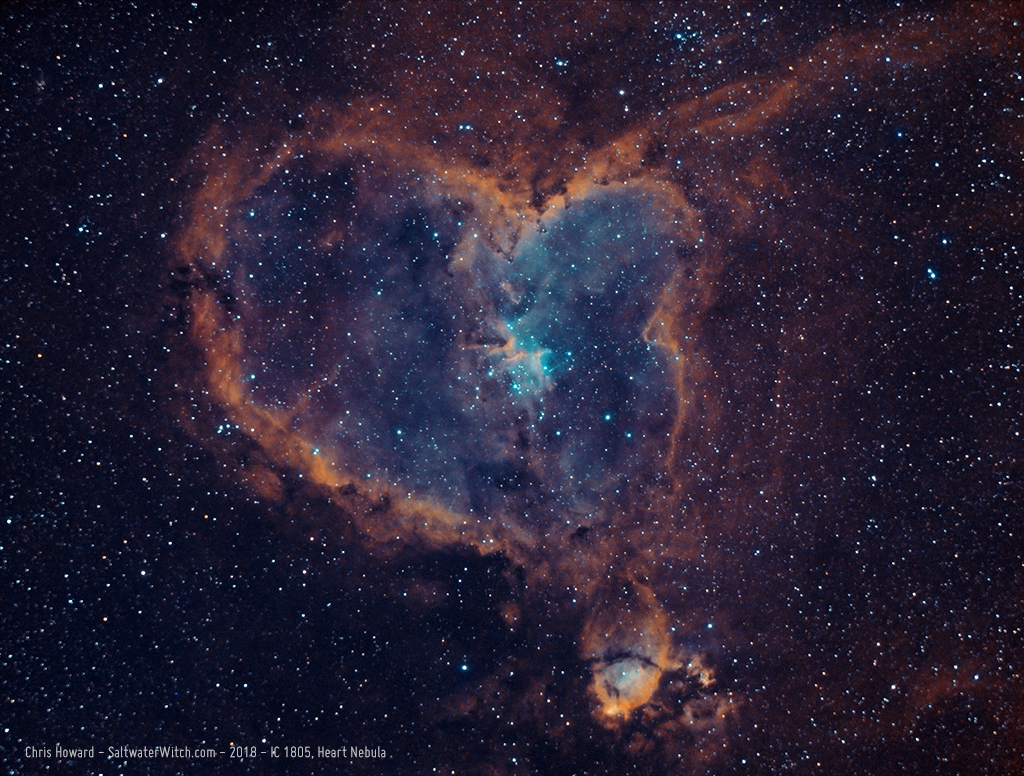
IC 1805 - Heart Nebula in the Hubble Palette
The clouds and icy rain are here, and I've had time to process some of the data I captured over the last two nights. Here's IC 1805 and neighboring nebulae and star clusters in hydrogen-alpha, oxygen 3, sulfur 2 using the Hubble palette (SHO mapped to RGB). The Heart swings around the north celestial pole below the "W" asterism of Cassiopeia, and with trees to the north and the house blocking the view west I don't have all night to capture data. So, I went with the 11 x 300 seconds of Ha, 21 x 300 seconds of OIII, and 13 x 300 seconds of SII. Equipment: William Optics ZS61 APO refractor, ZWO ASI1600MM-Pro monochrome camera (unity gain 139/21), Astronomik filters, iOptron CEM25P mount, INDI/Ekos/KStars running in Stellarmate/Raspberry Pi 3b+.
Posted December 28, 2018
Astro System Update
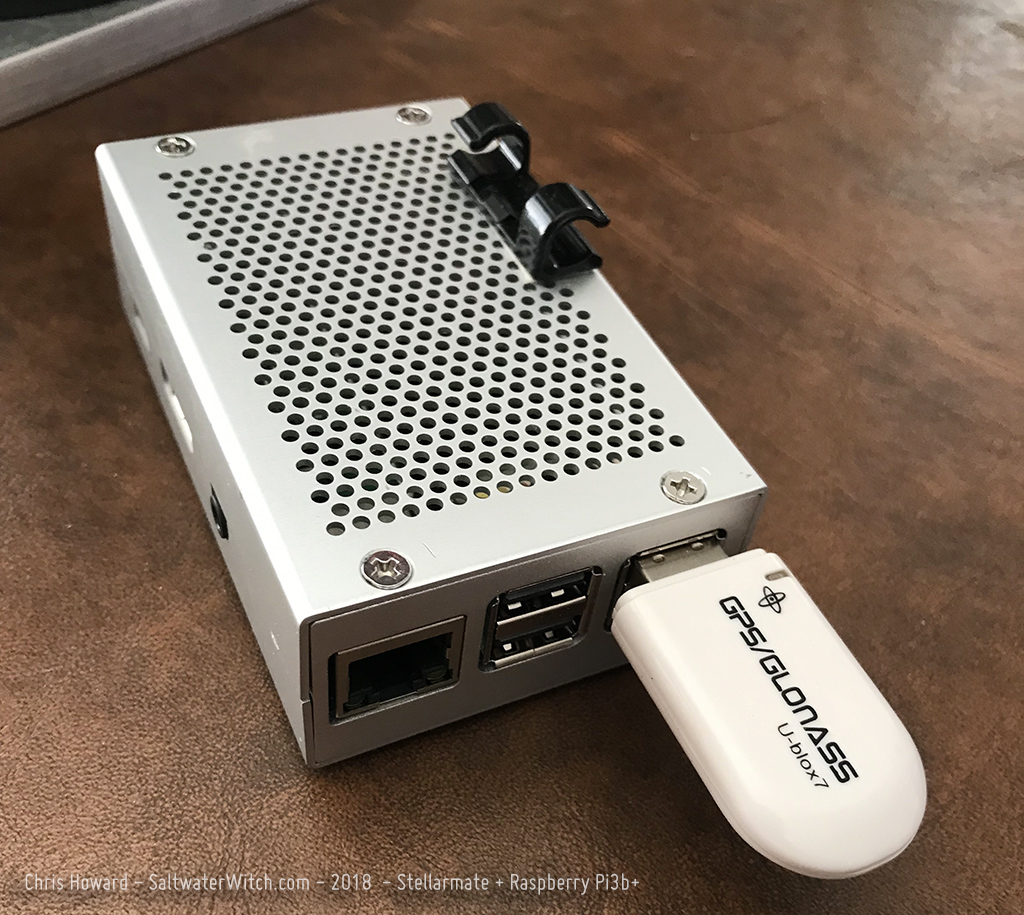
I bought Stellarmate OS in October and installed it on a Raspberry Pi3b+ (The latest Pi with a 1.4GHz 64-bit quad-core processor, dual-band wireless, and Bluetooth 4.2/BLE). This system is now running the INDI server core of my astro setup, and I replaced the second Pi in my "distributed INDI-based astro-imaging setup" post with an iOptron StarFi wireless telescope (mount) adapter. For the Orion Atlas EQ-G mount I'm using the Shoestring bluetooth-to-serial adapter (BT2EQ6 Bluetooth Module with DB-9 connector). I bought an inexpensive GPS dongle to get position and system time for Ekos and KStars. So far, Stellarmate is working out well. The only downside I have experienced is common on any remote astro system, that's the delays in the capture and focus workflows for large FITS files. My Atik 414EX had larger pixels and lower resolution, and ended up with 16-bit FITS files around 3 or 4 MB, while my higher resolution ZWOs (ASI071MC and ASI1600MM-P) are ten times that size.
Posted December 27, 2018
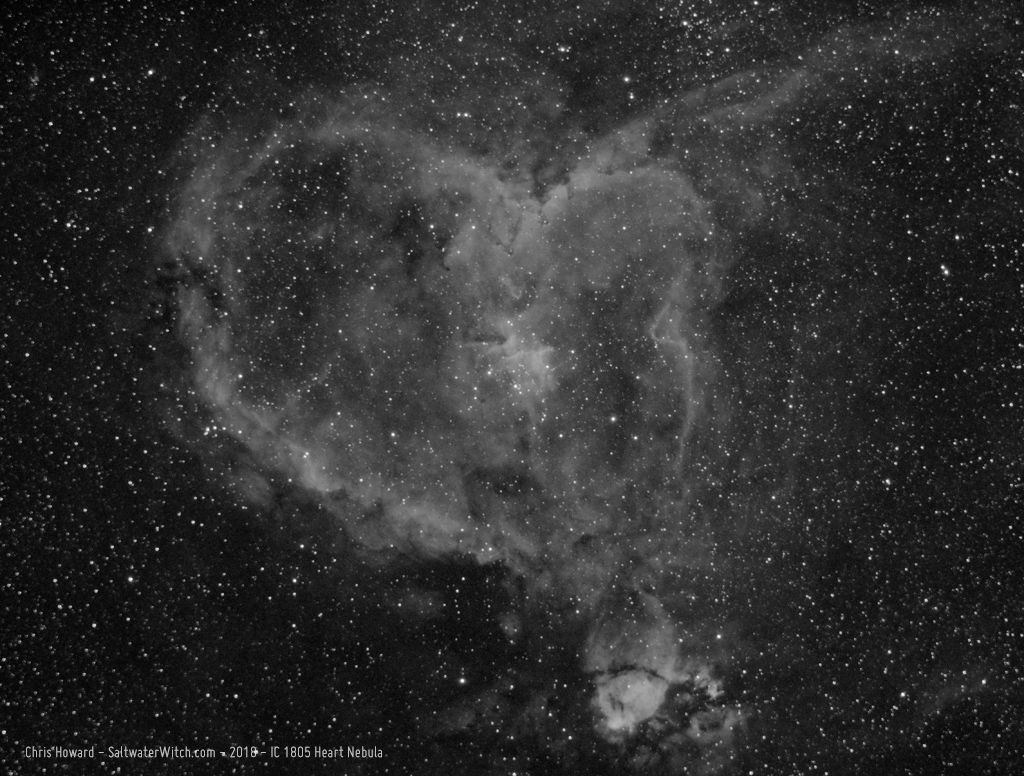
Heart Nebula (IC 1805)
With intermittent clouds rolling through last night it was difficult to stay on one target for long, but I did capture 11 x 300 second hydrogen-alpha frames of IC 1805, the Heart Nebula in the constellation Cassiopeia. This wonderful cloud of ionized hydrogen gas and dust is about 7500 lightyears away, and is made up of a few different nebulae, including the Fish Head (NGC 896) at the bottom, and the cluster of very large stars (some as much as 50 times the size of the sun) in the center (Melotte 15). Equipment: William Optics ZS61 APO refractor, ZWO ASI1600MM-Pro monochrome camera, Astronomik 12nm Ha filter, iOptron CEM25P mount, INDI/Ekos/KStars running in Stellarmate/Raspberry Pi 3b+.
Posted December 27, 2018
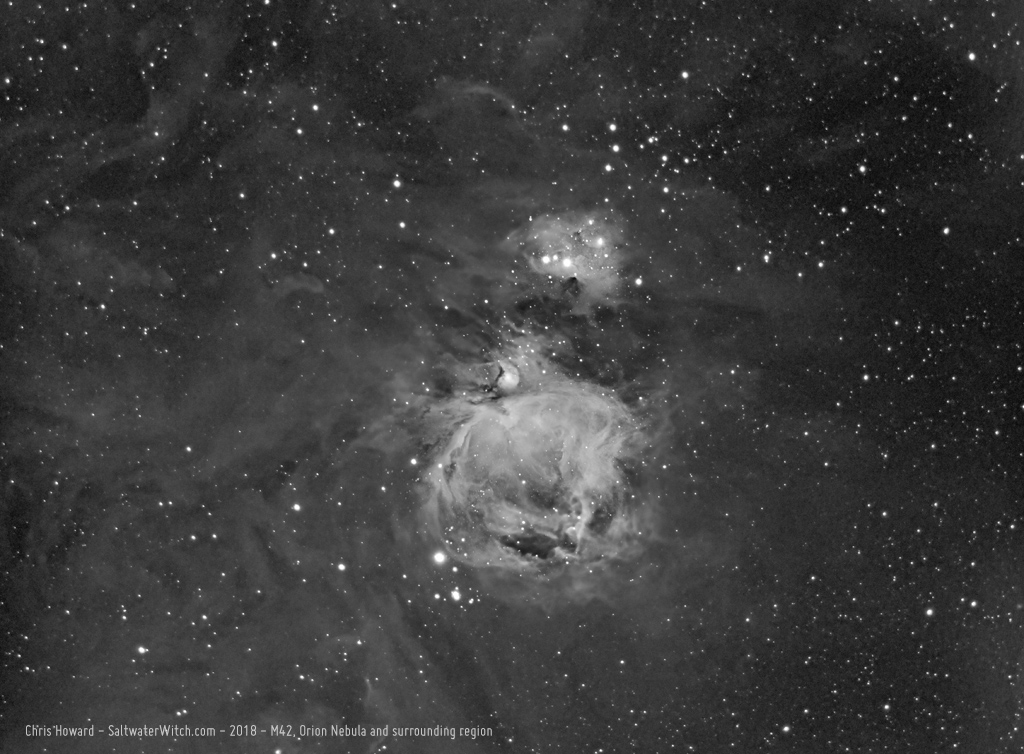
Astro Session with the new ZWO ASI1600MM-Pro
Wide-field of M42, the Orion Nebula--and it's amazing how cloudy and dusty the whole area is. I spent half the night adjusting things--focus distance, off-axis guider spacing, but managed to capture M42 and the surrounding region (two sets of subs: 21 x 300 second, and 20 x 20 second for the bright Nebula core and Trapezium). Calibration frames: 20 Dark and 20 Bias, No flat frames. I shot these with the ZWO ASI1600MM-Pro monochrome camera, Astronomik 12nm Ha filter, William Optics ZS61 APO, iOptron CEM25P mount.
I also managed to capture a dozen frames of the California Nebula:
Posted December 26, 2018
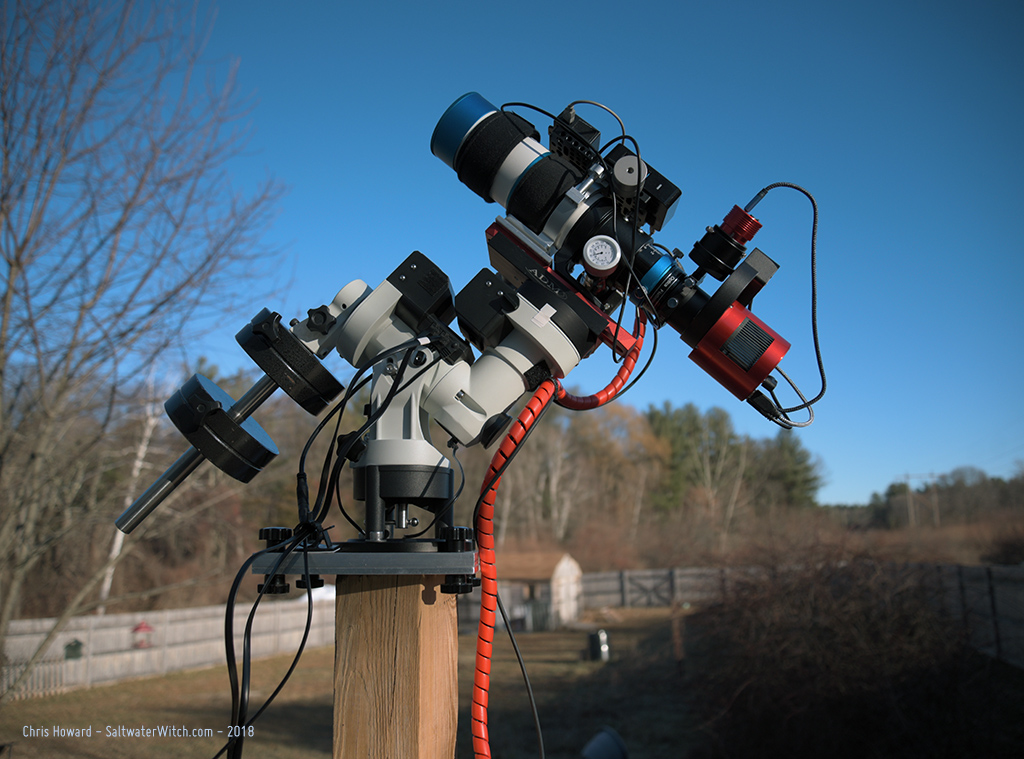
Astro Setup
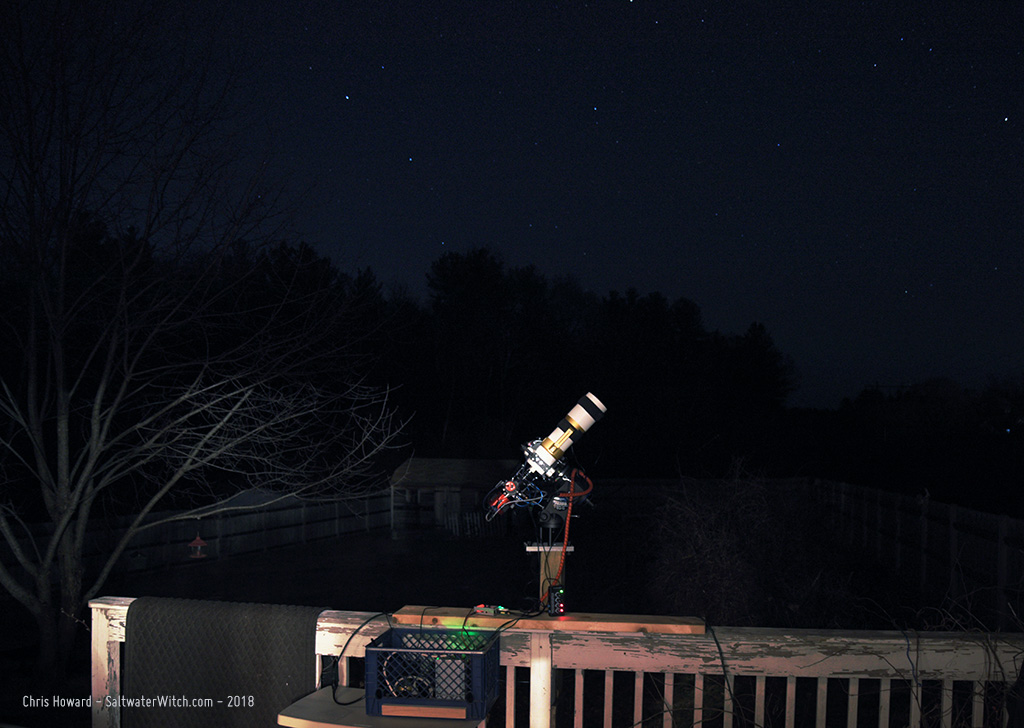
Tonight's setup with the new ZWO ASI1600MM-Pro monochrome camera. Going to test it out with some narrowband targets later.
Posted December 25, 2018
Heart Nebula with the ZWO ASI071MC Color CMOS Camera
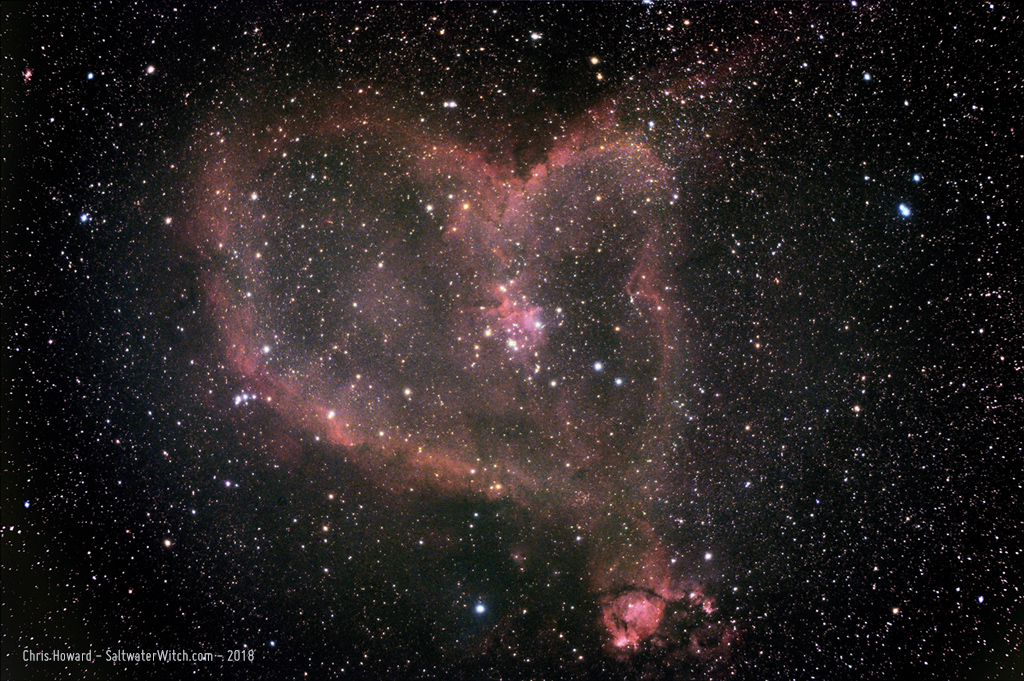
This one of the Heart Nebula (IC 1805) in Cassiopeia is comprised of 27 x 600 second exposures, taken over several nights, with the ZWO ASI071MC and the William Optics GT81 APO refractor, no filters, no calibration frames, stacked in DSS, processed in PSCC 2019. This is pretty impressive for a color camera when you consider the Heart is mostly made up of glowing ionized hydrogen gas and dust (perfect for narrowband imaging), and it's a relatively dim object--with the exception of NGC 896, the bright "Fish Head Nebula" at the bottom.
Posted December 13, 2018
Orion Mosaic
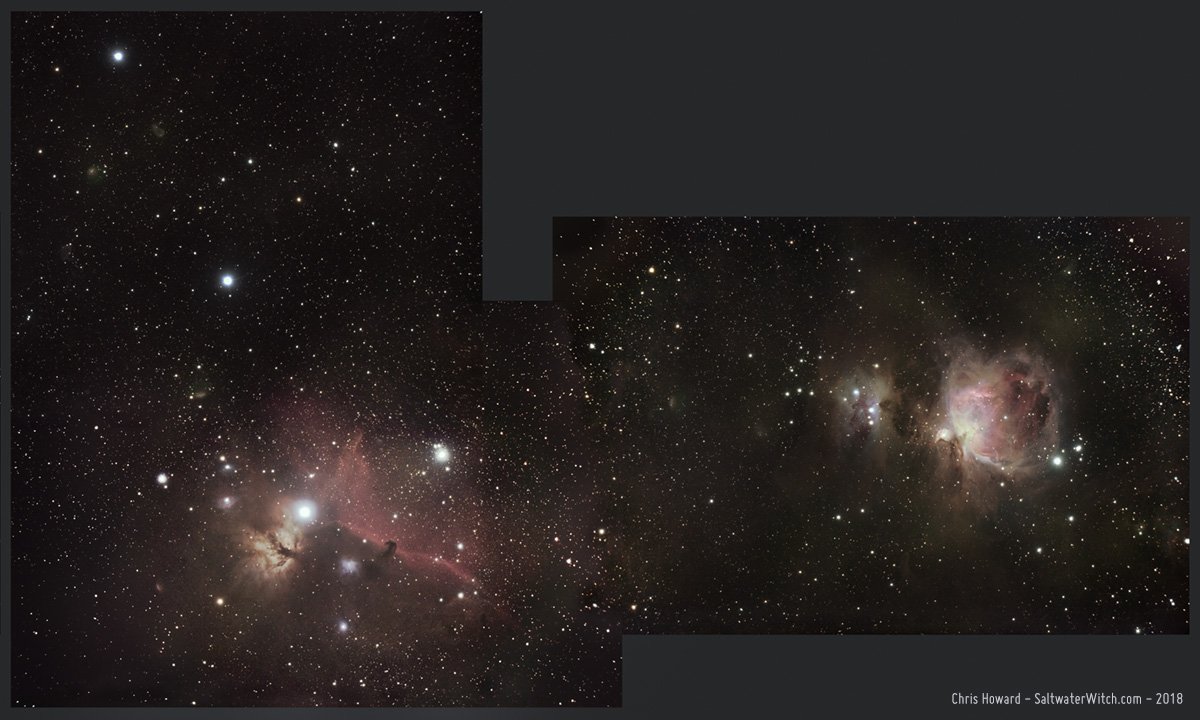
I've had the Orion Atlas EQ-G, William Optics GT81, and ZWO ASI071MC camera set up for the last three days. It's been cold--down around -10C in the early morning hours. With a new moon that's slowly waxing, but still mostly absent from the night sky, I've been using the color camera to capture some amazing targets, including this three panel mosaic of the Orion Nebula (M42), Running Man Nebula, Horsehead Nebula (Barnard 33), Flame Nebula (NGC 2024), and the three giant stars in Orion's Belt, Alnitak, Alnilam, and Mintaka. This is why the Orion Constellation is arguably the sky's most impressive constellation. NOTES: 31 x 300 second exposures for each, with an additional set of 10 and 30 second exposures for the Trapezium in M42--that really bright triangular region. There's just so much fiery star forming action at the heart of the Orion Nebula that any exposure over a dozen seconds is going to blow out the whole area.
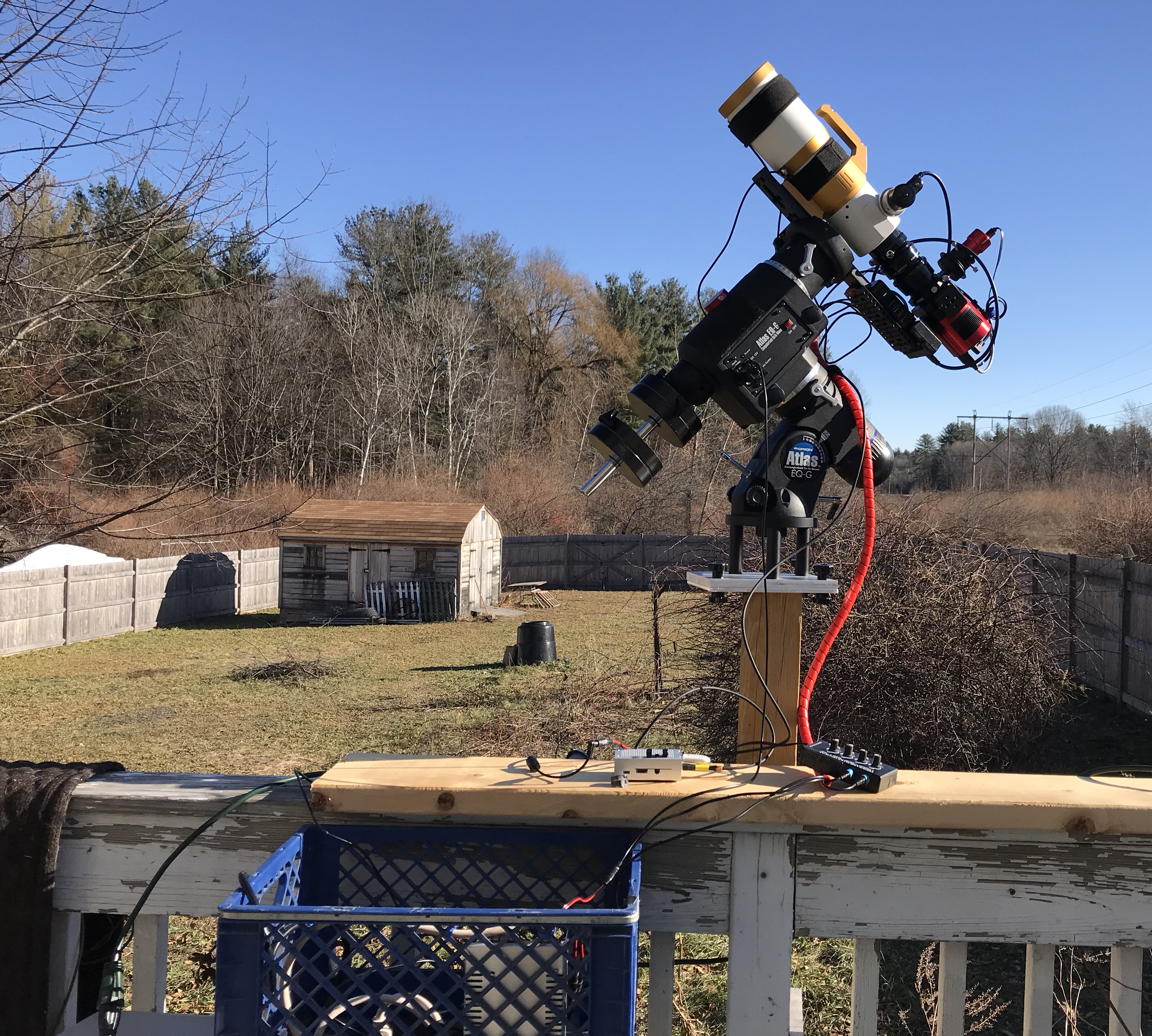
Here's my setup for the last few nights:
Orion at the southern Meridian: