Astro Session - May 24, 2018
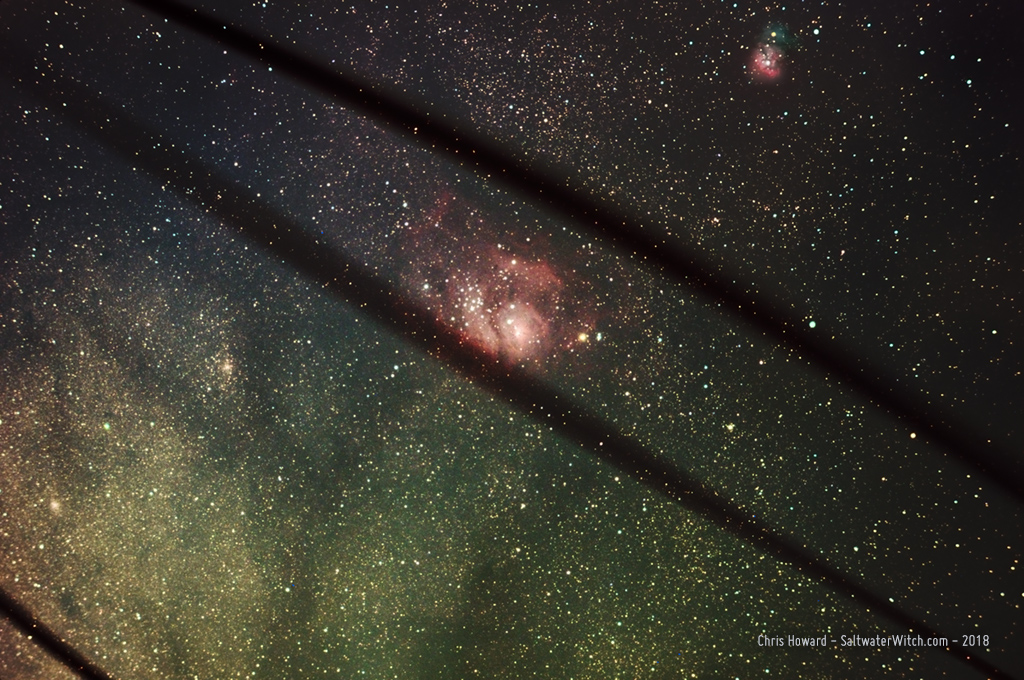
Fourteen stacked frames through the powerlines: The Lagoon Nebula (M8, NGC 6523) and Trifid Nebula (M20, NGC 6514). We have a couple sets of transmission lines running east-west south of our property, and unfortunately they interfere with the amazing stuff in the constellation Sagittarius, which is even lower on the horizon than Serpens (also amazing). Transit for M8 is 23°, compared with 33° or so for the Eagle Nebula. We really need to take a trip south to get a better view of these beautiful ionized hydrogen structures. At the middle and lower left I also captured two globular clusters, NGC 6544 and NGC 6553. That's a very bright section of the milky way lighting up the whole lower left of the frame. Yes, there are stars running through the long bands of power lines, because over the 16 or so minutes of exposure time the earth rotated about four degrees. So, those stars were not obscured by the lines in some of my exposures, but when I stack them all together, aligning all the stars, they're going to appear where they were when camera caught them. That's also why the powerlines appear blurry--they're actually smeared out across the frame. They are much narrower and sharper than that in the individual subs. What's funny--to me, anyway--is that I was shooting the Eagle Nebula, and after 30 or so exposures I started to wonder if I had a chance to get the Lagoon Nebula. I slewed even lower toward the horizon, took a test frame, and saw the powerlines running through it...and thought what the hell, maybe the lines will look kind of cool in the foreground.
North America Nebula (NGC 7000) 50 stacked frames from the ZWO071MC camera.
The Eagle Nebula, Messier 16, sometimes called Star Queen is a diffuse nebula in the constellation Serpens. M16 was only 22° above the horizon to the southeast when I was taking these subs, low enough to have the atmosphere and some light pollution from Hampton affect the result. Even so, I'm here in New Hampshire at 43° latitude, and I'll take any chance I can get to shoot the Eagle Nebula.
Swan Nebula (M17, Checkmark Nebula, Omega Nebula, NGC 6618) is another H II region in the constellation Sagittarius.
The Great (and powerful) Globular Cluster in the constellation Hercules (M13) with a hint of the spiral galaxy NGC 6207 at the top. Last night was my first night out with the William Optics ZenithStar 61, and as I expected, it's just a brilliant little refractor. Paired with the ZWO ASI071MC cooled camera and the WO 0.8x Flat/Reducer F6-A, you get a spectacular 4.7° × 3.1° field of view--that's a big chunk of the sky. If you're looking for a pretty fast widefield apochromatic, this is it. It's not the best choice for the Hercules cluster, but I was just slewing all over the sky, taking pictures, and waiting for the North America Nebula to get above 30 degrees.
Posted May 24, 2018
Astro Session - May 18, 2018
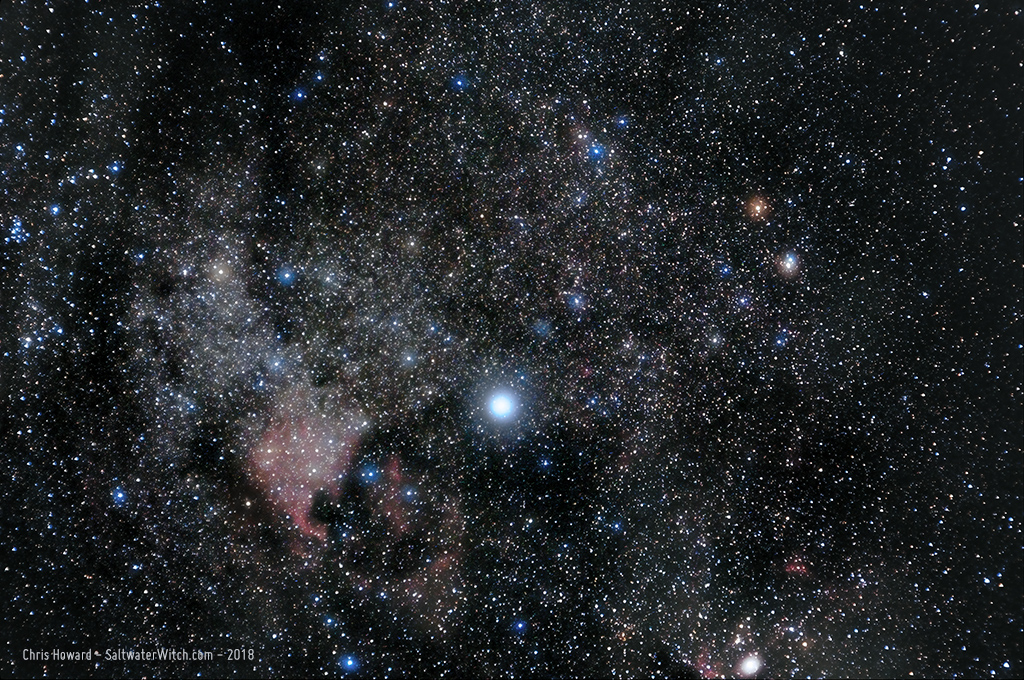
We have not had a really clear night for a month, and last night was still fairly poor for imaging. Even so, I set up the ZWOASI071C paired with a Nikon 24-85mm lens to see what I could capture for a wide-field shot centered on the star Deneb in the constellation Cygnus. This area of the Milky Way just happens to be surrounded by some distinctive clouds of ionized hydrogen, including the North America Nebula (NGC7000) and the Pelican Nebula (IC 5070). Both of these are pretty faint, but they are large, so if you stack enough frames you can bring out enough to see why NGC7000 was given its name. For size comparison, the North America Nebula is four times the size of a full moon. (122 stacked 30 sec. frames, ZWO ASI071MC cooled CMOS camera, iOptron CEM25P EQ mount, Nikon 24-85mm F/3.5-4.5 ED lens @ 85mm. Location: Stratham, New Hampshire, US. Bortle ~4)
Posted May 18, 2018
Astro Session - May 7, 2018
Last night I tested out an inexpensive super-wide-angle 6mm C-mount lens hooked up to my QHYIII178 color CMOS camera (without the IR cut filter, which is why the trees are a bit odd looking). It was pretty cloudy to start and the whole view was fogged in by 3am, but I still managed to get the Milky Way as it was sweeping up and across the sky. This camera + lens would make a nice all-sky type setup, but I'm thinking about using this to capture the full night sky when we have meteor showers--the Lyrids, Perseids, Geminids. This shot is from one of the third-floor windows, facing east. (Our attic is finished). I can stick the camera with a long USB3 cable on the end of an 8-foot length of PVC pipe--out the same window--to get it above the roof of the house and get the whole sky in view. Then I can use SharpCap (https://www.sharpcap.co.uk) to capture several thousand 10-second frames over the course of the night, and bring them together into a video.
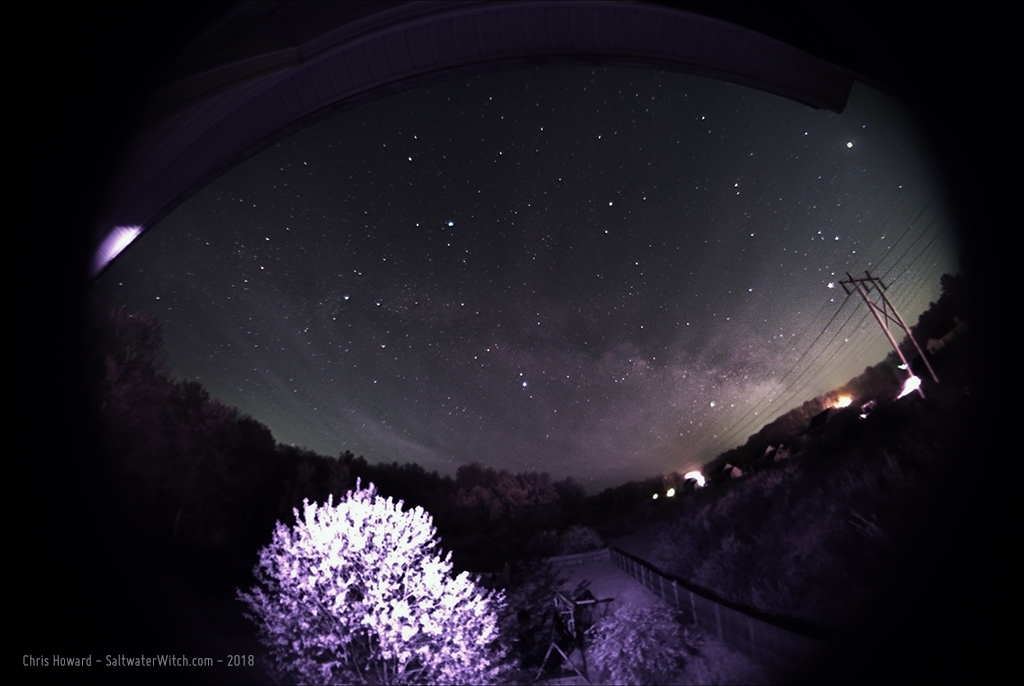
Now with video and me talking! Night Sky Video test with the QHYIII178C CMOS camera and 6mm wide-angle lens--with me yapping about the camera and other equipment, explaining settings and other interesting stuff about this all-sky setup. My plan is to use this the next time our planet's orbit takes us through the path of some comet's orbit. (one of the ways we get seasonal meteor showers).
Watch the full video:
Posted May 7, 2018
Astro Session - April 22, 2018
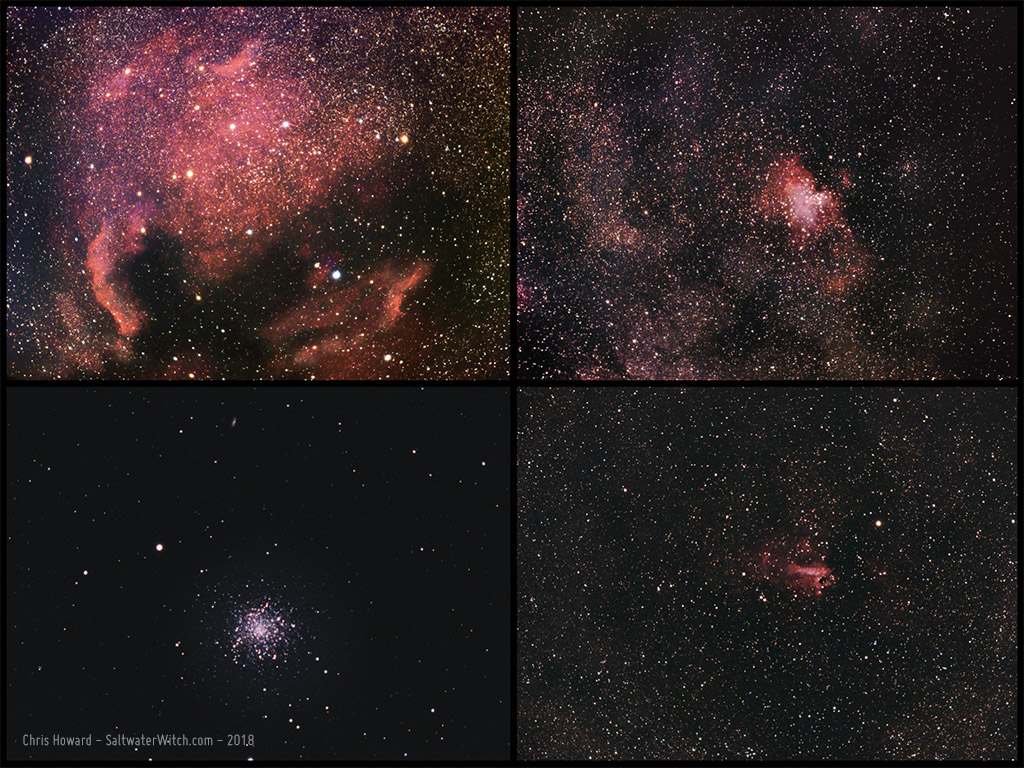
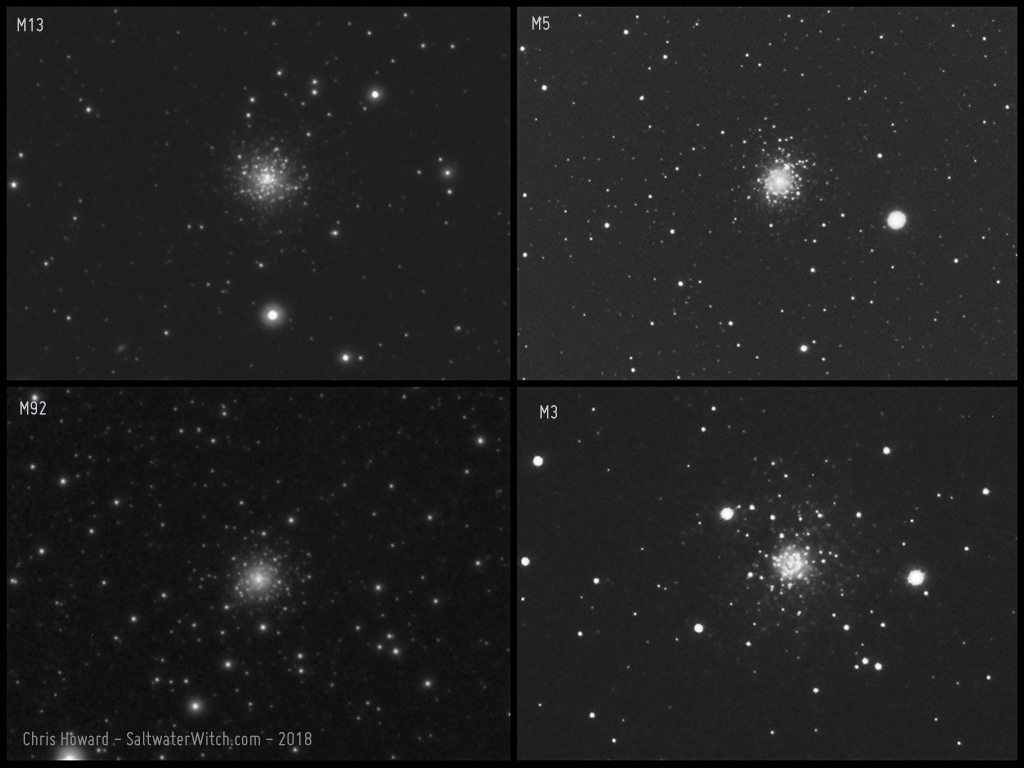 Although the skies were clear last night, the "seeing" wasn't great--"seeing" refers to the amount of atmospheric interference from temperature changes, convection currents, and other funny stuff going on in the air above your telescope. I did get to test out the Pentax 200mm f/4 lens with the Atik 414EX monochrome CCD, and an Ha longpass filter. These clusters are fairly small, so this isn't a very good setup for shooting them, but here you go anyway. Top left: the 300,000 stars that make up Messier 13 (NGC 6205), a globular cluster in the constellation Hercules. Messier 5 in the constellation Serpens. The M3 globular cluster the constellation Canes Venatici. Messier 92 (NGC 6341) is another cluster in the constellation Hercules.
Posted April 22, 2018
Astro Session - April 5, 2018
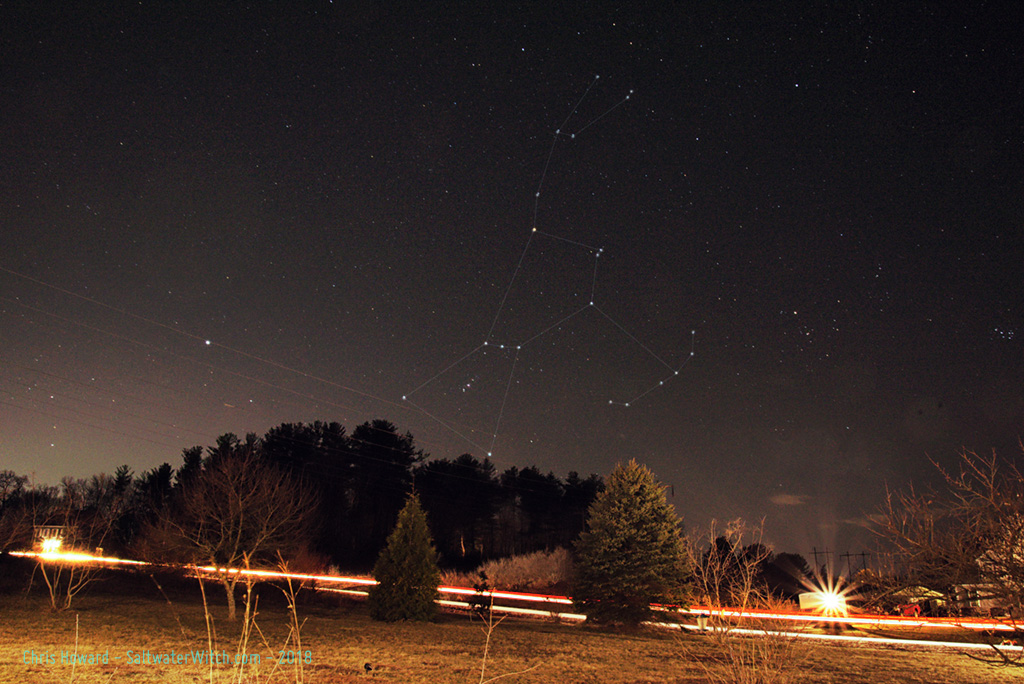
As the days become longer, as we swing around our sun, headed for aphelion in July (greatest distance from the sun), and our planet's 23.5 degree tilt is angled toward its rays, we'll be seeing less of the constellation Orion--in normal viewing hours. I took this 30 second exposure last night around 9PM, and Orion is already moving below the trees to the southwest. That's the Pleiades (M45) at the far right. I also happened to capture the headlights and brakelights of Alice's car as she's driving past to our driveway, almost home after picking up Christopher from work.
Posted April 5, 2018
Astro Session - March 16, 2018
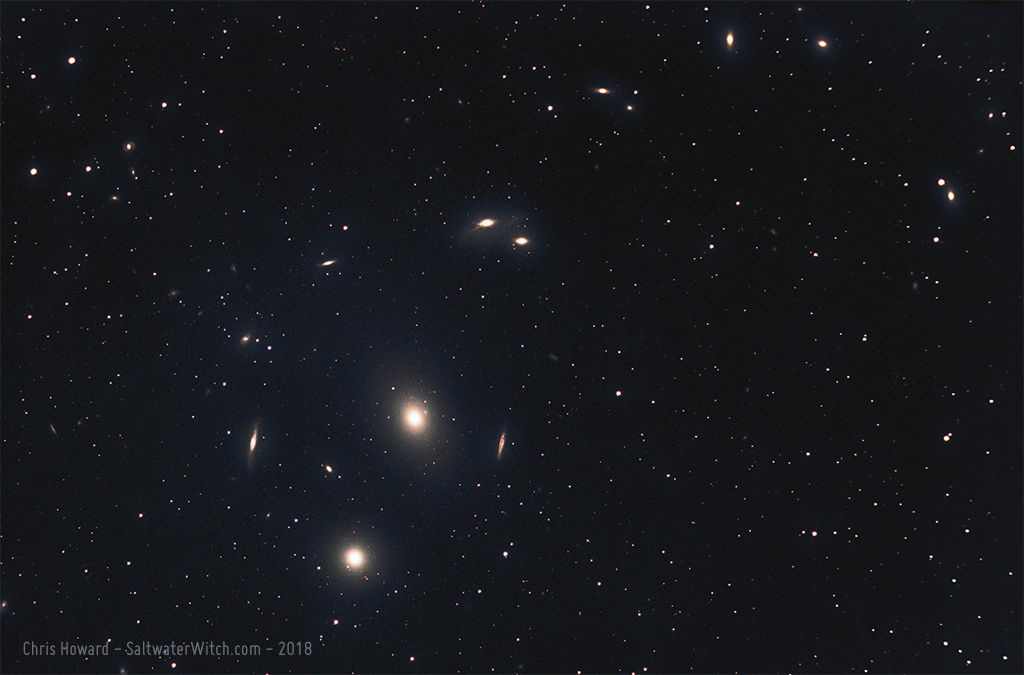
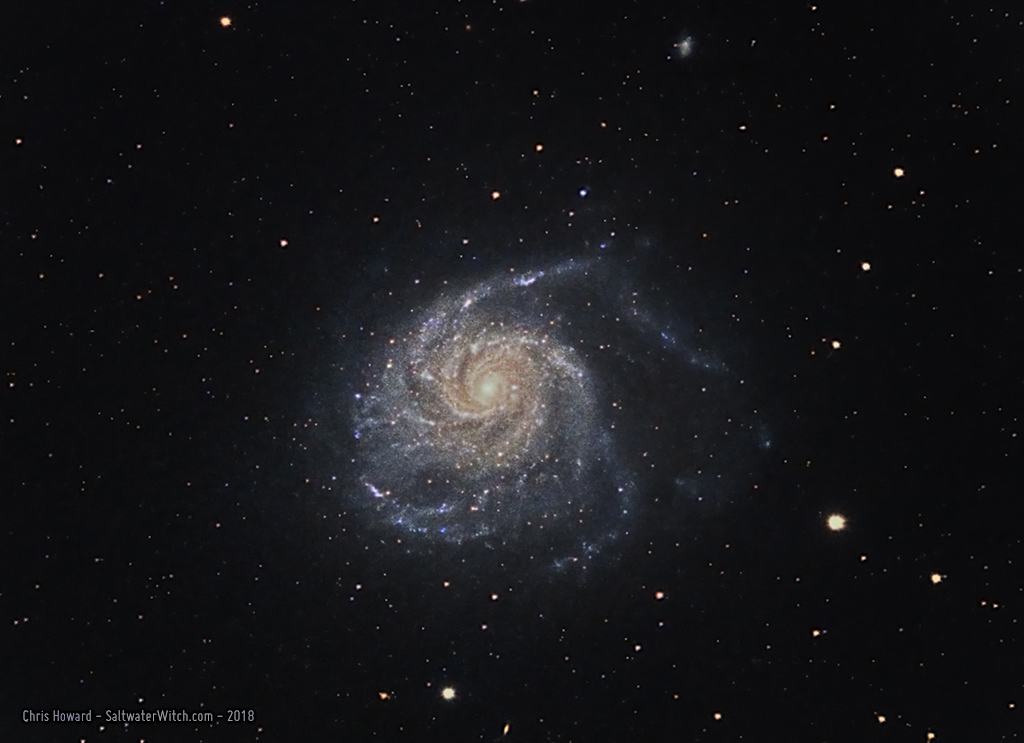
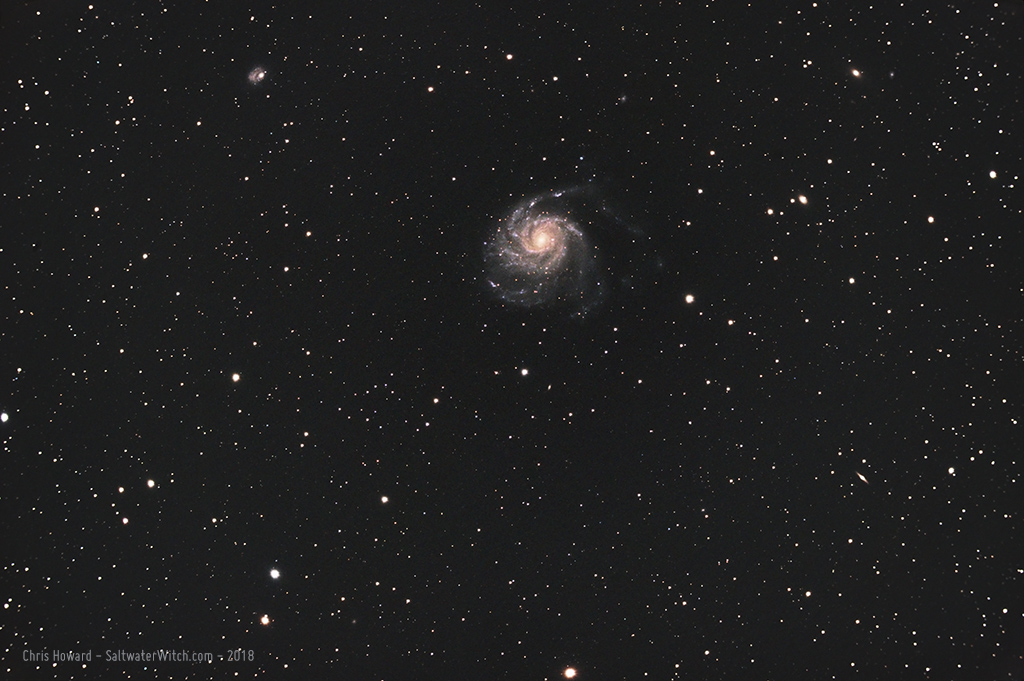
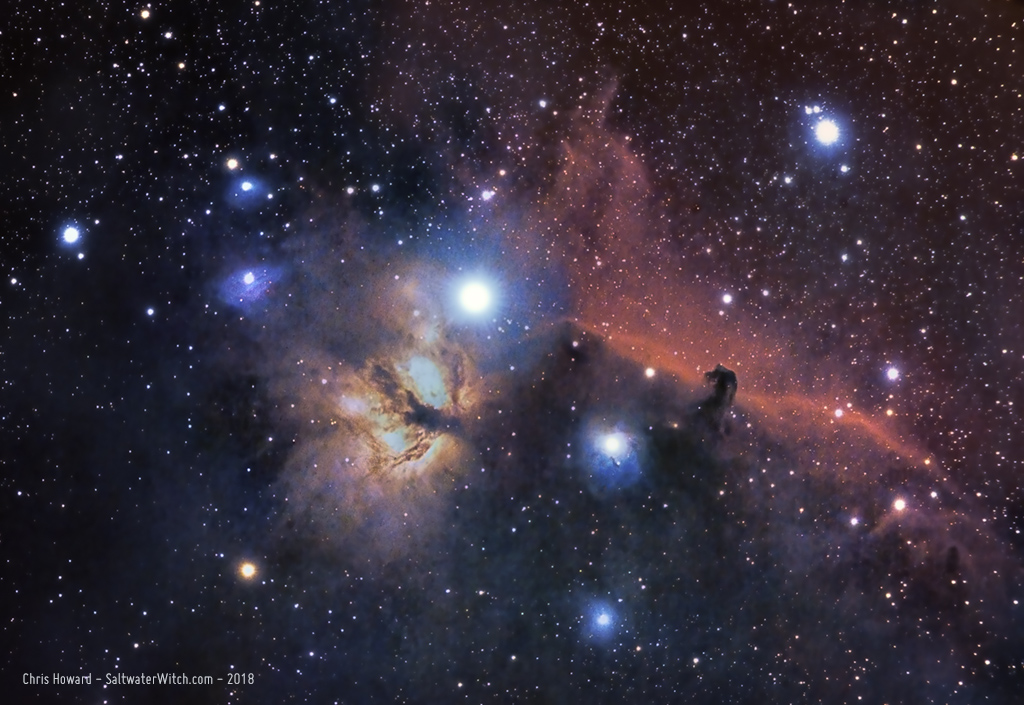
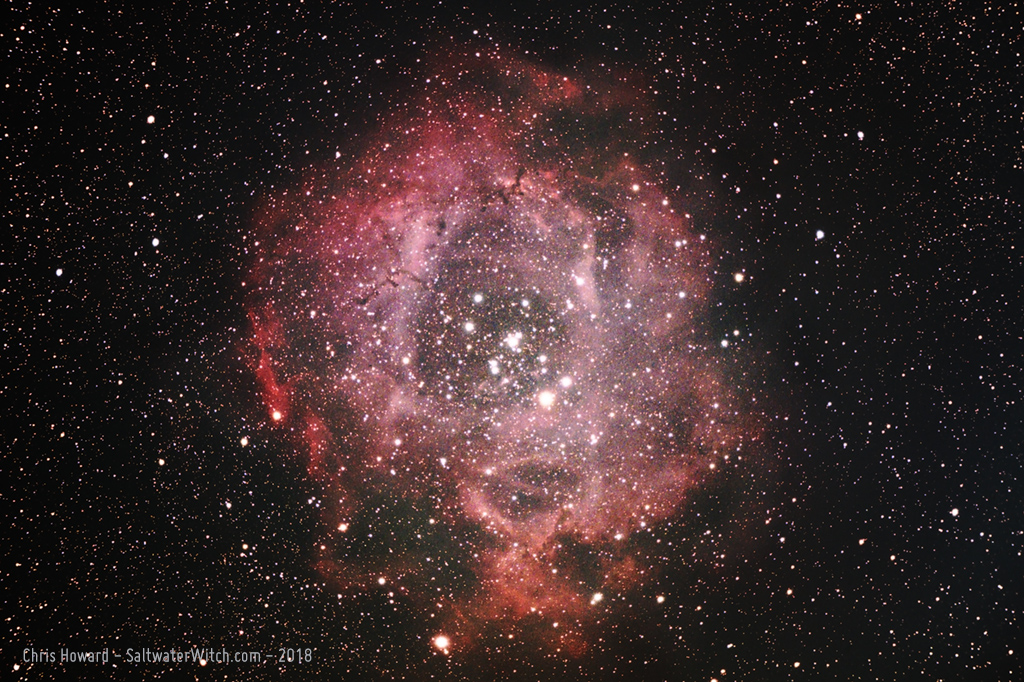 This was the first chance I've had to put the ZWO ASI071MC through some serious long exposure tests on four very different targets, the region around Alnitak in Orion, the Rosette Nebula, Markarian's Chain, and M101. I ran most of these frames with unity gain (90 Gain, 20 Offset), and I built up a nice library of dark calibration frames in the afternoon, for 600, 300, and 120 second exposure times.
Rosette Nebular Region - Caldwell 49 (13 x 300 sec frames, 24 dark calibration frames) in the constellation Monoceros, about 5000 lightyears from earth. William Optics GT81 APO refractor, ZWO ASI071MC-C camera, iOptron CEM25P EQ mount.
A whole string of galaxies millions of lightyears from earth. Markarian's Chain in the Virgo Cluster, including M84, M86, the Eyes Galaxies (NGC 4435 and NGC 4438) and a few more galaxies and galaxy pairs. The Eyes are 52 million lightyears away! 30 x 120 sec frames, 20 dark frames, stacked in DSS. William Optics GT81 APO refractor, ZWO ASI071MC-C camera, iOptron CEM25P EQ mount.
Pinwheel Galaxy, M101, a spiral galaxy about 21 million lightyears from earth in the constellation Ursa Major (Big Dipper). (Light frames: 10 x 120 secs, 4 x 600 secs, 12 x 300 secs). William Optics GT81 APO refractor, ZWO ASI071MC-C camera, iOptron CEM25P EQ mount, INDI/KStars/Ekos.
Part of the Orion Molecular Cloud Complex that surrounds the blue supergiant Alnitak (large star in the center), including the Flame Nebula (NGC 2024), IC 434, Horsehead Nebula (Barnard 33), NGC 2023, IC 431, and more. About 1500 lightyears from earth. (22 x 300 sec frames, 24 dark frames). William Optics GT81 APO refractor, ZWO ASI071MC-C camera, iOptron CEM25P EQ mount. In case you're wondering, I'm pretty damned excited about this camera (ZWO ASI071MC), just going off what it can capture in faint nebulosity, and what I can bring out without much effort by stretching 22 stacked frames. I can't wait to see what I can capture in the summer when the big galaxies like Andromeda and Triangulum swing through.
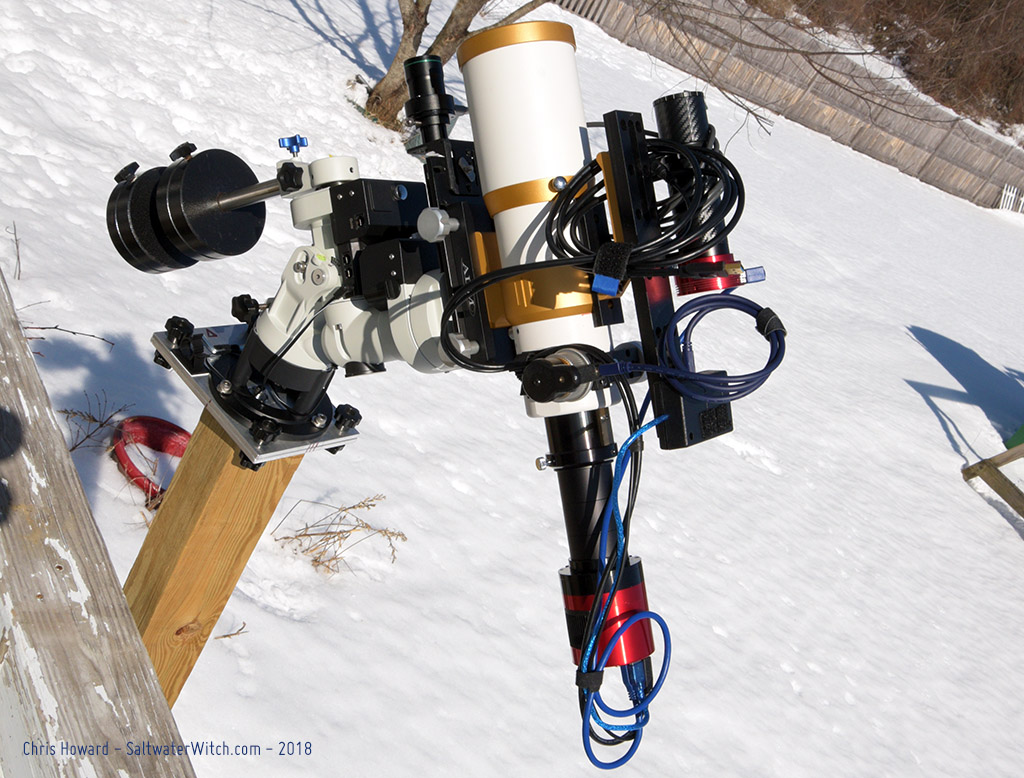
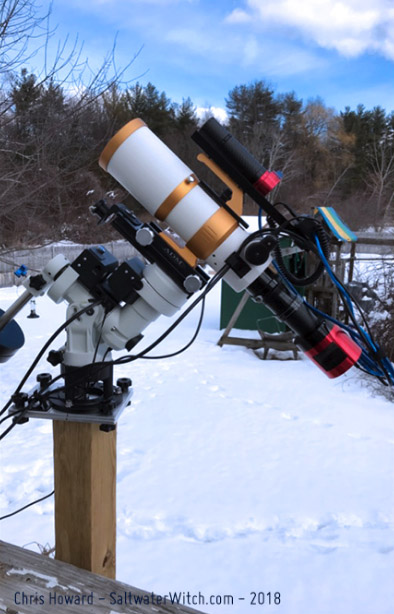
Here's my setup for last night's astro session, with the William Optics GT81 APO refractor, ZWO ASI071MC-C primary camera, iOptron CEM25P EQ mount.
Posted March 16, 2018
Astro Session - March 11, 2018
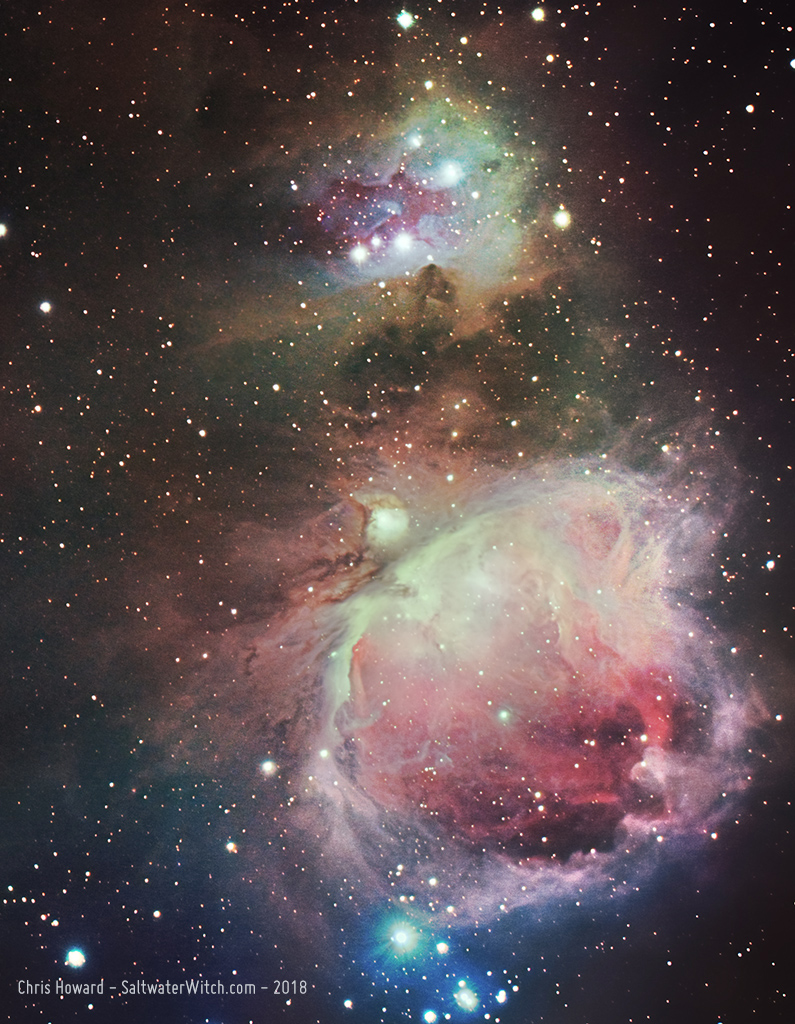
 First test shots of M42, the Orion Nebula, M43 De Mairan’s Nebula, Sh2-279 Running Man with the ZWO ASI071MC cooled CMOS camera. No calibration frames, just 17 stacked 300 second light frames, with the sensor cooled to -10C. Last night was not very clear, scattered clouds, fairly poor seeing. I can't wait to test things out with some really clear and dark skies. I definitely need cal frames, because things ended up pretty noisy after processing. I will say, so far, with only a few hours of use, I'm impressed with this ZWO color camera. That doesn't surprise me. ZWO makes a solid camera--I've been using an ASI120MM-S for several years, as my guide camera. It's fast--USB 3, with a small but very sensitive monochrome sensor, and it just always works under any OS on a variety of hardware--Windows, Linux, MacOS. That's what I meant--it shouldn't surprise me that the ASI071MC (quite a bit more expensive and a far more capable camera) just works well. What did surprise me is how much this camera can pick up, bringing out some very faint nebulous areas. I know it has a very wide/high dynamic range. That's one of the things I was looking for in an OSC camera. For this M42 test I used a Gain of 0 and Offset of 8, the minimum recommended by ZWO for long exposure times and HDR (high dynamic range). We'll see how things go on the next clear night. I'd like to test out unity gain settings, and LRN (Lowest read noise) setting, which is high gain, high offset, used for short exposures. (William Optics GT-81 + 0.8x Field Flattener/Reducer f/4.7, ZWO ASI071MC cooled CMOS camera, iOptron CEM25P EQ mount, 30mm mini guide scope with ZWO ASI120MM-S guide cam, INDI/KStars/Ekos observatory control. Location: Stratham, New Hampshire, US. Bortle ~4). Astrobin
Posted March 11, 2018
Astro Session - February 27, 2018
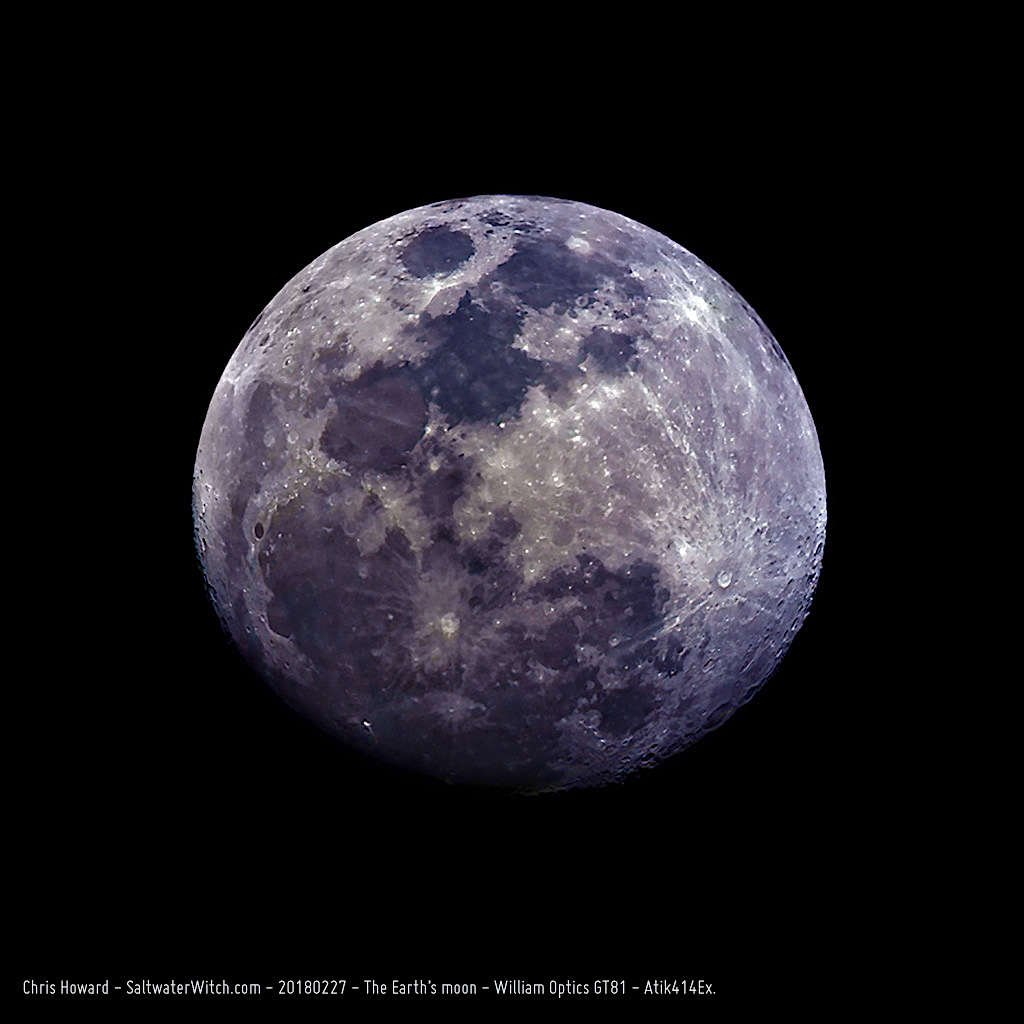
Our moon is looking especially beautiful tonight, even if it's making it difficult to do some deep space imaging. This is a single frame with the William Optics GT81 refractor and Atik 414EX CCD camera and a Celestron UHC/LPR filter that's been sitting in its box for a couple years--so I thought I'd give it a try. I also added a subtle RGB color layer from a few months back.