Astro Session - February 16, 2018
I took the Nikon D750 out tonight and got a nice 30 second exposure of the constellation Orion (upper right of the first image), with some of the PSNH transmission lines in the foreground. That's Sirius almost center in the shot, with Procyon on the upper left. Centered in the image about a quarter of the way from the top, there's a reddish blur between the star Procyon and the star Betelgeuse in Orion--that's the Rosette Nebula--see my December 26 post. (Nikon D750, 24mm, Hoya LiPo filter, f/4.5, 30 sec. exp. ISO 800). The second shot is M44, the Beehive Cluster in the constellation Cancer--plus a few more stars. (Nikon D750, 24mm, Hoya LiPo filter, f/4.5, 1 x 300 second exposure, ISO 800). These are both single exposures, and I shot both on the iOptron CEM25P mount, and what amazed me was that, with pretty good polar alignment, just using the polar scope (no drift or polemaster), I was able to get 3 and 4 minute exposures unguided. The M44 shot is 300 seconds (5 minutes) with some slight star elongation, but still not a bad shot.
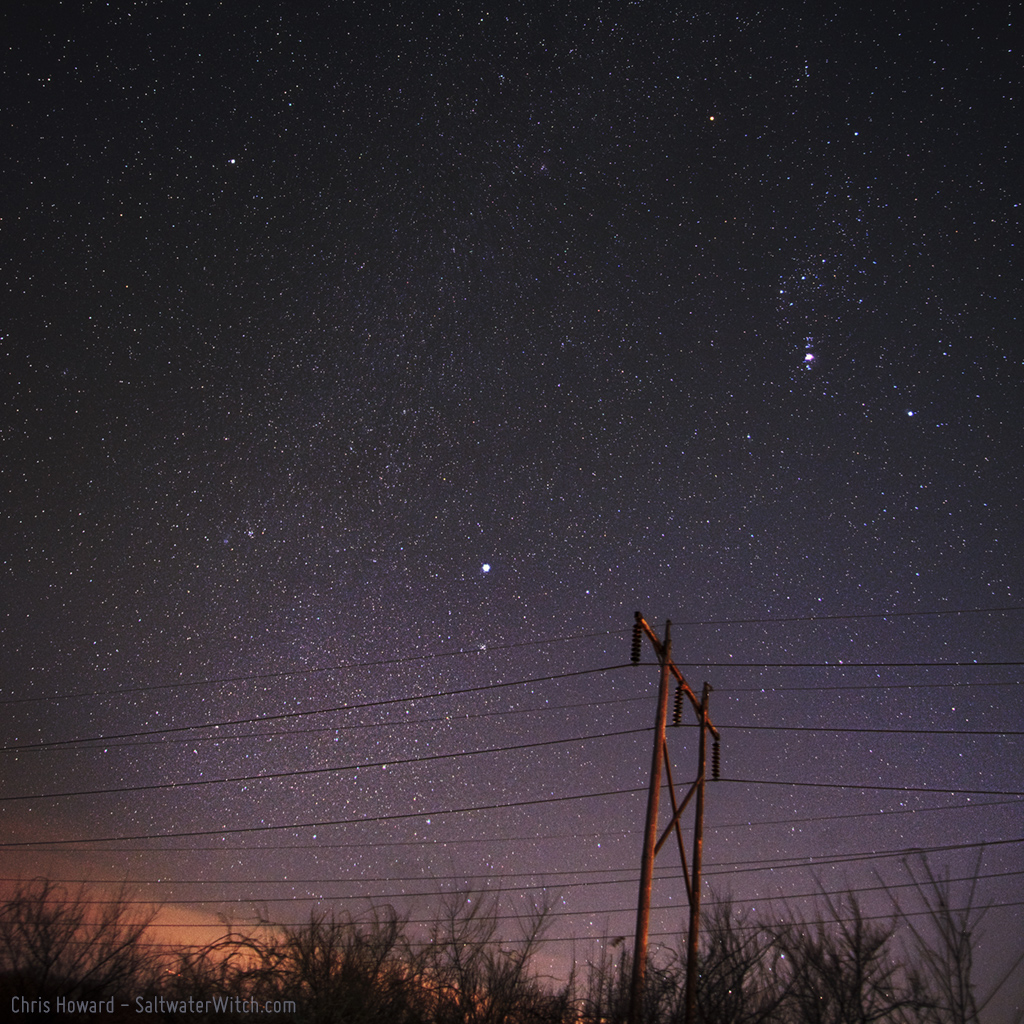
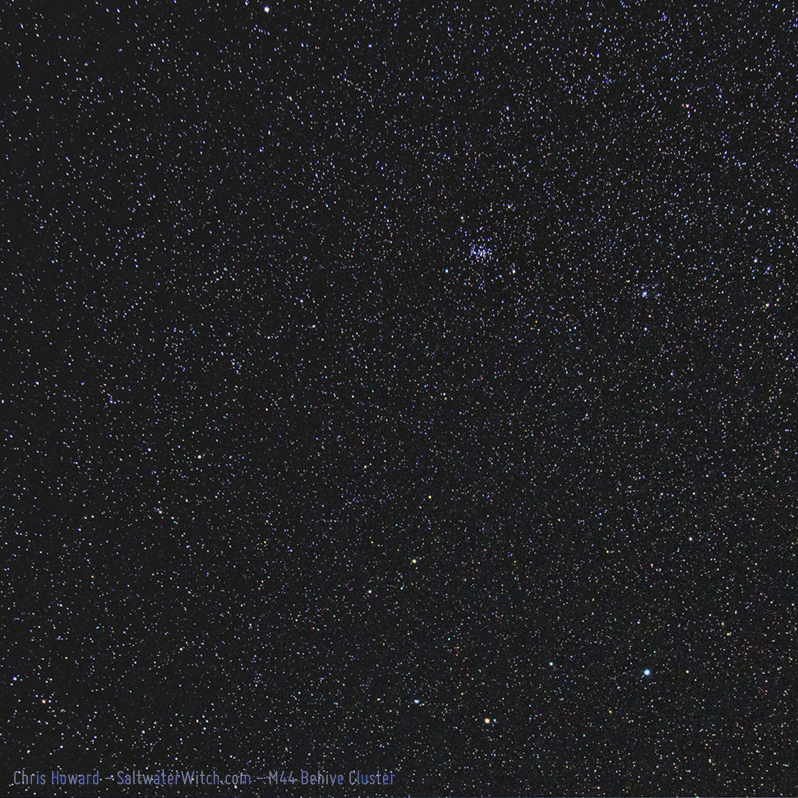
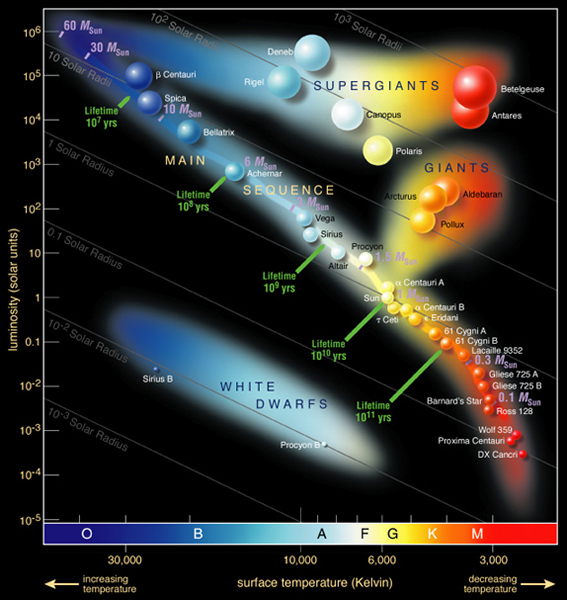 The color of stars is interesting to look for--take a closer look at the Beehive Cluster (M44) image and it's easy to see that the star-field is full of color. I think there's this notion that stars are white pin-points of light in the night sky, but every star has a color, most of them ranging from red to deep blue, depending on many factors including where in its life-cycle it is, the materials it's made from, size, and more. See the Hertzsprung-Russell diagram, listing some of the more familiar stars in our galaxy by surface temperature and luminosity. Our star, the Sun, is pretty close to the middle of the Main Sequence line, between cooler, redder stars and the hotter blue stars. What's interesting is that the shot of the constellation Orion I took the other night--included here--contains several of these stars from the diagram. If you start at the Sun and follow the Main Sequence line up toward the blue end, you will quickly find Procyon, which is the bright star in the top left corner of my image. Sirius--in the diagram--is a couple up from there, but it's almost in the center of my shot. Keep going into the blue, and there's Bellatrix, the blue star which makes up Orion's right shoulder. Now head right from there, out of the Main Sequence line and into the Supergiants, and find the blue supergiant Rigel, which makes up Orion's right foot. And finally, keep going right to the massive red supergiant, Betelgeuse ("Beetle-juice"), which is the left shoulder of Orion. (Hertzsprung-Russell diagram source: ESO - European Southern Observatory, ). How's that for taking one picture of the night sky with some nice examples of stars of varying size, color, and lifespan?
Posted February 16, 2018
Astro Session - February 11, 2018
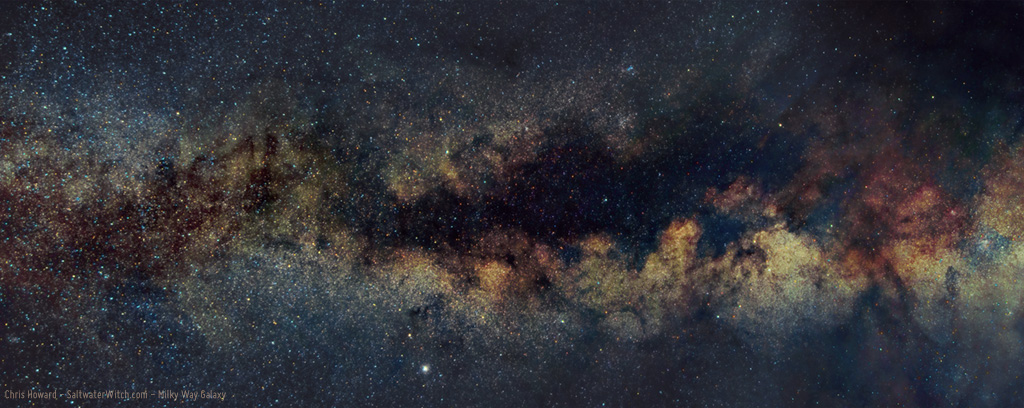
It's been a cloudy week, and the seven days ahead don't look much better. So I'm digging through some wide-field frames from last summer--to stack and process, and I particularly love this small section of our galaxy, the Milky Way. We are about 26,000 lightyears from the center of our galaxy, all of us on our little blue planet orbiting a G-type main-sequence star. And if you're looking inward, toward the galactic center from our world, you'll see something like the image here (this is a crop of a much wider field of view, so you'll actually see much more, that well-known and aptly-named long pale band across the sky). We are right in the thick of things with our galaxy, which is well over a 100,000 lightyears across and contains as many as 400 billion stars. To put the size of our galaxy in perspective (and keep in mind that 100,000 lightyears is the low side of the approximate diameter, calculated to be between 100,000 and 180,000 lightyears across), we are talking about 587,863,000,000,000,000 miles. So, we'll round up a bit and say our galaxy is at least 588 quadrillion miles across. And to put the size our galaxy in perspective, one of our neighboring galaxies, M31, Andromeda, may be twice the size of the Milky Way, with as many as a trillion stars (It seems like there's always a debate on the size of M31). And if that doesn't make you think about our place in the universe, take a look at this Hubble image and understand that almost everything in the frame, every point and spiral and smear of light is itself an entire galaxy: https://www.nasa.gov/feature/goddard/hubble-spies-big-bang-frontiers. How's that for something to contemplate on a nice Sunday afternoon? You're welcome.
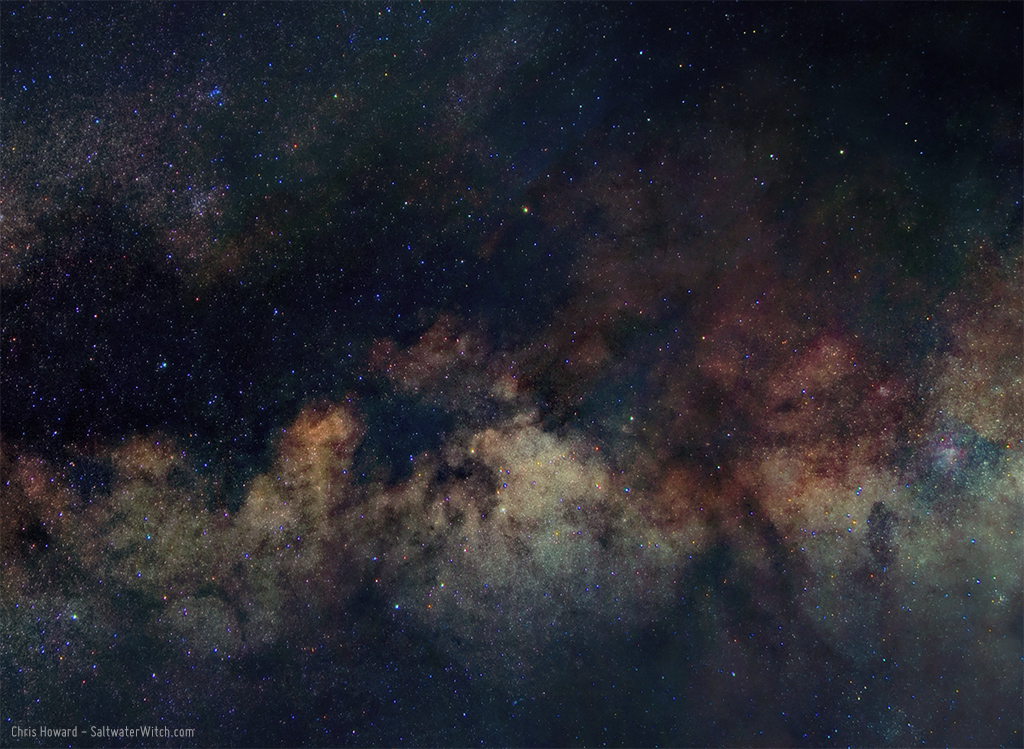
The above shot covers a 30 × 20° FOV of the Milky Way from a little below M17 (Swan Nebula) in the constellation Sagittarius to a little past Delta Aquilae, the bright white star at the bottom left, in the constellation Aquila. Below, is my original shot cropped from M17 on the right to just past Eta Cygni, a variable double star in the constellation Cygnus--about twice the width of the one above. The brightest star in the frame, low center, is Altair.
Posted February 11, 2018
Astro Gear - January 14, 2018
 Astrophotography - Leveling Up
Something strange and wonderful happened over the summer, and at the time I was wondering if it was a unique couple days. Well, it has continued, and looks like it’s here to stay. I seem to have made it to the next level. How do I know? Not only am I taking 5, 10, 20-minute subs with narrowband filters, they look good. Really good. Okay, so I’m not in the same set with the astrophotographers posting some of the really impressive dark nebulae, integrated flux nebulae (Yes, the mysterious IFN), and other deep sky objects out there on Astrobin and elsewhere, but I’m very happy with the images I’m getting out of my equipment.
There’s a process we go through when we set out on this whole astronomy and astro imaging path--from beginner to wherever you are now. A process when we learn how to use new equipment, when we set up an equatorial mount, work through the intricacies of guiding, alignment, processing images, automating our gear with ASCOM or INDI—and whatever software you’re using on top of these protocols for observatory control.
We learn in different ways, but there’s one part of the process all of us have or will experience--I’ve experienced this four or five times over the last few years: one day you set up your EQ mount and OTA, you start everything up, your alignment process goes smoothly, you slew to your first target, focusing just works, plate solving and tracking have pinned your view down to the exact few arcseconds or degrees in the sky where you want to shoot, and suddenly you’re leaning back during 20-minute subs, thinking about things that—as someone who’s obsessed with astronomy—you should be thinking about on a night out under the stars, like: isn’t it amazing that the light allowed through the really narrow bandpass of the Ha filter to touch the CCD sensor on my camera has travelled 23 million lightyears through 2.176 x 10^20 kilometers of interstellar space, through the earth’s atmosphere to get here--to get to the telescope and camera I just set up in my backyard. Or maybe you’re thinking, hey, the neighborhood around Cassiopeia and Cepheus really is a kick-ass part of the sky when it comes to interesting nebulae. It’ll be something like that.
That’s the day things just work, and from that day forward (apparently) they continue to work--for the most part. Things click effortlessly together, and you’re not thinking about problems with focusing, or why the guide camera keeps losing the guide star, or any of the thousand other pieces of the astro-imaging process that can ruin that night out under the stars. It’s as if you’ve leveled up. All the accumulated knowledge, failures, weirdness in the system you’ve experienced--all the troubleshooting you’ve done over the last few years has seeped into your brain to become automatized behavior. And stuff that was difficult a month ago is now second nature. It’s like that happy moment in a good D&D game when you add up the points and you’re suddenly a level 8 Paladin Astrophotographer. It’s a damn good night.
And don’t worry if it this hasn’t happened yet--or recently. That only means if you stick with this astro stuff you’ll level up soon. Even if you’d like to, you won’t forget the frustrations of last night--as time-consuming and apparently wasteful they may have appeared. You’re learning from them. You’re picking up details you may not even be aware of, and you’re packing them away for the next clear night.
Here’s to clear skies. Go find them!
Posted January 14, 2018
Astro Session - January 13, 2018
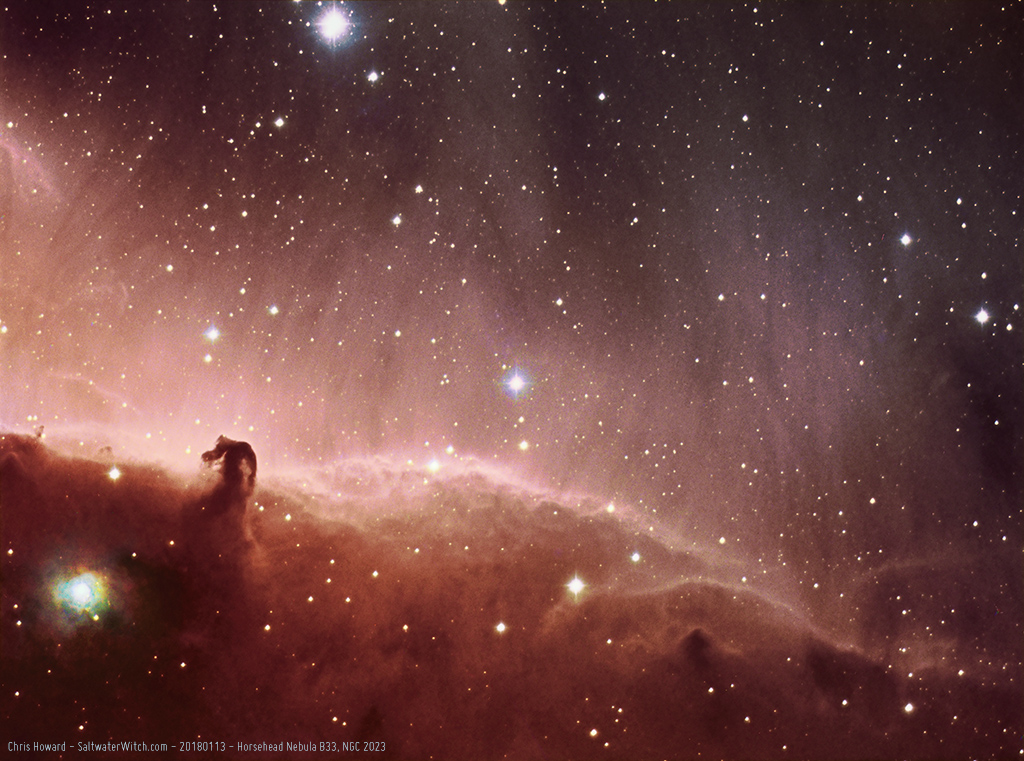
It's winter and that's when Orion is arguably the main attraction in northern hemisphere skies. HaRGB of the Horsehead Nebula (Barnard 33) along with the reflection nebula NGC 2023 (below and left), part of a whole neighborhood of nebulosity around the leftmost star in Orion's Belt, the blue supergiant Alnitak. (I kept Alnitak out of frame, but it would off to the left with a wider field of view). The Horsehead is an absorption (or dark) nebula about 1500 lightyears from Earth, and shows up so prominently because it's blocking most of the starlight behind it. (10 x 600 second Ha frames, 10 x 240 second RGB frames, 24 dark cal frames taken with an Atik414Ex mono CCD, William Optics GT-81 + 0.8x Field Flattener/Reducer f/4.7, iOptron CEM25P EQ mount, Astronomik 12nm Ha filter, Baader RGB filters, WO 50mm guide scope with ZWO ASI120S-MM guide cam, INDI/KStars/Ekos observatory control. Location: Stratham, New Hampshire, US. ~Bortle 4)
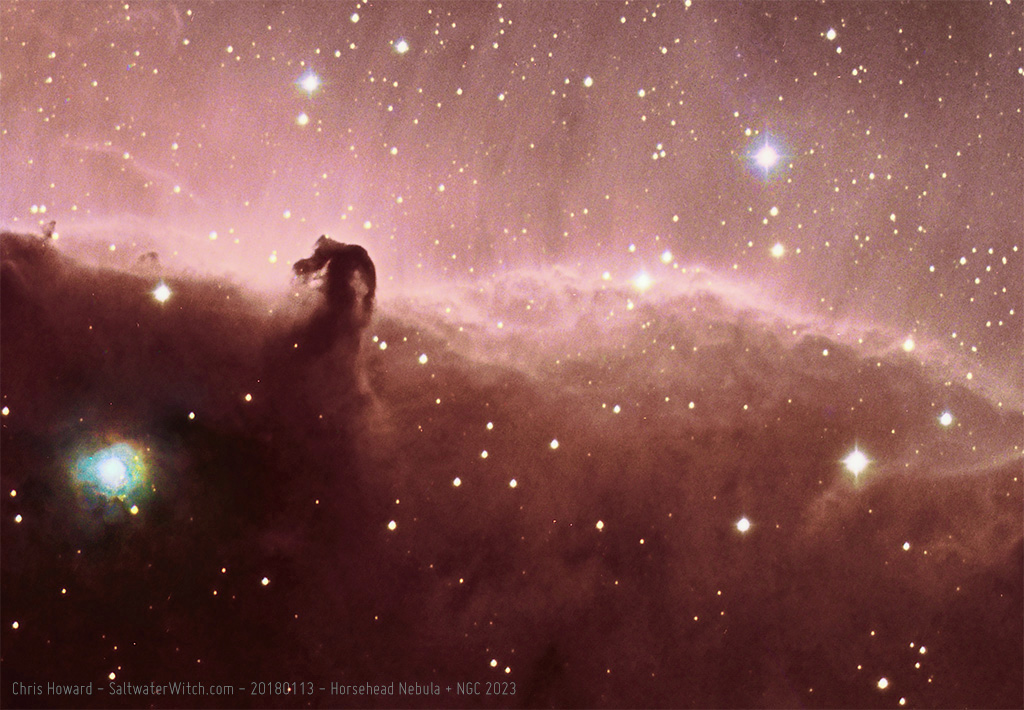
The full FOV for this shot:
Posted January 13, 2018
Astro Session - January 10, 2018
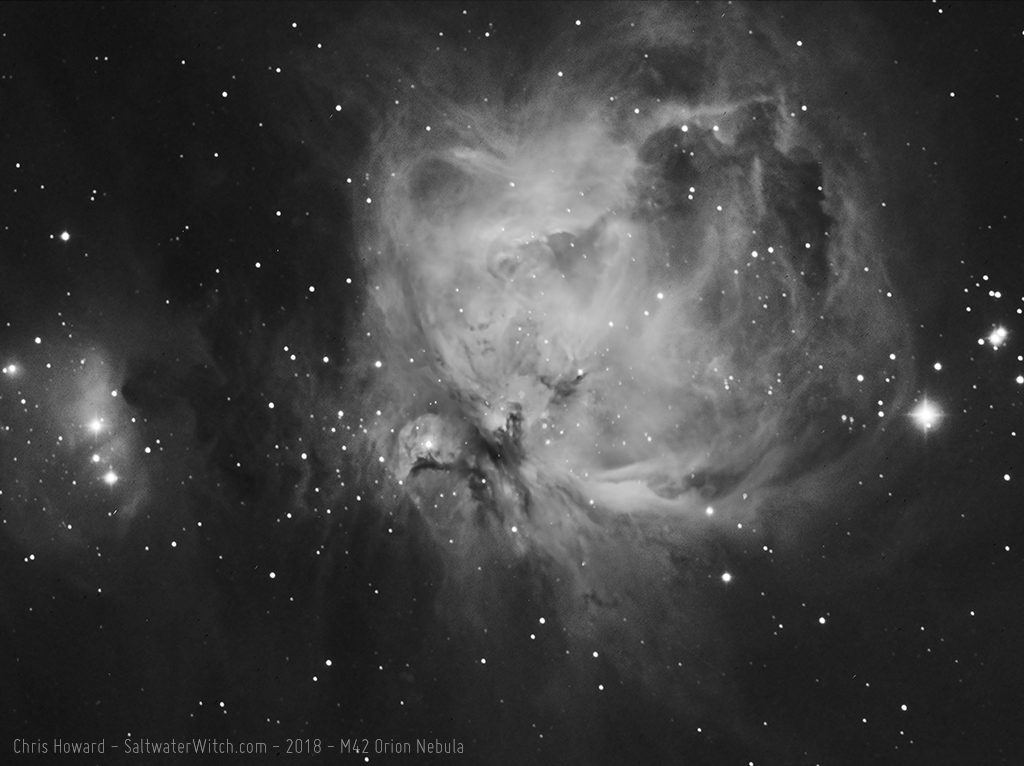
The temps are nice--downright warm compared to what we've been hit with over the last couple weeks. The clouds are the problem. They gave me two hours of clear skies, and I spent them taking a batch of five minute exposures of M42, the Orion Nebula. (Atik414Ex mono CCD, William Optics GT-81 + 0.8x Field Flattener/Reducer f/4.7, iOptron CEM25P EQ mount, Astronomik 12nm Ha filter, WO 50mm guidescope with ZWO ASI120S-MM guide cam, INDI/KStars/Ekos observatory control).
Posted January 10, 2018
Astro Session - December 27, 2017
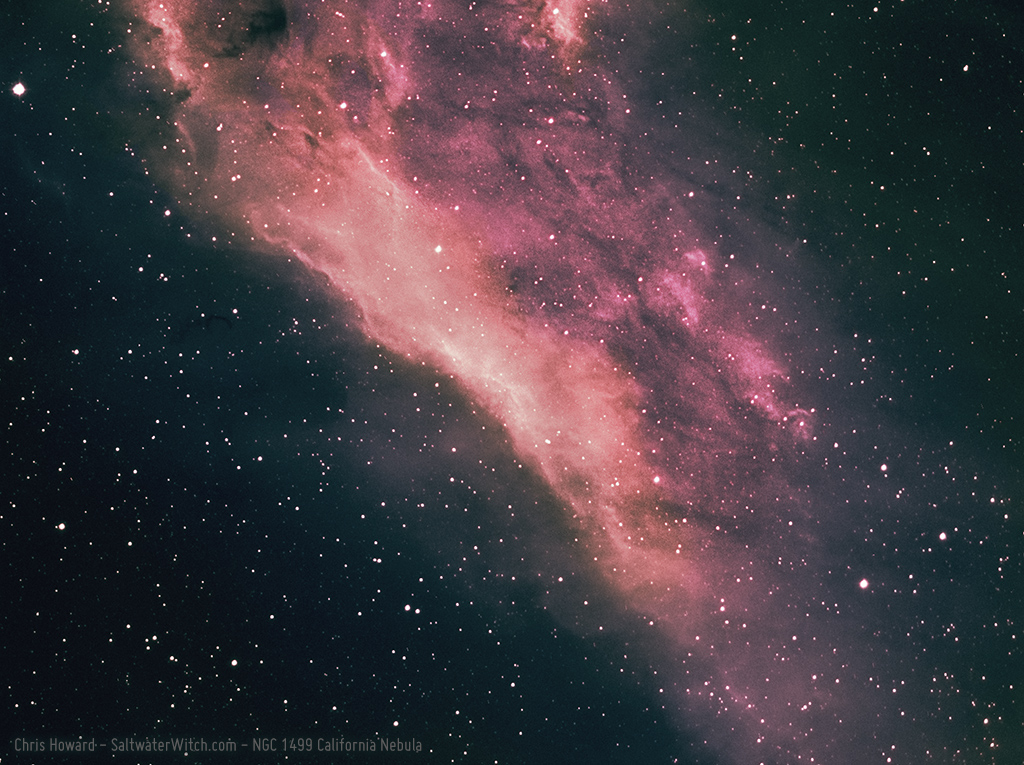
California Nebula NGC 1499, an emission nebula in the constellation Perseus. Named after the Golden State because of the similarity in shape--and this is just the lower portion, basically Santa Barbara on down, although depending on how you match up coastline similarities you might be able to squeeze in everything up to Pismo Beach. I attempted to do some Ha + RGB color process stuff with this set, and I think it worked out. I overloaded the red channel to bring out some contrasting shades, and the GB didn't contribute much. NGC 1499 is mostly ionized hydrogen, and it's massive, almost 2.5°. I'd have to take two or three combined shots to get the whole nebula in one image with the camera+telescope FOV of my setup: Atik414Ex mono CCD, William Optics GT-81 + 0.8x Field Flattener/Reducer f/4.7, CEM25P EQ mount, Baader and Astronomik filters, WO 50mm guidescope with ZWO ASI120S-MM guide cam, INDI/KStars/Ekos observatory control.
Posted December 27, 2017
Astro Session - December 26, 2017
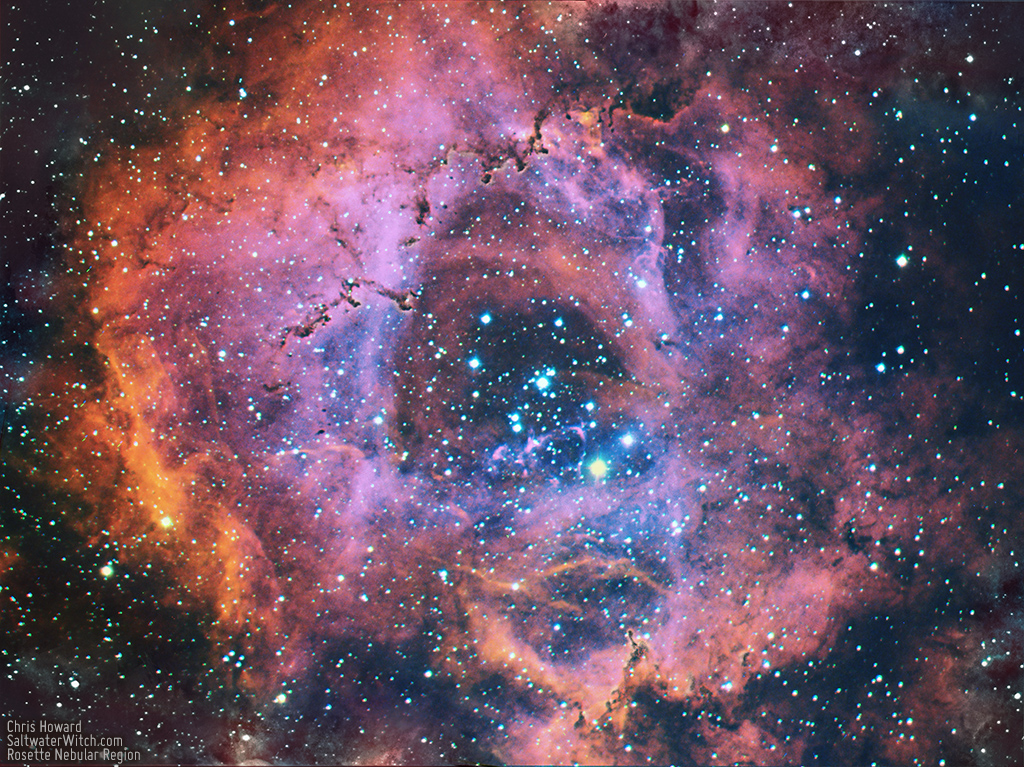
I took several hours of hydrogen-alpha, oxygen 3, sulfur 2, and RGB images last night. Here's the color version of the Rosette Nebula (nebular region) with OIII and SII frames added to a bunch of Ha frames I shot at the beginning of the month.
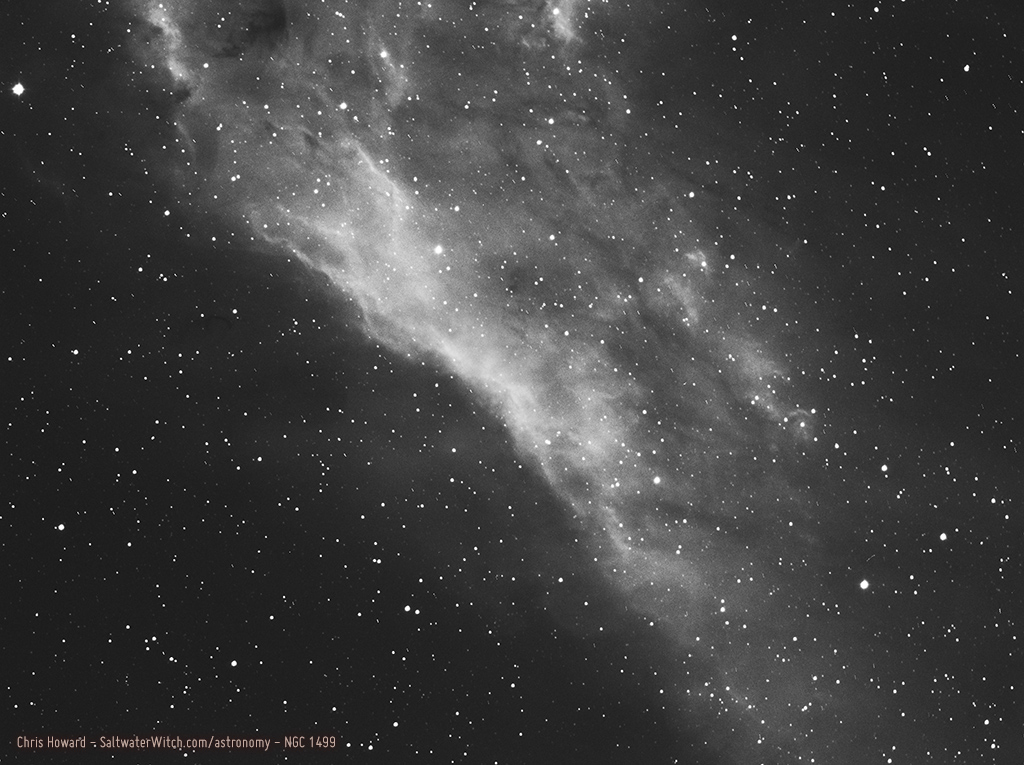
Okay, this new astro setup worked well (see yesterday's post). I just bolted on the mount, did a quick polar alignment, and I was taking beautiful twenty-minute exposures of NGC 1499 (California Nebula). I shot some hydrogen-alpha of the California while waiting for the Rosette Nebular region to come into view.
I have been on this automated portable astrophotography path for a while; it's been a slow but continuous process of remote controlling my entire astro imaging rig from anywhere. I set it up, and as long as there's power and wifi, I'm good to go. This latest iteration, making the whole rig portable, is going to make things easier on those nights when I know I'll only have two hours of clear skies. Before now I wouldn't even think about setting up because that could eat up an hour alone. (Atik414Ex mono CCD, William Optics GT-81, CEM25P EQ mount, WO 50mm guidescope with ZWO ASI120S-MM guide cam, INDI/KStars/Ekos observatory control)
Four stacked 1200-second frames of NGC 1499 with the 12nm Astronomik Ha filter:
Posted December 26, 2017
Astro Session - December 26, 2017
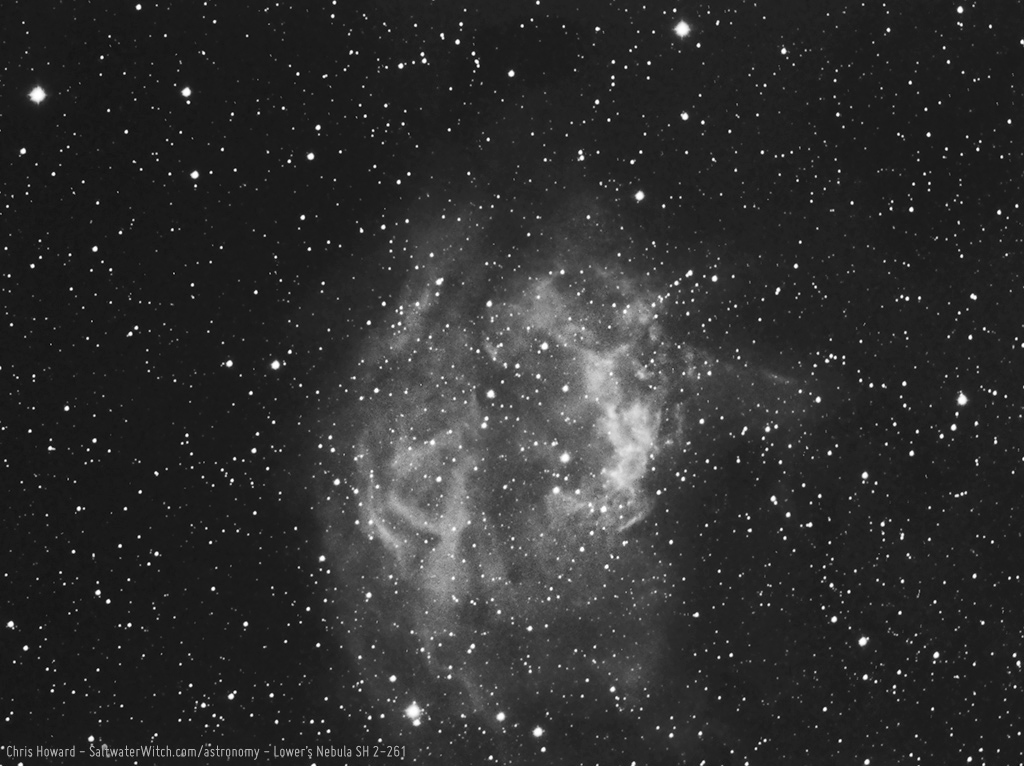 A couple test Ha frames of Lower's Nebula (SH 2-261) in the constellation Orion. I only took two exposures of Lower's Nebula while waiting for the Rosette Nebula to rise, and it reminded me of a scene in the movie Roxanne with Steve Martin (CD Bales) and Daryl Hannah (Roxanne):
C.D. Bales: You must know about M31.
Roxanne: Yeah.
C.D. Bales: Now, see, I like it when they give astronomical objects names, you know, like "Andromeda" and "Saturn" and "Sea of Tranquility." This whole numbering thing is just too boring for us civilians.
Roxanne: Do you know how many objects are up there?
C.D. Bales: Well, I know it's over fifty.
That's the problem when you're a constellation like Orion, with a nebula so massive and bright you can see it clearly without a telescope (M42), or you possess dark nebular structures famously shaped like animals (Horsehead nebula, Barnard 33). You get overlooked if you're not a superstar or supernova remnant or "The Great" Orion Nebula. Yeah, that's Lower's Nebula (SH 2-261), which I'm sorry to say, I had never heard of before last night. Unfortunately that's probably because Lower's Nebula isn't the buckle on Orion's Belt. It isn't even hanging off of Orion's famous belt. It is literally out on a distant arm of the constellation--yes, Orion has one arm raised, far away from the Belt, and the famous stars like Betelgeuse, Bellatrix, and Rigel, and that's where you'll find this obscure cloud of hydrogen that doesn't even have a wikipedia page (In English. I found an Italian page for SH2-261. Nicely done, Italy.)
(Subframe info: one 600-second exposure and one 1200-second exposure stacked in DSS, no calibration frames, Atik414Ex mono CCD running at -10C, Astronomik 12nm Ha filter, William Optics GT-81, CEM25P EQ mount, WO 50mm guidescope with ZWO ASI120S-MM guide cam, INDI/KStars/Ekos observatory control)
