Astro gear - December 25, 2017
My Winter Astro Setup, essentially the same William Optics GT-81 - iOptron CEM25 combo, with the addition of the iOptron Tri-Pier Adapter, some 6x8 aluminum plates off eBay, and one treated 4x4 post from Home Depot.
The good side of winter and astrophotography is it’s usually dry on clear nights--and “clear” really means clear in terms of astronomical seeing, atmospheric turbulence and all that. Downside is that it’s freakin’ cold. Tonight it’s supposed to get down to about -8°C (about 20°F), pretty cold to be out for a long time, but not painfully cold.
Here are a couple shots of my setup for tonight--and possibly the rest of the winter. (William Optics GT-81, CEM25P EQ mount, Atik414Ex mono CCD, WO 50mm guidescope with ZWO ASI120S-MM guide cam, INDI/KStars/Ekos observatory control). What’s cool is that I can unbolt the mount with the pier adapter and aluminum base plate (they’re all bolted together) from the 4x4 post and top plate, and carry in the entire setup--mount, scope, cameras, etc. What I especially like about this is the ease with which I can setup and tear down each night. The whole thing remains balanced and ready to go, with polar alignment reduced to very fine adjustment to zero in on the NCP.
Note on my other mount: I probably won’t use my Orion Atlas EQ-G mount until spring when things start to warm up, and that’s based on the weight of the Atlas and the low temperatures--with ice adding some difficulty to the setup process. (Yeah, I don’t want to lug around this monster with any probability of slipping, landing on my back, and having to catch fifty or sixty pounds of metal out of the air before it kills someone). The average winter low in New Hampshire is around -12°C, and the average winter high temp is still below 0°C (around 30°F). It’s not unusual for things to get down to -20 to -30°C (-10 to -20°F). We’re still in December, so early in the season, but we’re already getting repeated snow storms interspersed with temps above 0°C (32°F). We typically get a few days of warmer weather here and there, snow and ice melting weather, but there haven’t been enough of them to make a dent in the accumulating snow and ice we have in the yard, driveway, or back deck. We just ended yesterday (the 25th) with another 6 inches or so. When there’s ice, lighter is better.


Posted December 25, 2017
Astro Session - December 1, 2017
We were very close to a full moon last night, so my astro imaging options were limited to narrowband. I spent most of the night with Hydrogen-alpha, an inexpensive 12nm Astronomik filter, but as you can see, able to bring out some fantastic contrast, depth, and details throughout this region of interstellar ionized hydrogen. (This is the filter I currently have in the 1.25" wheel. My Baader 6nm Ha is in the 2" filter wheel)
The "Rosette Nebula" is a cluster of nebulosity that includes NGC 2237, NGC 2238, NGC 2244, NGC 2239, NGC 2246 and more. The Rosette is a bright mag 9 area of the sky about 1.3° across in the constellation Monoceros. (subframe info: 28 600 second exposures in hydrogen-alpha, no calibration frames, Atik414Ex mono CCD running at -10C, Astronomik 12nm Ha filter, William Optics GT-81, CEM25P EQ mount, WO 50mm guidescope with ZWO ASI120S-MM guide cam, INDI/KStars/Ekos observatory control). https://www.astrobin.com/324406/
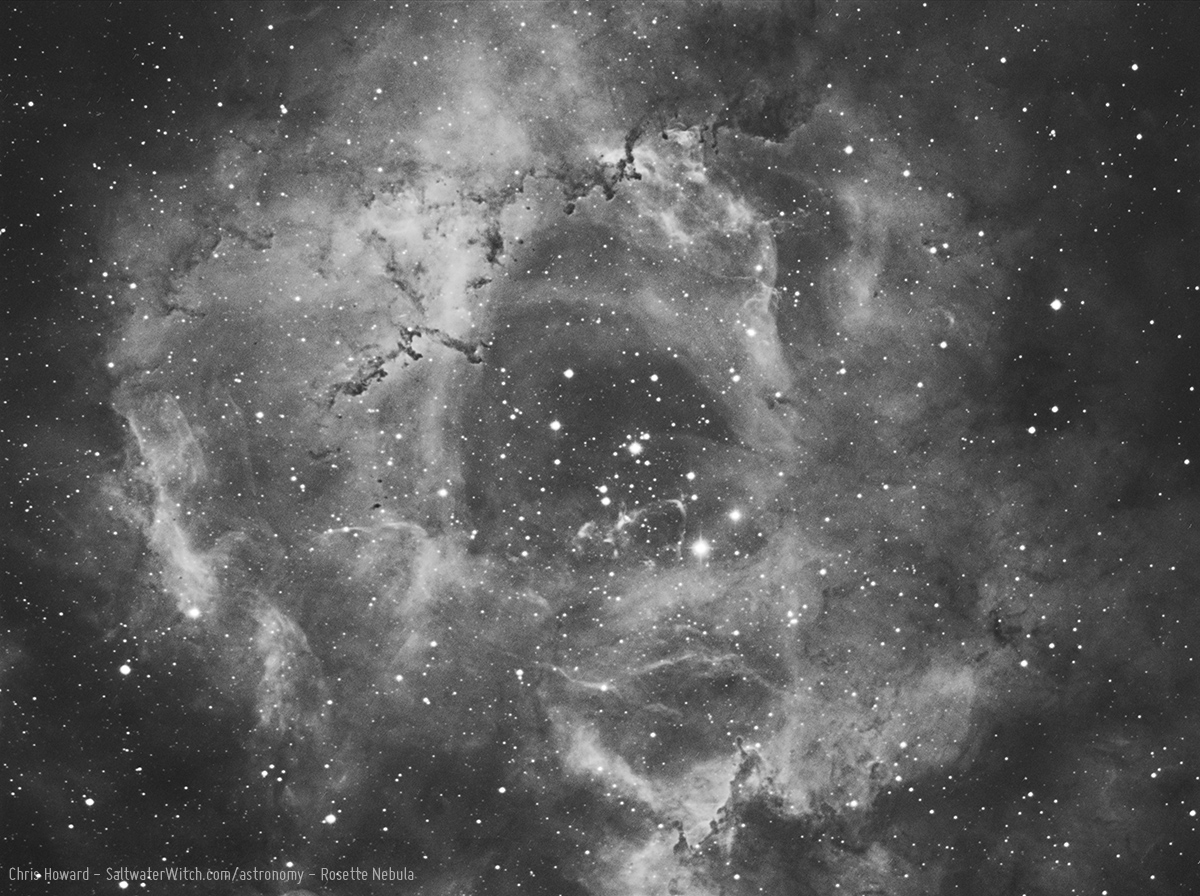
One of many reasons I love the Atik 414EX is how clean (free of noise) the light frames are when you cool the sensor down to -10C or below. I didn't shoot dark frames, or any other calibration frames last night, and didn't use any from my library when stacking.
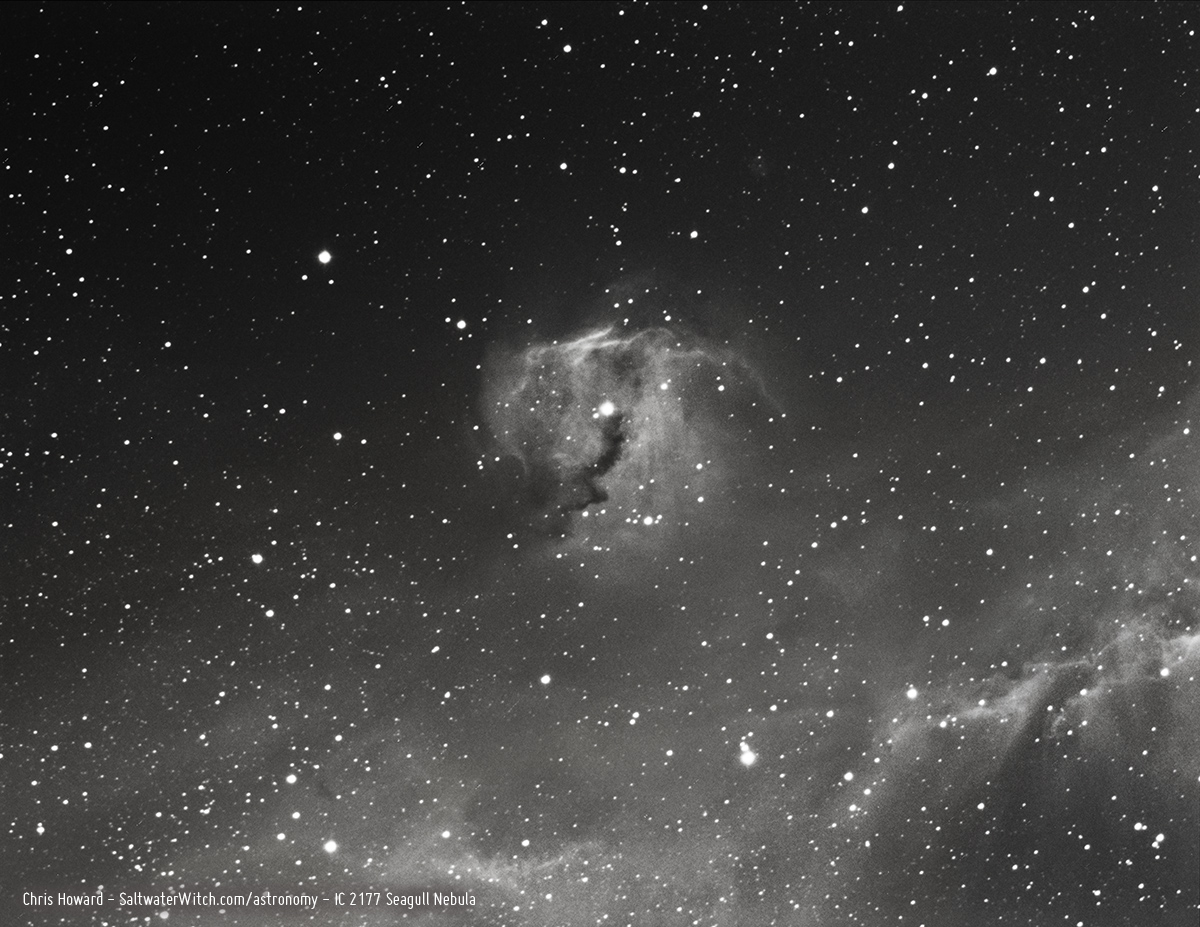
My last target of the night: center portion of IC 2177, the "Seagull Nebula" in the constellation Monoceros. There's noise that showed up during stretching, but this one of IC 2177 is just 4 stacked Ha frames, each 600 seconds.
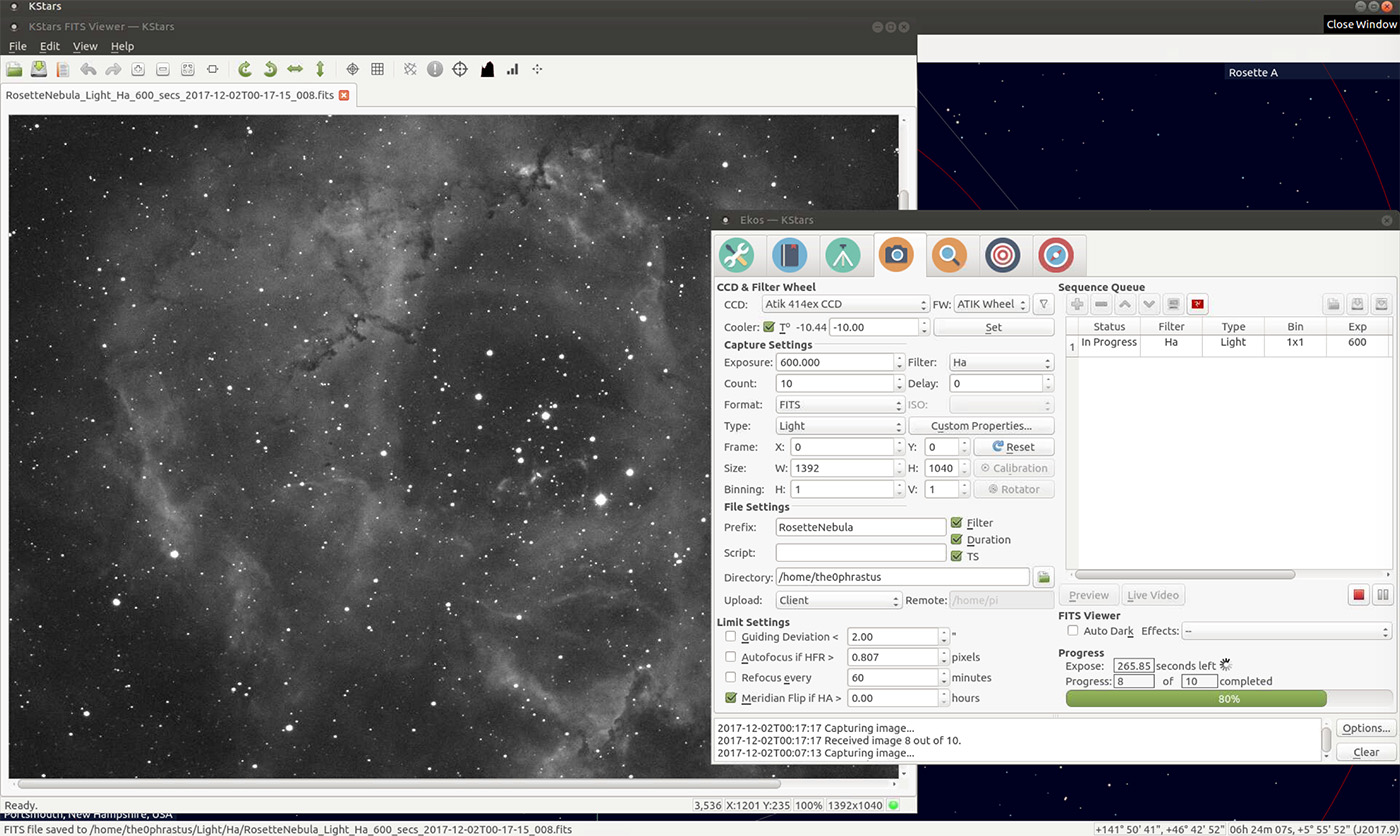
Here's a screenshot of Ekos and KStars, in the process of capturing 600 seconds of photons landing in my backyard from the Rosette Nebula. This is pretty much what I see--the tools I work with--when remotely controlling the mount, telescope, cameras, targeting, focusing, plate solving, and more. And that's what a single 600-second frame looks like. With stacking I'm obviously getting a lot more signal to noise.
Posted December 1, 2017
Astro Session - November 10, 2017
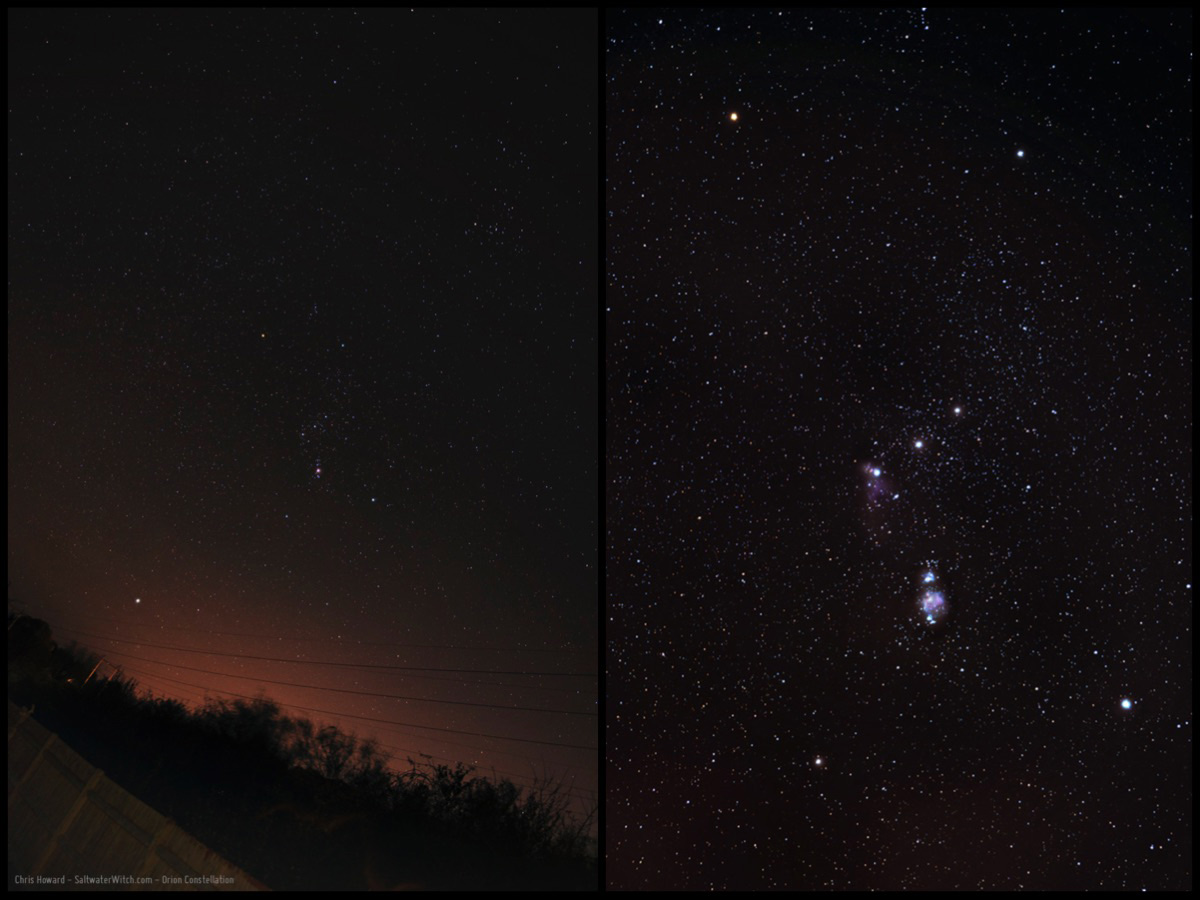
Constellation Orion (and that's Sirius in the lower left). I was out in the cold last night, with the Nikon D750 (24mm, 30 sec. exposure, ISO 800). Love that Hampton sky glow.
Posted November 10, 2017
Astro Session - November 10, 2017
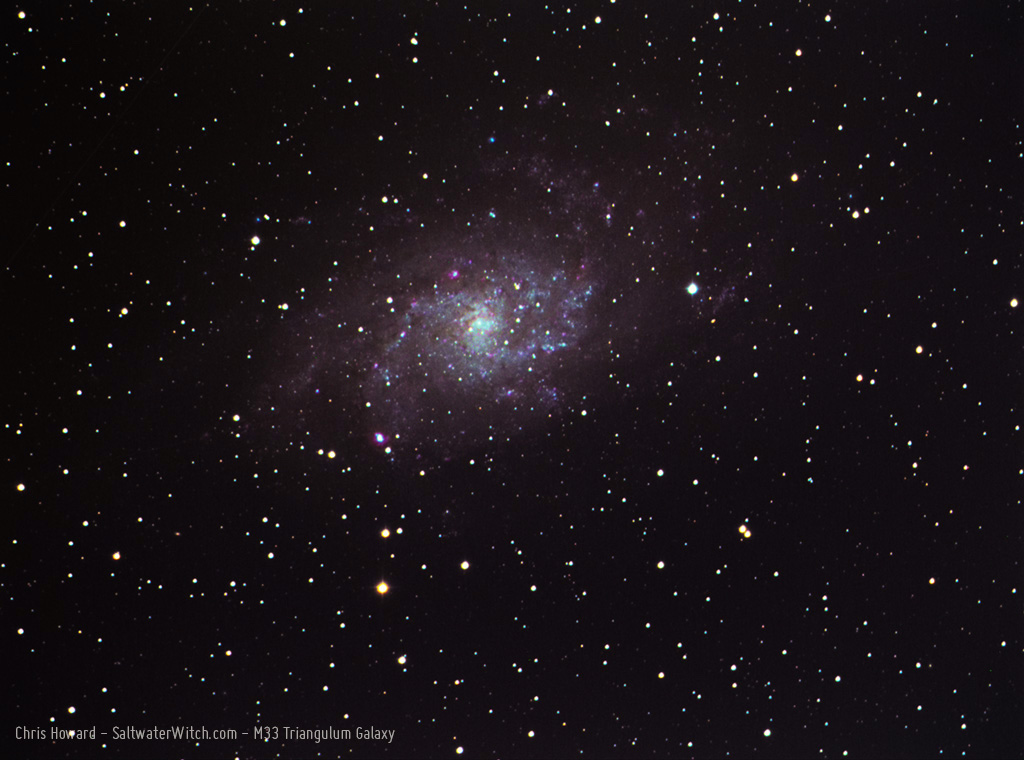
M33 Triangulum Galaxy, about 3 million lightyears away, so... not that far. M33 is a relatively small spiral galaxy with only 40 billion stars. I'm having some trouble with my guide camera (ZWO ASI120MM), so this is all unguided. I took 80 LRGB exposures--120 seconds each, 10 Ha frames at 120 secs, 20 dark calibration frames, stacked in DSS).
Posted November 10, 2017
Astro Session - October 18, 2017
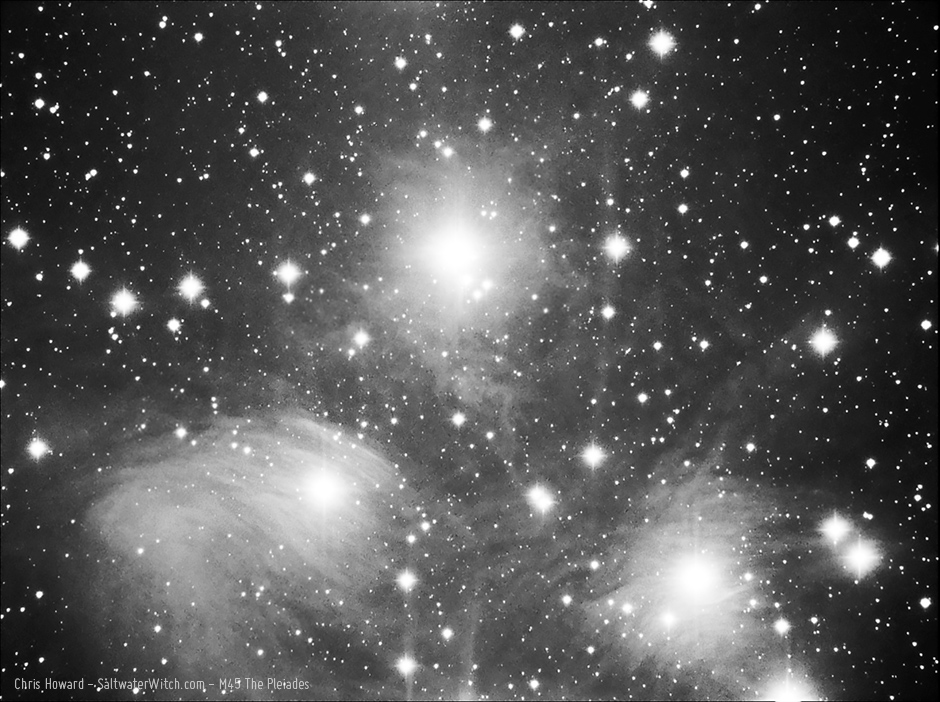
The three central and brightest (low magnitude) stars in the open star cluster M45, called The Pleiades or The Seven Sisters: Alcyone (upper middle), Maia (right), and Merope (left). The light of the stars in the Pleiades pass through and illuminate a cloud of dust in the interstellar medium. (8 x 5 minute exposures, 18 dark frames - William Optics GT-81 478mm FL, Atik 414EX Monochrome CCD, Baader luminance filter, CEM25P EQ mount).
Posted October 18, 2017
Astro Session - October 17, 2017
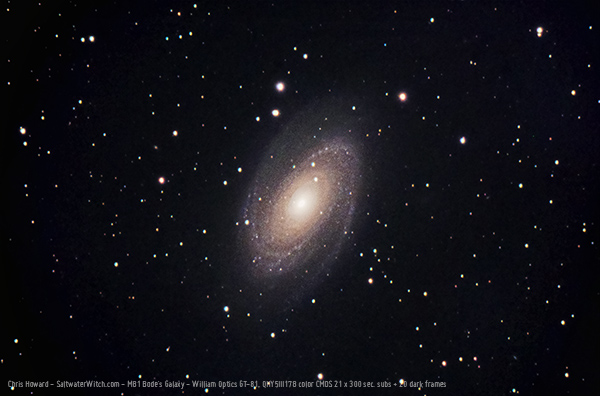
Color version of M81 (Bode's Galaxy) in the constellation Ursa Major (Big Dipper). From another set of subs I shot at 4am--this time with the color QHY CMOS camera, QHY5III178. Info: 21 x 300 sec. with 20 dark frames, QHY5III178 color CMOS, William Optics GT-81, CEM25P EQ mount, WO 50mm guidescope with ZWO ASI120S-MM guide cam, INDI/KStars/Ekos observatory control.
Posted October 17, 2017
Astro Session - October 13, 2017
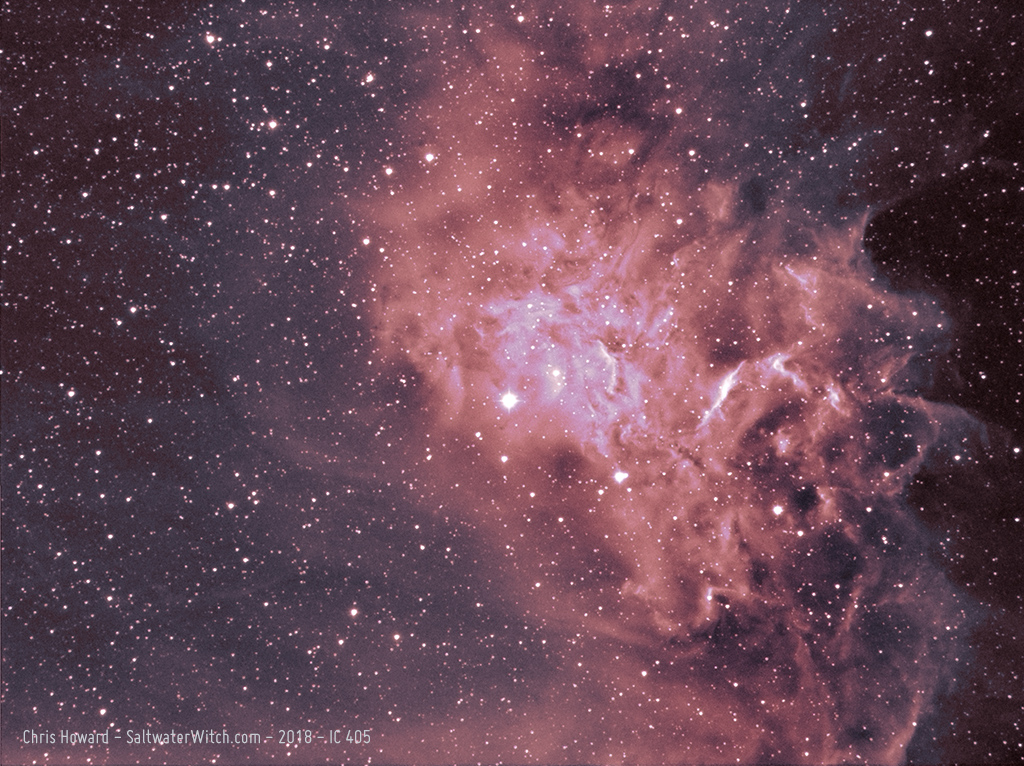
IC 405--"Flaming Star Nebula" in the constellation Auriga, centered on the mag. +6 star AE Aurigae. It's relatively close to us, at about 1,500 light-years. This set of subframes covers the center of the fairly large nebula, which measures 37 x 19 arcminutes. (6 x 1200 second subs in Ha, O3, S2, taken with my current main setup: Atik414Ex mono CCD, William Optics GT-81, CEM25P EQ mount, WO 50mm guidescope with ZWO ASI120S-MM guide cam, INDI/KStars/Ekos observatory control).
Posted October 13, 2017
Astro Session - October 12, 2017
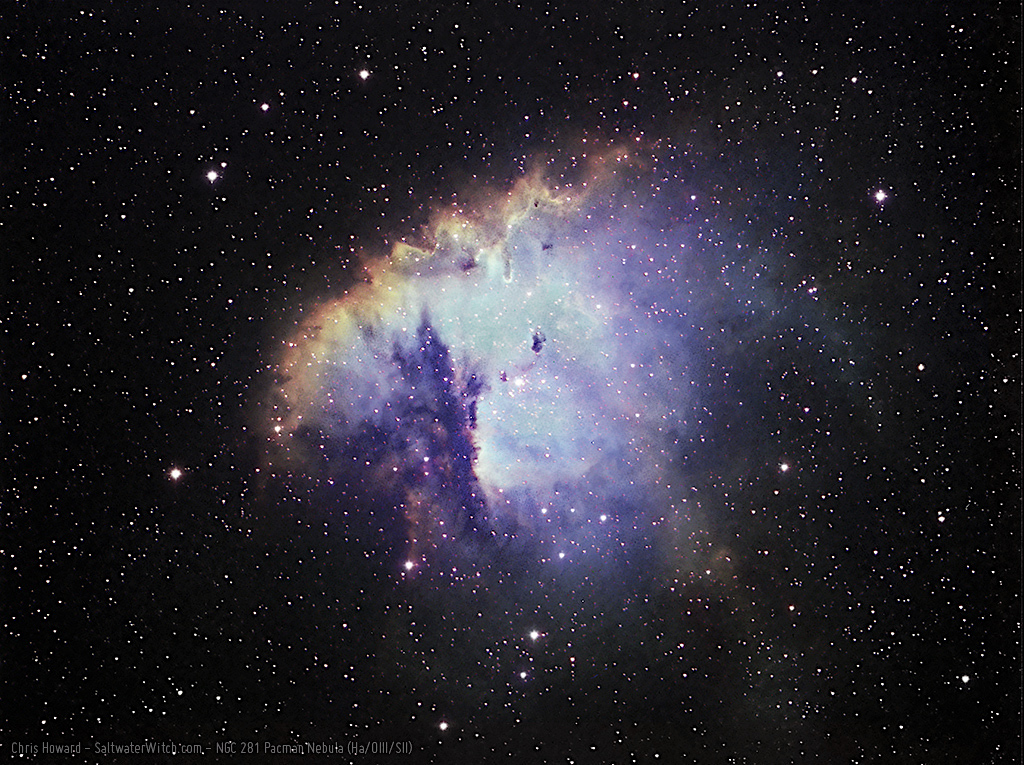
NGC 281 (IC 11, Sh2-184) "Pacman Nebula" in the constellation Cassiopeia. More narrowband imaging, although the moon is waning, and didn't even make into the sky until the early morning hours. I completed the subs for NGC 281 by 1am, and scheduled some narrowband exposures of IC 405, Flaming Star Nebula. (subframe info: 6 x 1200 second exposures in Ha, 5 x 1200 sec OIII & SII with 16 dark frames, Atik414Ex mono CCD, Astronomik 6nm Ha, OIII, SII, William Optics GT-81, CEM25P EQ mount, WO 50mm guidescope with ZWO ASI120S-MM guide cam, INDI/KStars/Ekos observatory control).