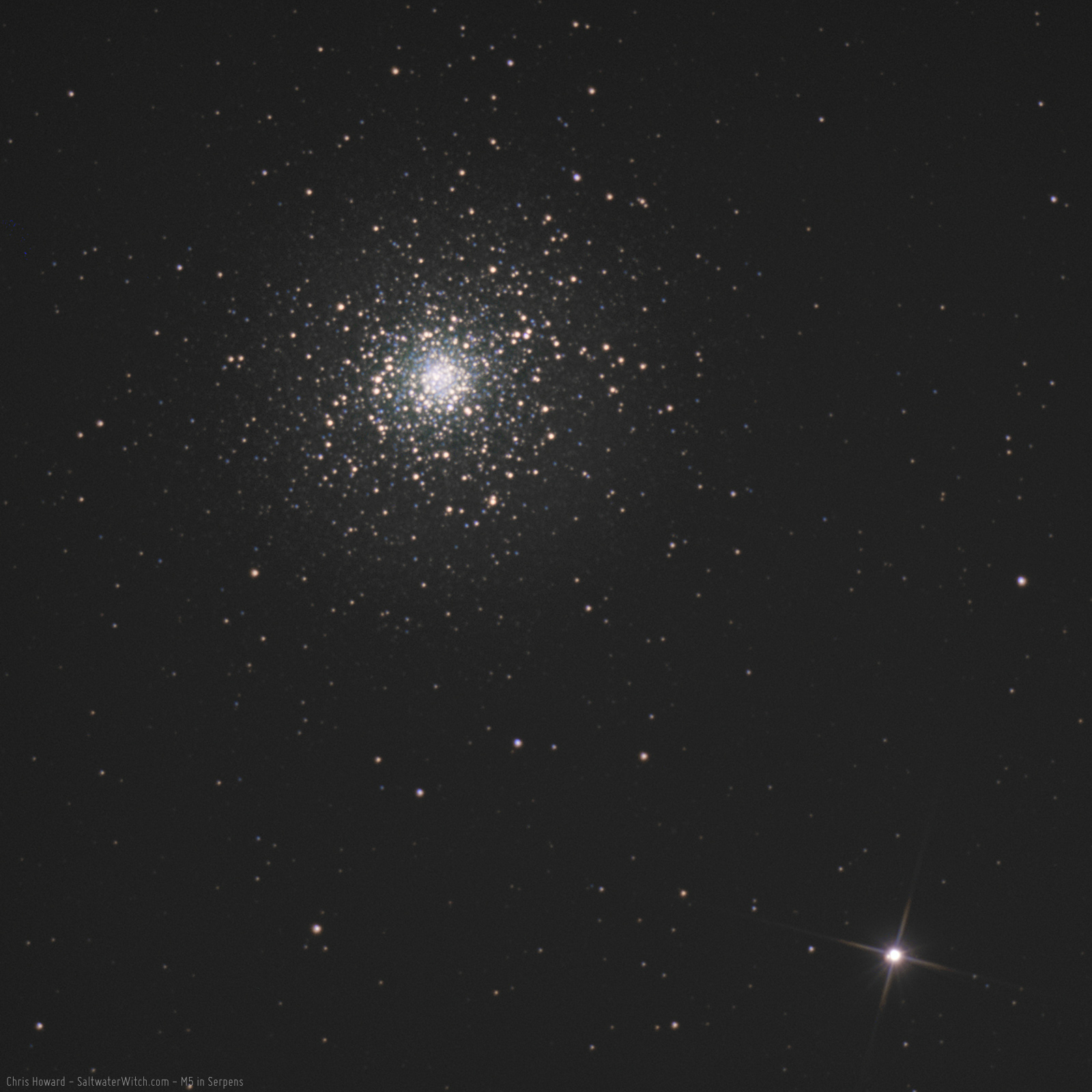
Messier 5 and 5 Serpentis
The M5 globular cluster in the constellation Serpens (NGC 5904) might be the oldest globular cluster in our galaxy, somewhere around 13 billion years old, with the Milky Way itself almost as old as the universe at 13.61 billion years, forming just a few hundred million years after the Big Bang. M5 is about 27,000 lightyears away in the galactic halo, and is one of the largest clusters, with a diameter of about 165 lightyears. Imaging notes: 60 x 60-second subs with the ZWO ASI071MC cooled to -10C and the 800mm FL newtonian scope.
Take a closer look at the variable double star, 5 Serpentis, lower right with the diffraction spikes (the spikes are an artifact of some reflector telescopes, like the Hubble Space Telescope). If you look closely, you can see both stars, 5 Serpentis A is the larger of the two, with 5 Serpentis B just visible at the lower left of the main star. The main star (5 Serpentis A) is a large F-type main-sequence star, that has been fusing hydrogen like mad, has used most of it up, and is headed toward a red giant phase. Its companion, 5 Serpentis B, much smaller, has recently been estimated to have an orbital period of 3,371 years.
Posted May 11, 2023
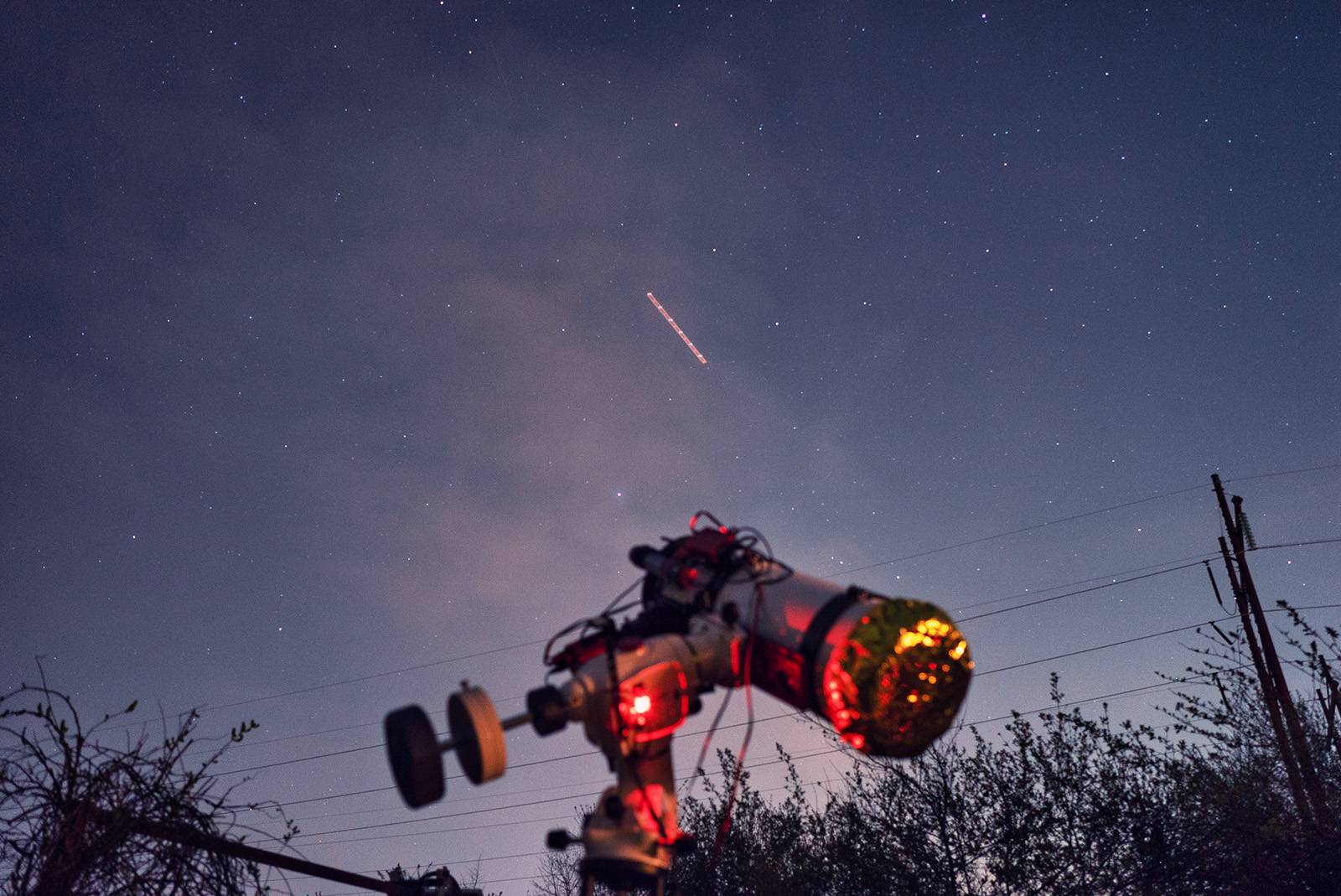
Imaging run, 20230510
An 8 second exposure of my astro setup during last night's imaging run, shot in the backyard with the Sony A7s and Zeiss Batis 25mm f/2 lens. The skies weren't very clear, with patchy clouds sliding by and overall poor seeing (astronomical seeing represents the impact of atmospheric turbulence), but still managed to capture Messier 5 in the constellation Serpens.
Posted May 10, 2023
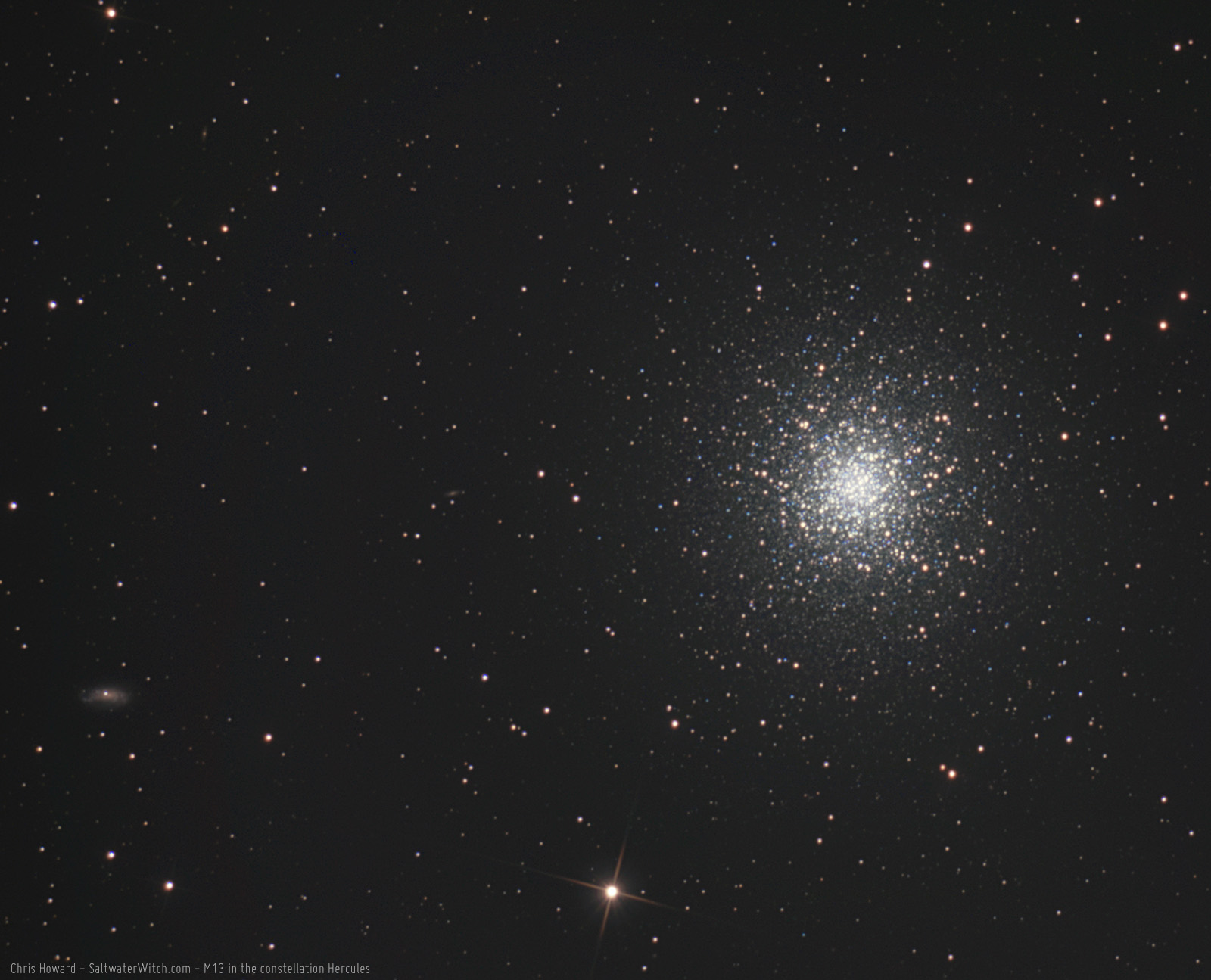
What a Cluster!
From last night's imaging session: the massive star cluster, M13, NGC 6205, the Hercules Globular Cluster, is made up of hundreds of thousands of stars. Like most globular clusters, M13 is not found within the disk and spiral arm structures of the galaxy, but in the galactic halo, the outer spherical shape of the galaxy, above and below the galactic plane. M13 is about 145 lightyears in diameter. Notice the spiral galaxy on the lower left side--that's NGC 6207 (about 30 million lightyears away), with the far more distant galaxy IC 4617 (489 million LY!), just a tiny, faint smear between NGC6207 and the M13 globular cluster. Imaging notes: 800mm f/4 newtonian, ZWO ASI071MC cooled to -10C, 60 x 120-second exposures stacked in DSS.
Posted May 10, 2023
Tangled clouds in Cygnus
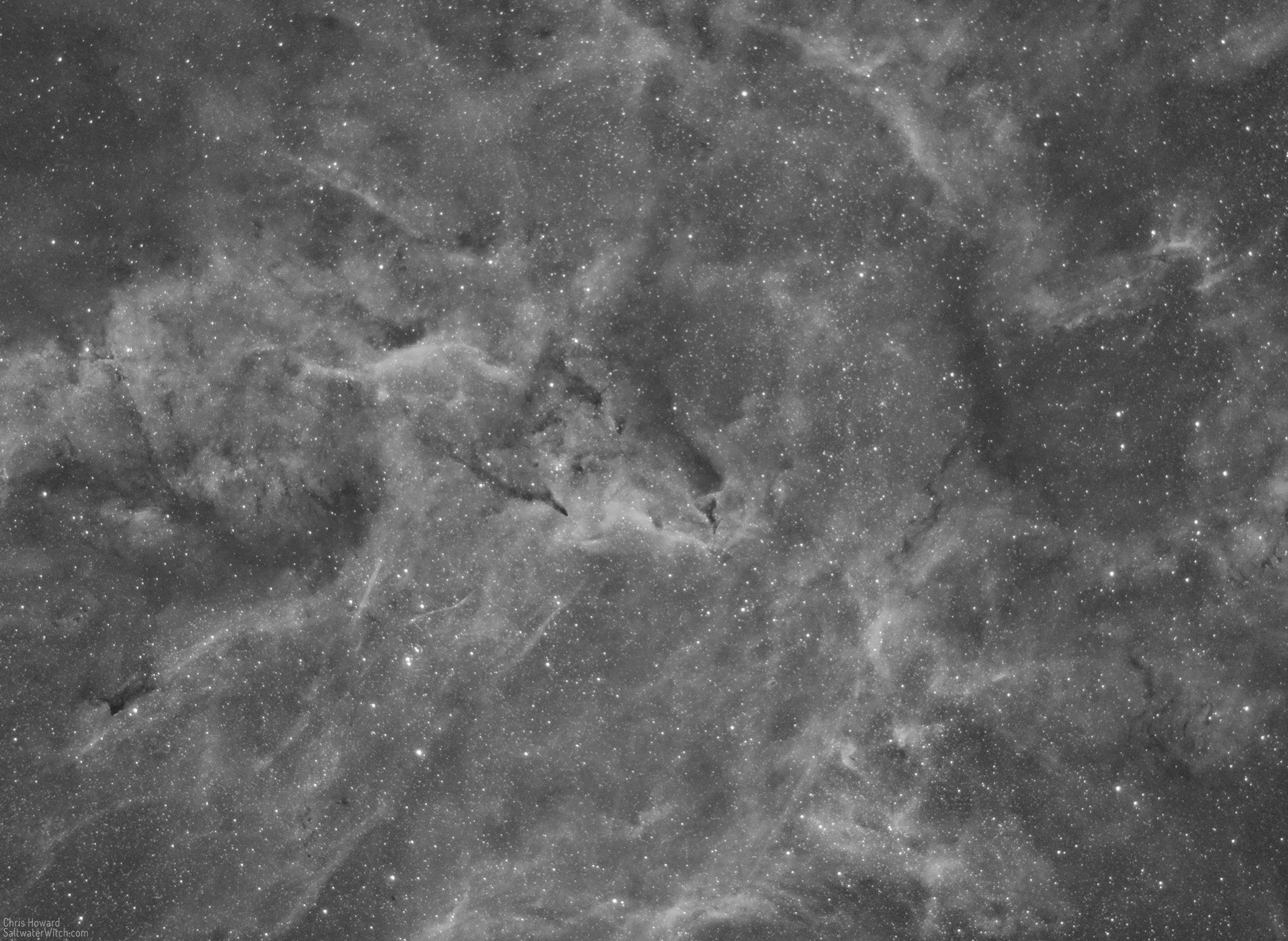
There's a lot going on in this detailed look at one tiny section of the vast network of interstellar dust and clouds of hydrogen in the constellation Cygnus, including the open star clusters NGC 6871, NGC 6883 and a handful of dark nebulae including Barnard 147 (LDN 853, the pointy dark channel of dust a little left of center), B146, LDN 856, 858. Notes: 28 x 8-minute exposures, almost four hours of data in hydrogen-alpha (Antlia 3nm Ha Pro filter), William Optics GT81 Apochromatic refractor 382mm FL at f/4.7, ZWO ASI1600MM-Pro mono camera cooled to -10C.
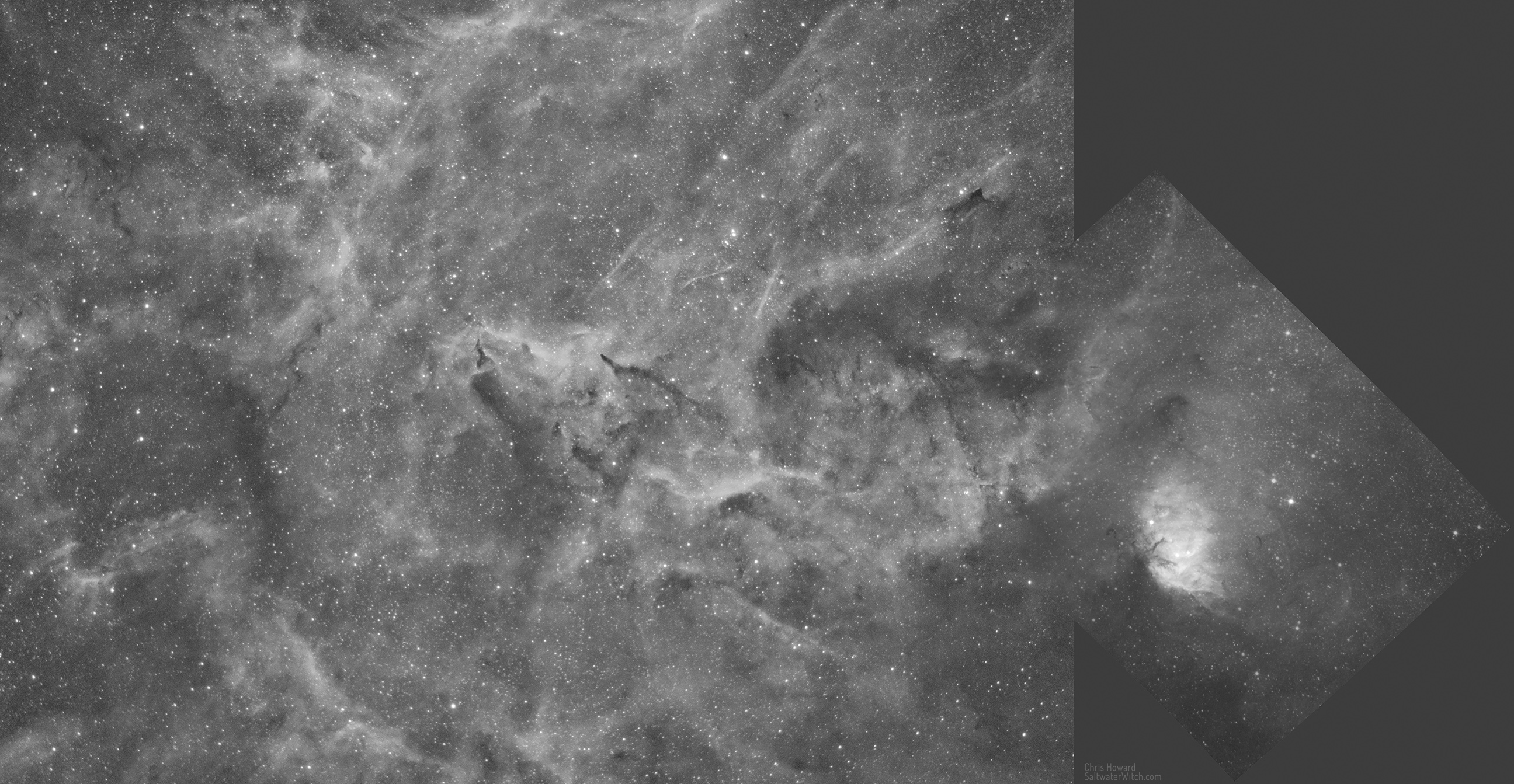
Cygnus Composite - I combined images from two different scopes, all the data for the wide field view (left) came from my William Optics GT81, and I captured the data for the Tulip Nebula (Sh2-101, right) with the Apertura 8"/203mm Newtonian.
Posted November 4, 2022
Narrowband Boogeyman in Orion
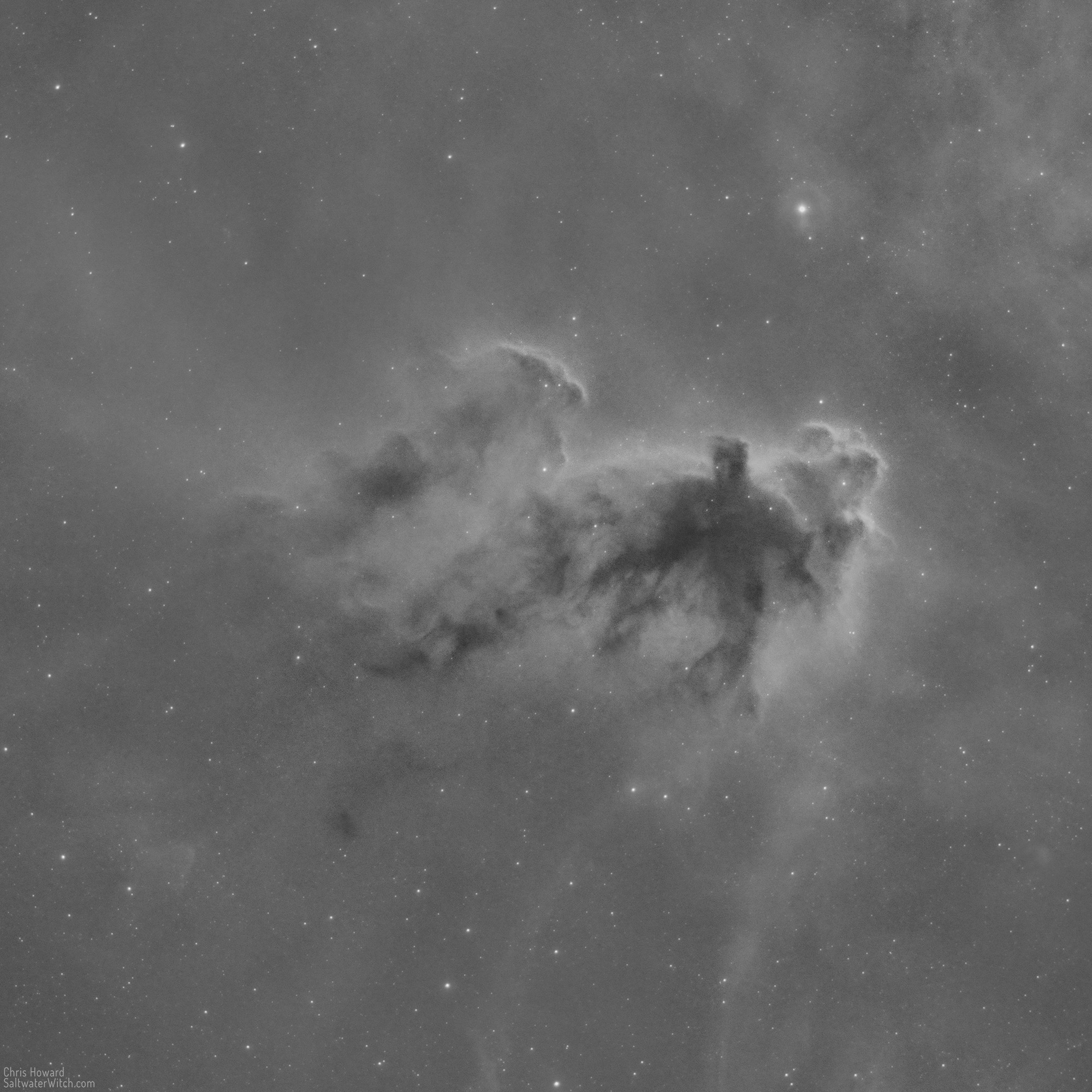
Sure, we're a few days late for halloween, but check out the creepiness of the dark molecular cloud LDN1622, the "Boogeyman Nebula" about 500 lightyears away in the constellation Orion, along with a bright lumpy backdrop of nebulosity lit from above by the variable star 56 Orionis. LDN1621 is the dark nebula to the left of the Boogeyman, and the reflection nebula VdB 62 is just to the right. The uneven cloudiness at the top right is a small section of Barnard's Loop (Sh2-276), which may give you an indication of LDN1622's location, on the other side of the Loop from M78, about halfway up one side of Orion. Notes: 36 x 8-minute exposures, almost five hours of data in hydrogen-alpha (Antlia 3nm Ha Pro filter), William Optics GT81 Apochromatic refractor 382mm FL at f/4.7, ZWO ASI1600MM-Pro mono camera cooled to -10C.
Posted November 4, 2022
M78 in RGB
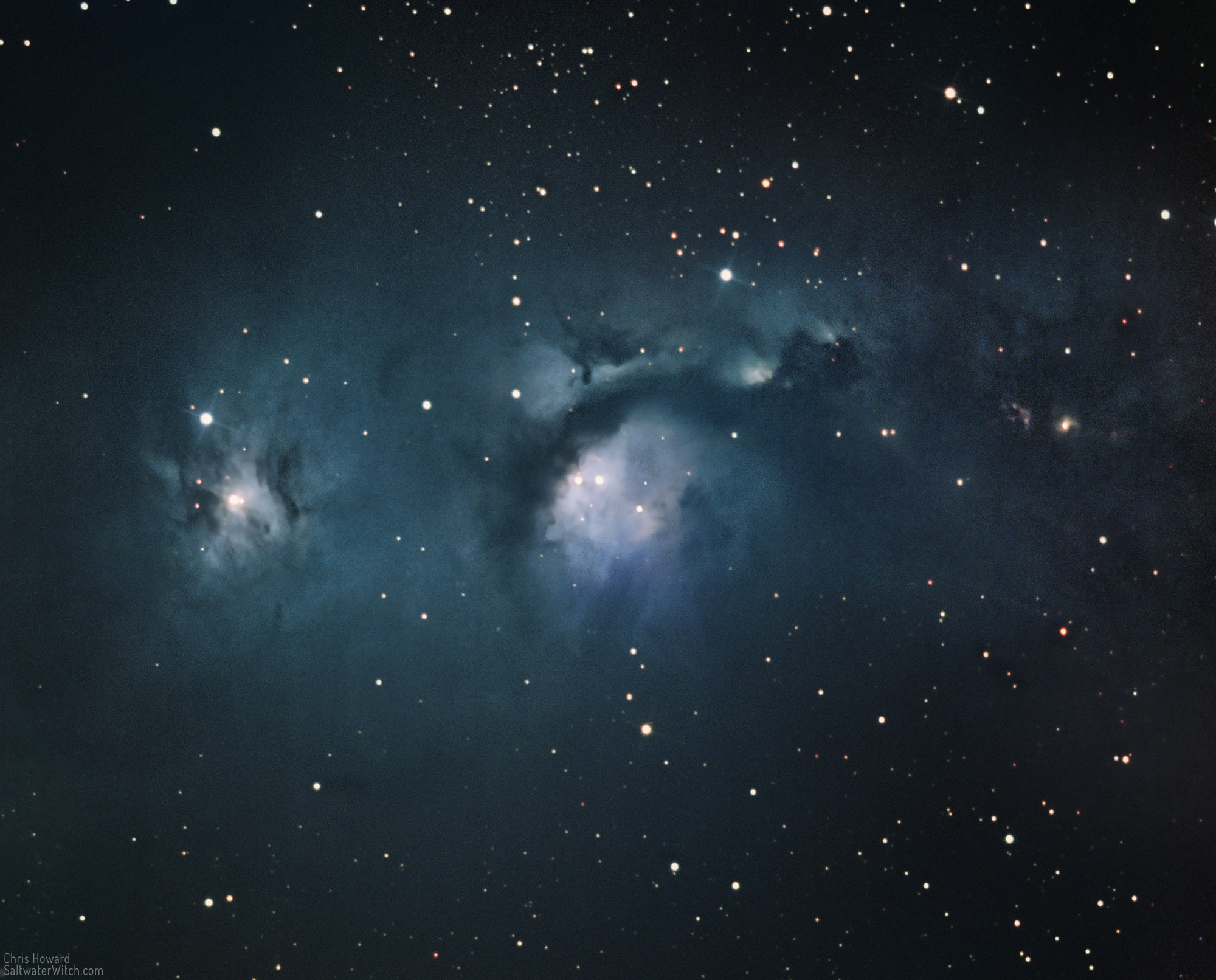
I swapped out the narrowband EFW with the RGB+Ha filters, and ran through RGB for Messier 78 (NGC 2068), a reflection nebula in Orion. I also experimented with 2x2 binning with the ZWO ASI1600MM-Pro mono camera, and it taking the resolution from 0.98 arcseconds/pixel to 1.96" / pixel worked pretty well.
Posted October 30, 2022
Astro setup last week
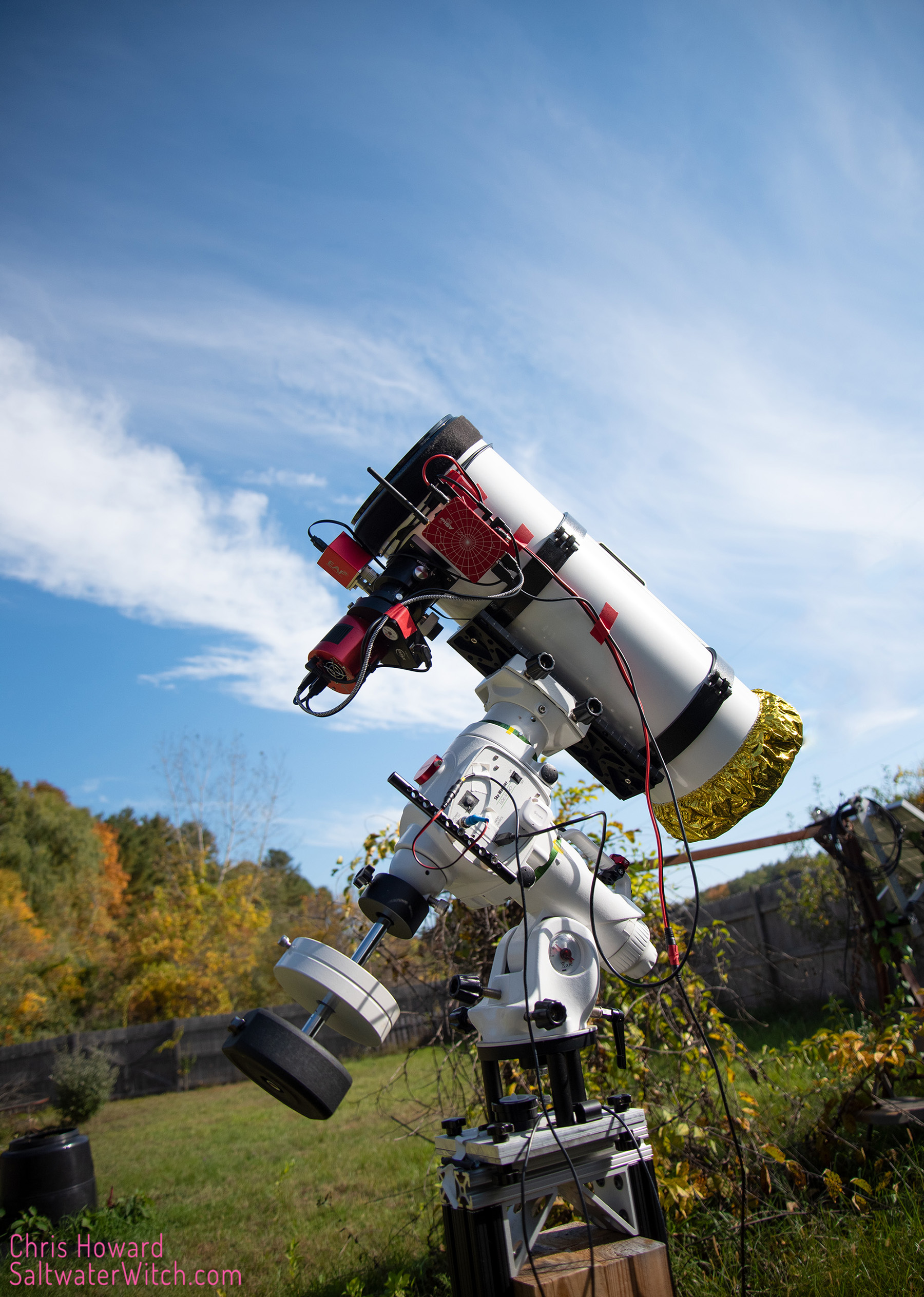
Well, we had a good run of clear night skies last week, and here we are heading toward the new moon, and it's going to rain for three or four days. Anyway, it was great while it lasted. Taking very long exposure images with a telescope, and by long exposure I'm talking the shutter open 5 minutes for each frame. Every image I captured over the last five clear nights has been through this 8 inch Newtonian scope (8 inch primary mirror (203mm) inside the tube where the gold foil cap covers the end, the secondary mirror is where the camera connects to the focuser, toward the top of the scope). And I ran every night's imaging session with the ZWO ASIAir controller.
Posted October 24, 2022
A few more from this run of clear October skies
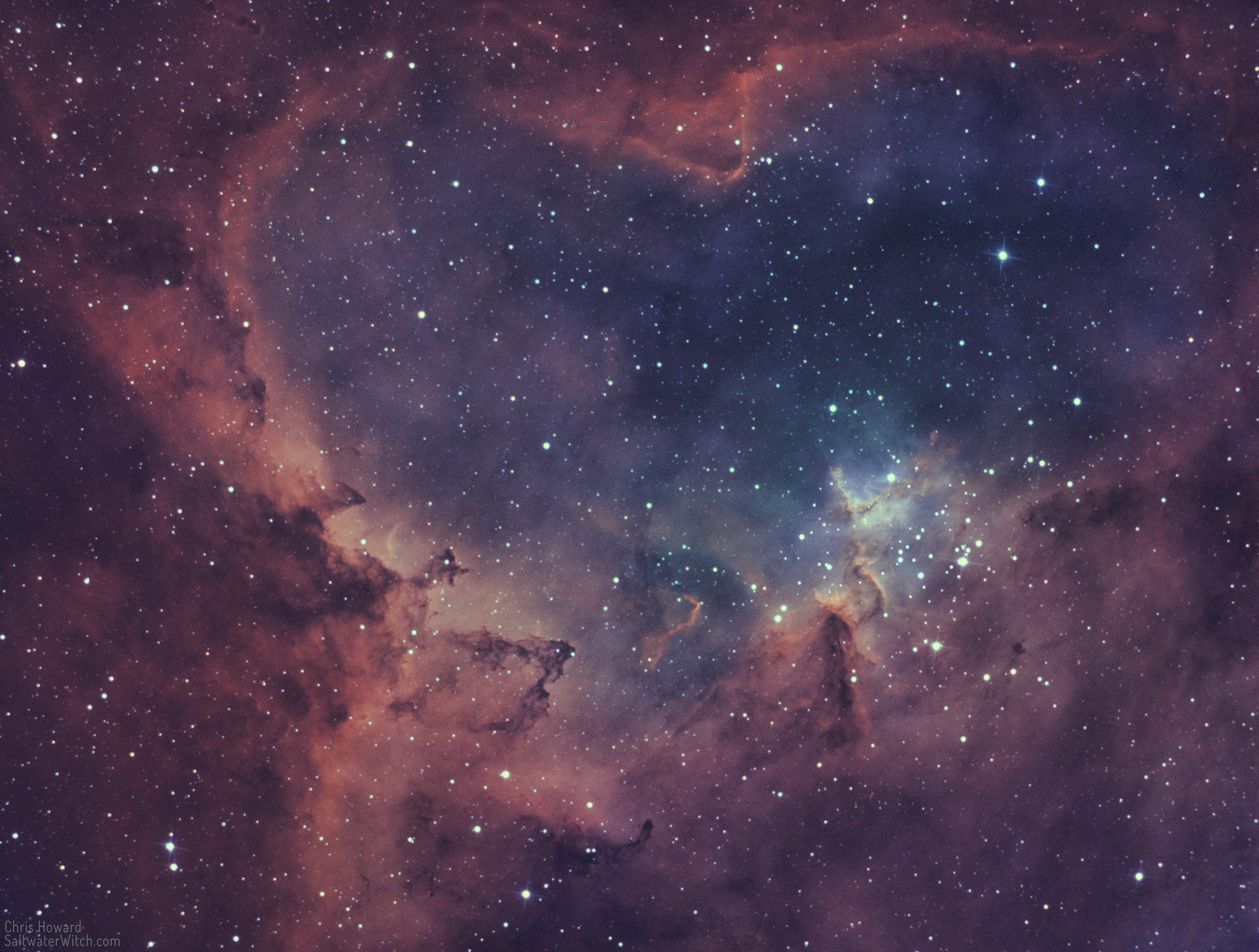
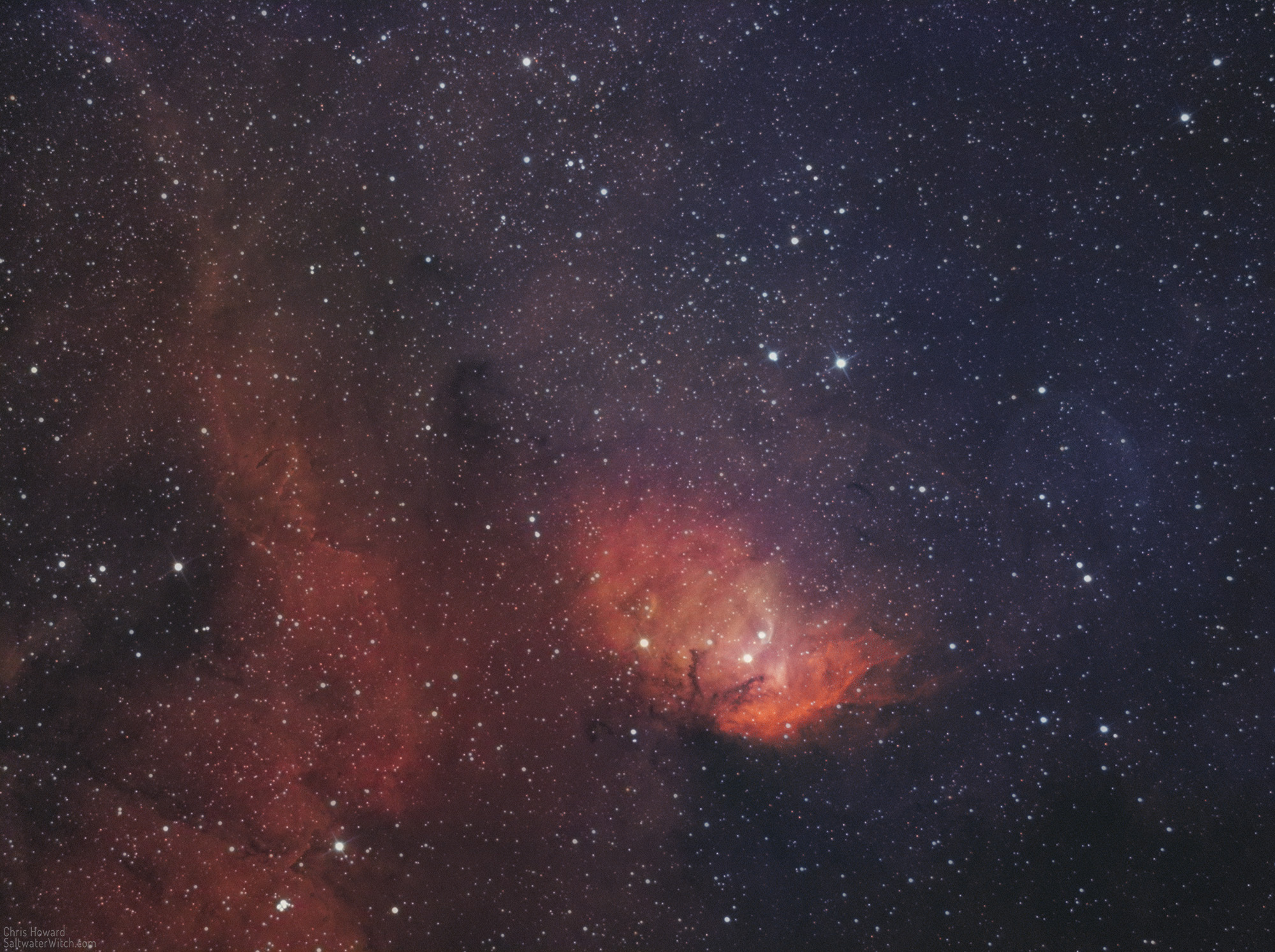
A few more processed (to some degree) images from the data I have gathered over the last five clear nights. Gear notes: I captured all the data for these in my backyard with an Apertura 800mm f/4 Newtonian OTA, ZWO ASI1600MM-Pro mono camera, Antlia 3nm filters, ZWO ASI290M OAG, on the Sky-Watcher EQ6R-Pro mount with the ZWO ASIAir Plus controller.
The core of the Heart Nebula (IC 1805) in Ha+OIII with the star cluster, Melotte 15 surrounding coils and branches of interstellar dust and gas.
Here's the Tulip Nebula (Sharpless 101) in Ha + OIII, a very energetic HII region about 6000 lightyears away in the constellation Cygnus.
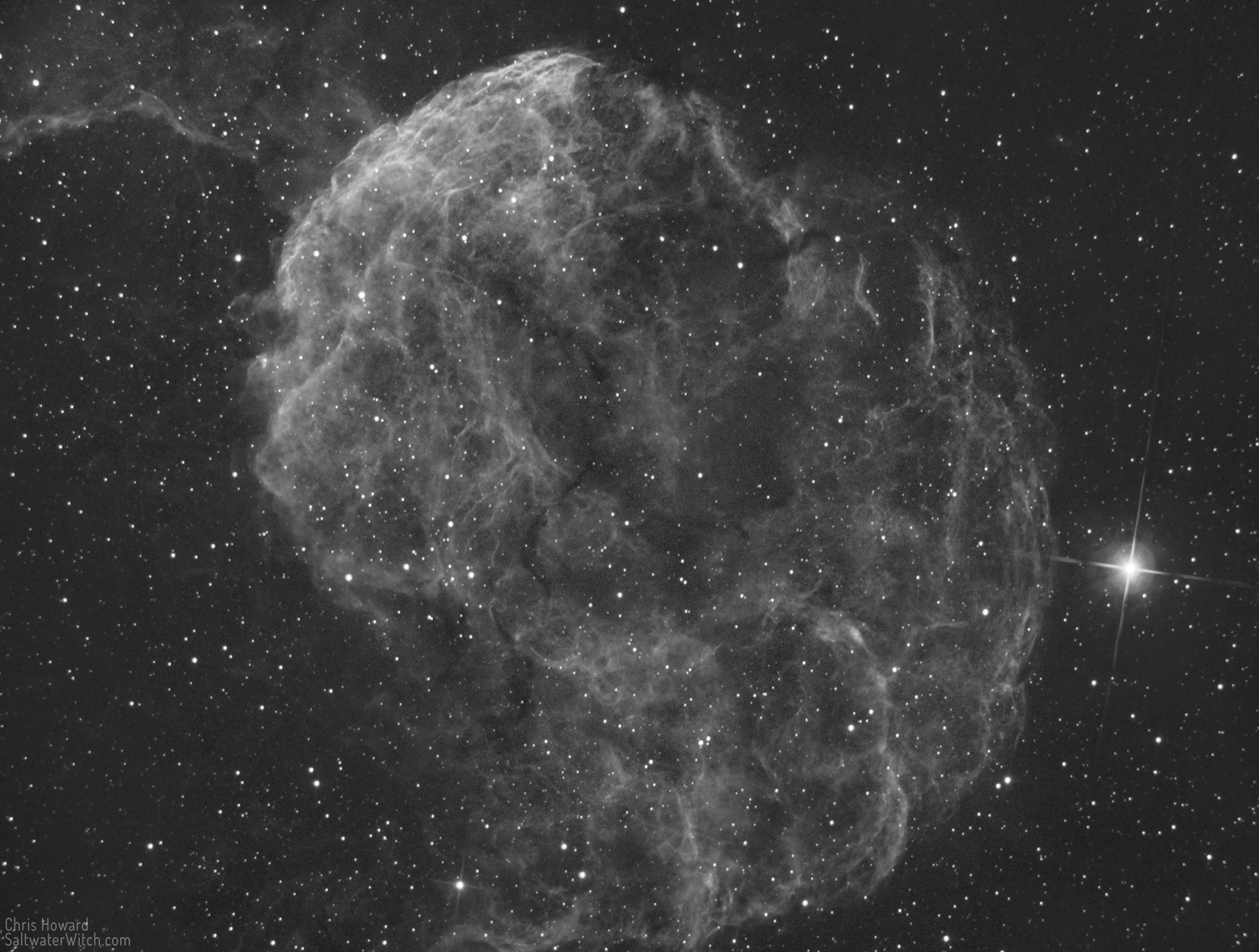
The Jellyfish Nebula (IC 443, Sharpless 248) in hydrogen-alpha. IC 443 is a (Sh2-248)) is a supernova remnant about 5000 lightyears away in the constellation Gemini. Trailing off, out of frame top left, is the HII region Sharpless 249. There's ongoing research to determine if these two interact, but they probably do not. SH2-249 is most likely further away than the IC 443 supernova remnant. [https://ui.adsabs.harvard.edu/abs/1984A%26A...140..395D]