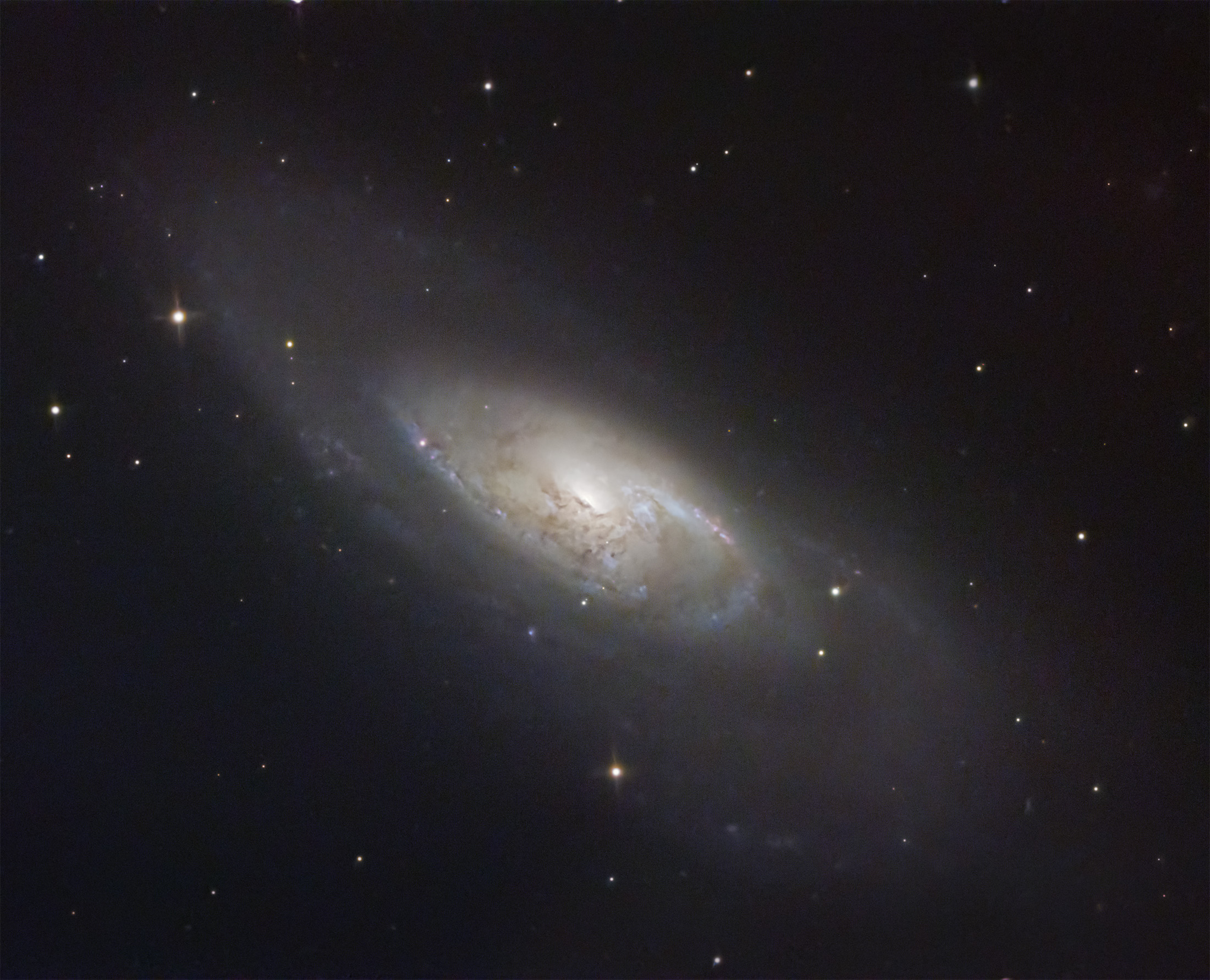
Galaxy M 106: Water Masers and Supermassive Blackholes
March 28, 2026
It’s 5am, we’re just coming out of astronomical dark, and I’m reading through the following article while I’m capturing the 206th sub-exposure of M106/NGC4258 Galaxy:
An Improved Distance to NGC 4258 and Its Implications for the Hubble Constant, M. J. Reid, D. W. Pesce, A. G. Riess, 2019, Volume 886, Number 2, The Astrophysical Journal Letters. https://doi.org/10.3847/2041-8213/ab552d
The first line of the abstract says it all:
NGC 4258 is a critical galaxy for establishing the extragalactic distance scale and estimating the Hubble constant (H0).
And it doesn’t stop there. The first line of the intro to this article tells you how much fun astronomers are having: “The nucleus of NGC 4258 [M106 galaxy] hosts a [water] H2O megamaser in a sub-parsec-scale accretion disk surrounding a [supermassive] 4 × 10^7 M⊙ black hole.”
A megamaser is a galactic scale maser, or Microwave Amplification by Stimulated Emission of Radiation. Okay, cool name, and that you get to add "mega-" to it makes it that much cooler. Megamasers can act as markers for astronomers to detect and study galaxy evolution, measure rotational speed, relative distances, all kinds of interesting information. And this galaxy, M 106, NGC 4258, is particularly useful for this.
I captured 212 subs of M 106 (NGC 4258), a spiral galaxy in the constellation Canes Venatici. Integration time is about 7 hours. M106 is 7.576 megaparsecs or a little over 24 million lightyears away from us. I stacked 189 together with minimal processing in Pixinsight and the result is pretty nice, given the constraints of the setup—an inexpensive camera and OTA.