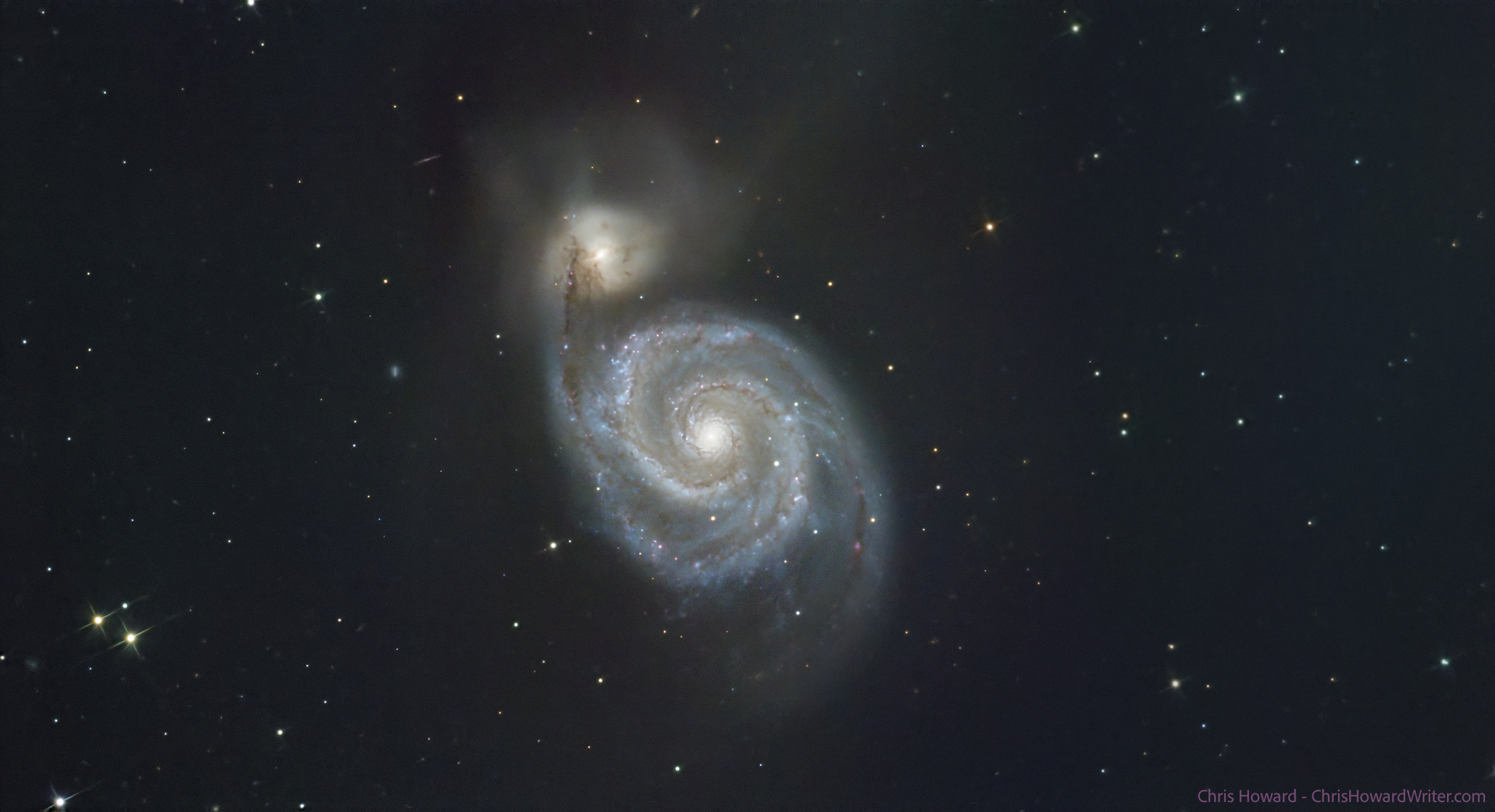
M51 - Better Processing & More Info
March 19, 2026
Same imaging data, better processing. I stretched the last one a bit too far, blowing out the galaxy core. M51 is bright, so you don't need really long exposures, and over a hundred two-minute subs is perfect for capturing all that dust and faint structure while keeping the bright core intact. The stars are still pretty wonky around the edges. That might be collimation, but I'm also not using a field flattener--didn't think I'd need it with the Sony IMX715 being such a small camera sensor.
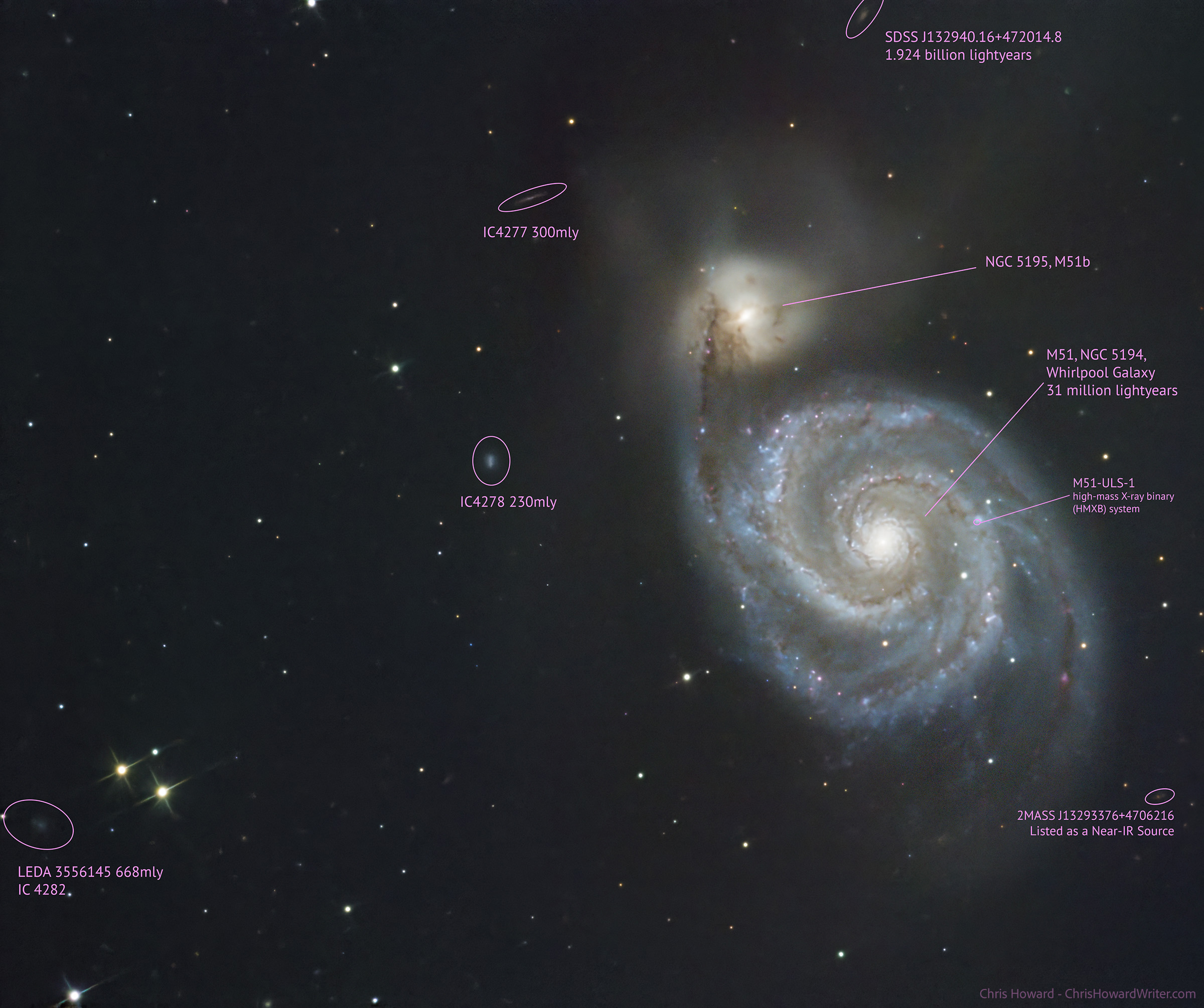
Other galaxies (and other interesting objects) in the frame
I started here: https://aladin.cds.unistra.fr/AladinLite/?target=ic455&fov=1.49&survey=P%2FDSS2%2Fcolor
IC4277 300mly (left, top of M51) edge-on spiral galaxy
IC4278 230mly (left of M51) smudged, vertical bar left of M51
SDSS J132940.16+472014.8, 2MASX J13294019+4720147, USNOA2 1350-08286567, PGC 3556035 1.924bly, mag 18 galaxy (top, middle, above M51, almost out of frame), http://ned.ipac.caltech.edu/cgi-bin/nph-objsearch?search_type=Near+Position+Search&in_csys=Equatorial&lon=13+29+40.19&lat=+47+20+14&radius=0.1
LEDA 3556145, SDSS J133119.76+471101.9, IC 4282 668mly (lower left in the frame) https://simbad.cds.unistra.fr/simbad/sim-id?Ident=LEDA%203556145%20
2MASS J13293376+4706216, Listed as a Near-IR Source (λ < 3 µm)
M51-ULS-1, RX J132943+47115, high-mass X-ray binary (HMXB) system, with candidate exoplanet named M51-ULS-1 b, https://en.wikipedia.org/wiki/M51-ULS-1, https://www.universetoday.com/articles/astronomers-might-have-found-a-planet-in-another-galaxy